


Facing widespread discontent, President Roh Moo-hyun said yesterday that he was considering a national referendum on whether he should resign, and rejected an offer from his Cabinet and presidential aides to quit.
But Roh, who has a hostile relationship with the opposition-controlled National Assembly, acknowledged it was unclear whether a referendum was legal. The confusion raised the possibility of months of political wrangling at a time when South Korea is trying to revive its faltering economy and stop North Korea's development of nuclear weapons through peaceful dialogue.
"If a president is sacrificed in the middle of his term and if that serves to straighten out South Korean politics, I think that is a bigger stride forward for the development of South Korean politics than a case in which the president simply completes his five-year term," Roh said at a news conference.
The leadership crisis followed months of increasingly virulent criticism of Roh, whose blunt style and perceived inconsistency on major policy issues have alienated many South Koreans. Corruption scandals involving presidential aides have also drained his approval ratings.
Roh's rejection of resignation offers from the Cabinet eased chaos in the short term, but the months ahead are likely to be difficult. Roh, a former human rights lawyer who took office in February, suggested the law could be altered to allow for a referendum to assess the public's confidence in him.
"I think the law on a referendum could be changed," he said. A debate on a law change, or a constitutional amendment, would likely be a lengthy, divisive process.
The opposition Grand National Party, which controls the National Assembly, said Roh's behavior was baffling.
"President Roh should clearly propose how and when he is going to ask the people about their confidence in him before the confusion amplifies," the party said in a statement.
The political upheaval began Friday, when Roh said he wanted a "pardon" from the people to restore moral strength in his 8-month-old government, which is besieged by hostile legislators and unfriendly news media.
Roh had said he was unsure about a referendum because it could hurt national security amid tension over North Korea's nuclear development.
Roh's initiative was a risky political gamble aimed at winning a fresh mandate for his increasingly unpopular government. The opposition Grand National Party, which controls a majority at the National Assembly, demanded a national referendum.
Prosecutors are investigating an allegation that Choi Do-sool, a longtime Roh aide, received 1.1 billion won (US$956,000) from SK Group, South Korea's third-largest conglomerate, shortly after Roh won December's presidential election.
SK, an oil and mobile phone giant, is also accused of giving 10 billion won (US$8.7 million) to the GNP. The opposition party denies the charge.
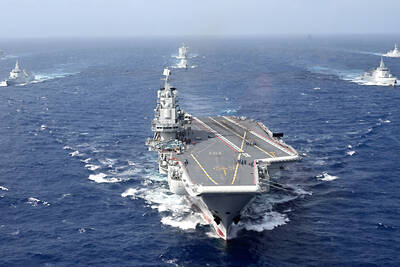
PROVOCATIVE: Chinese Deputy Ambassador to the UN Sun Lei accused Japan of sending military vessels to deliberately provoke tensions in the Taiwan Strait China denounced remarks by Japan and the EU about the South China Sea at a UN Security Council meeting on Monday, and accused Tokyo of provocative behavior in the Taiwan Strait and planning military expansion. Ayano Kunimitsu, a Japanese vice foreign minister, told the Council meeting on maritime security that Tokyo was seriously concerned about the situation in the East China and South China seas, and reiterated Japan’s opposition to any attempt to change the “status quo” by force, and obstruction of freedom of navigation and overflight. Stavros Lambrinidis, head of the EU delegation to the UN, also highlighted South China Sea
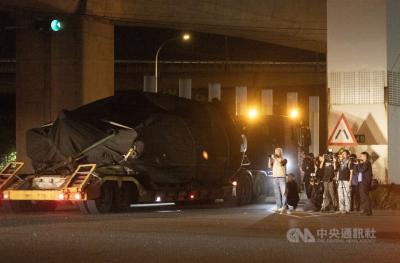
The final batch of 28 M1A2T Abrams tanks purchased from the US arrived at Taipei Port last night and were transported to the Armor Training Command in Hsinchu County’s Hukou Township (湖口), completing the military’s multi-year procurement of 108 of the tanks. Starting at 12:10am today, reporters observed more than a dozen civilian flatbed trailers departing from Taipei Port, each carrying an M1A2T tank covered with black waterproof tarps. Escorted by military vehicles, the convoy traveled via the West Coast Expressway to the Armor Training Command, with police implementing traffic control. The army operates about 1,000 tanks, including CM-11 Brave Tiger
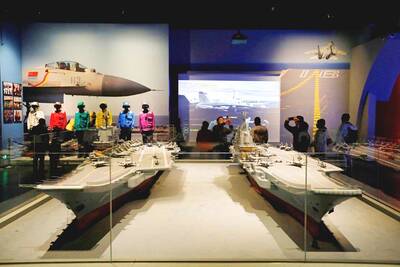
China on Wednesday teased in a video an aircraft carrier that could be its fourth, and the first using nuclear power, while making an allusion to Taiwan and vowing to further build up its islands, as it looks to boost maritime power, secure resources and bolster territorial claims. The video, issued on the eve of the 77th founding anniversary of the Chinese People’s Liberation Army Navy, featured fictional officers with names that are homophones of three commissioned aircraft carriers, the Liaoning (遼寧), Shandong (山東) and Fujian (福建). Titled Into the Deep, it showed a 19-year-old named “Hejian” (何劍) joining the group, sparking
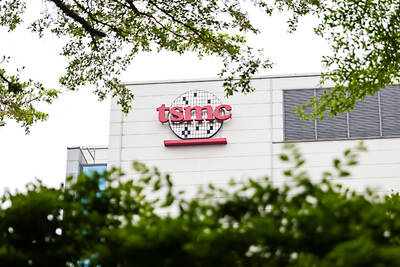
Taiwan Semiconductor Manufacturing Co (TSMC, 台積電), the world’s largest contract chipmaker, said it expects its 2-nanometer (2nm) chip capacity to grow at a compound annual rate of 70 percent from this year to 2028. The projection comes as five fabs begin volume production of 2-nanometer chips this year — two in Hsinchu and three in Kaohsiung — TSMC senior vice president and deputy cochief operating officer Cliff Hou (侯永清) said at the company’s annual technology symposium in Silicon Valley, California, last week. Output in the first year of 2-nanometer production, which began in the fourth quarter of last year, is expected to


 RSS
RSS