


Market insiders yesterday spoke in support of Fubon Financial Holding Co (
They also disagreed with City Councilor Lee Wen-ying (
"Those were a lot of silly political accusations," Goldman Sachs' Hong Kong-based spokesperson Eddie Naylor said yesterday. "Fubon Financial went through very extensive auction processes, which we managed and were in line with international practices."
"The process of the groundbreaking transaction was sophisticated and transparent, and our fee charges were in line with market levels," Naylor said.
Josephine Juan (阮淑祥), a manager at Taiwan Ratings Corp (中華信評) -- the local arm of Standard & Poor's -- also praised the merger, saying Fubon was the best merger partner and offered the highest market price for TaipeiBank.
Citing a rating agency report, Juan said that both Fubon Commercial Bank (
After the merger that incorporated TaipeiBank, parent Fubon Financial still maintained a long-term outlook rating of "AA-," she said.
Unless investigators found any irregularities in the bidding process, the prices offered by bidders would never match the bank's book price, Juan added.
On Saturday, former TaipeiBank president Liao Cheng-ching (廖正井) argued that the bank, whose assets stood at NT654.3 billion before the merger, shouldn't have been sold to smaller rival Fubon Financial, whose stand-alone assets were NT$122 billion.
But Fubon Financial vice chairman Daniel Tsai (
Before the merger, Fubon Financial's net assets stood at NT$101.2 billion, far greater than TaipeiBank's net assets of NT$45.6 billion, according to Tsai.
Endorsing Tsai's view, Chou Tien-chen (
"When it comes to share-swap deals, net assets will truly reflect the value of companies across all sectors," Chou added.
Minister of Finance Lin Chuan (林全) yesterday told the legislature that the ministry was in no position to step into the merger deal's pricing as long as the boards of both private companies gave their approval.


RESILIENCE: Taiwan plays a key role in semiconductors, energy, information infrastructure and advanced manufacturing, AIT Director Raymond Greene said Taiwan’s continued investment in deterrence and resilience remains vital, especially in uncrewed systems and other emerging technologies, American Institute in Taiwan (AIT) Director Raymond Greene said yesterday. Greene made the remarks at the annual National Strategic Summit on Supply Chain Resilience held by the Research Institute for Democracy, Society and Emerging Technology (DSET), a government-backed think tank. As Taiwan last year became the US’ fourth-largest trading partner and supply chain security is becoming more important, cooperation in emerging technologies continues to deepen between the two countries, he said. The US is committed to accelerating innovation, building key infrastructure, strengthening cooperation

The National Chungshan Institute of Science and Technology yesterday showcased its locally developed variants of the Vision 60 robotic patrol dog, which it plans to deploy on the nation’s outlying territories in the South China Sea. The variants were produced under the Joint Lab project — created by the institute and domestic companies — and assembled with domestically produced motors, lenses and artificial intelligence (AI) systems alongside licensed tech from the US, Missile and Rocket Systems Research Division deputy director Jen Kuo-kang (任國光) told the media event at a military base in Taipei’s Dazhi (大直) area. Taiwan has built up its strengths

RIGHT DIRECTION: Taiwan’s efforts to prevent forced labor include a proposal to ‘fully prohibit’ employers from withholding workers’ documents, an official said Taiwan is to establish a mechanism to restrict imports of goods linked to forced labor, the Executive Yuan said yesterday, after the US proposed imposing additional tariffs on Taiwanese goods over labor concerns. “The Ministry of Labor and the Ministry of Economic Affairs are to establish an interministerial review procedure,” Executive Yuan spokesperson Michelle Lee (李慧芝) said at a news briefing in Taipei. “The government is to use the Foreign Trade Act [貿易法] as the legal basis to restrict imports of goods produced with forced labor” and bring its supply chain governance more in line with international standards on human rights, resilience
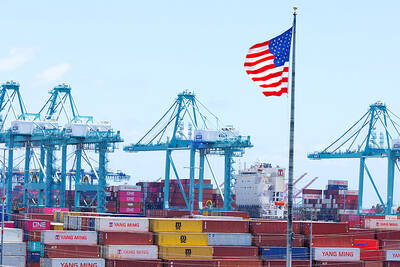
NOT IMMEDIATE: Taiwan has a chance to appeal the proposed 10 percent tariff before it starts, while other countries face a 12.5 percent tariff from the trade office Taiwan is among 60 economies determined by the US to have failed to impose or enforce a ban on the importation of goods produced with forced labor, according to a notice released on Tuesday by the Office of the US Trade Representative (USTR), which proposed imposing an additional 10 percent or more tariff on them. The USTR in a statement said that following an investigation, it had determined under Section 301 of the Trade Act of 1974 that the failure of the 60 economies to impose and effectively enforce a prohibition on the importation of goods produced with forced labor is


 RSS
RSS