


President Chen Shui-bian (陳水扁) yesterday requested government agencies to make efforts to declassify more government documents relating to the 1979 Kaohsiung Incident (美麗島事件) as the National Archives made public some of the declassified documents for the very first time.
"While about one fifth of the official documents regarding the incident are still confidential, I hope the National Security Bureau, Ministry of Justice Investigation Bureau, Armed Forces Police Command, and Reserve Forces Command will do their best to declassify as many and as soon as possible, in accordance with the law," Chen said.
Chen added that the Presidential Office should take the lead so other government agencies would follow suit.
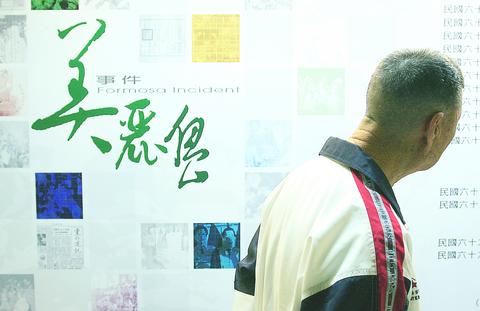
PHOTO: CHIEN JUNG-FONG, TAIPEI TIMES
In response, Presidential Office Secretary-General Chiou I-jen (
Chen made the request during the opening ceremony of an exhibition featuring some of the declassified officials documents regarding the incident at the Sun Yat-sen Memorial Hall.
The exhibition will run from March 1 to March 12 in Taipei and between April 4 and April 13 in Kaohsiung.
The information is also available on-line at the National Archives Web site (www.archives.gov.tw/formosa).
Chen also called on the public to forgive and tolerate the mistakes the KMT government made 24 years ago.
"In addition to expressing my utmost respect for those suffering in the incident, I hope the public will forgive the perpetrators and learn a valuable lesson from it," he said.
The Kaohsiung Incident, also known as the Formosa Incident, was an anti-government demonstration organized by Formosa Magazine on Dec. 10, 1979.
The magazine was a front for a broad alliance of tang wai (meaning outside the KMT) activists.
Originally meant to be a march in commemoration of International Human Rights Day, the event turned into a violent confrontation when members of the crowd unknown to the organizers -- and widely believed to have been agents provocateurs -- began attacking police.
Regardless of who was at fault, the ruling KMT court martialed and jailed eight people, who became known as the Kaohsiung Eight.
They were Control Yuan President Yao Chia-wen (姚嘉文), former DPP chairman Shih Ming-te (
Despite the DPP-led government's efforts, Shih, who withdrew from the party in January 2001, said that he was personally not impressed.
"The exhibition doesn't show the real truth of the incident because the confessions were extracted through torture," he said.
Shih also called on the public to pay more attention to those risking their lives to shelter him rather than those who reported him to the police which led to his arrest in January 1980.
"It's not important who betrayed me. What matters is those who stuck to their beliefs till the very end," he said.
Shih was the last of the Kaohsiung Eight to be jailed. He was a fugitive for 26 days before the police acted on a tip-off to arrest him. The two informers were later rewarded with NT$5 million each.
Shih was sentenced to life in prison and pardoned in May 1990 by former president Lee Teng-hui (
Chen Chu also called on the perpetrators of the riot and their accomplices to come forward to admit their responsibilities during the incident.
When asked who should be held responsible, Chen Chu hesitated to give a definite answer.
"I believe the evidence can talk and that no one can alter history," she said.
Chen Chu was sentenced to 12 years in prison and pardoned in May 1990.
Yao said that the exhibition should include information and analyses of the tang wai movement and its principles.
"They should make the public understand that the incident could've been avoided had the authorities tackled the matter more appropriately," he said.
Yao was sentenced to 12 years in prison and pardoned in May 1990.Also See Story:
Exhibit arouses political passions

‘NO SECURITY RISK’: The Railway Bureau reassured the public that the technicians’ activities were limited to technical guidance and did not involve sensitive systems The Railway Bureau yesterday said it had invited eight Chinese technicians to assist with an airport MRT construction project. The bureau issued the confirmation after an Internet user said Chinese nationals had entered the construction zone of Taiwan Taoyuan International Airport’s Terminal 3 project. They asked why “individuals from an enemy state” were allowed access to such a major national infrastructure project, which raised serious concerns over Taiwan’s industrial safety, sensitive systems and information security. The bureau’s Northern Region Engineering Branch Office said subcontractor Taiwan Handle Industrial Co (台灣手把工業) of the Taoyuan airport MRT’s “Contract No. CU05 Project A14 Station Civil, MEP &

The National Chungshan Institute of Science and Technology yesterday showcased its locally developed variants of the Vision 60 robotic patrol dog, which it plans to deploy on the nation’s outlying territories in the South China Sea. The variants were produced under the Joint Lab project — created by the institute and domestic companies — and assembled with domestically produced motors, lenses and artificial intelligence (AI) systems alongside licensed tech from the US, Missile and Rocket Systems Research Division deputy director Jen Kuo-kang (任國光) told the media event at a military base in Taipei’s Dazhi (大直) area. Taiwan has built up its strengths

NOT IMMEDIATE: Taiwan has a chance to appeal the proposed 10 percent tariff before it starts, while other countries face a 12.5 percent tariff from the trade office Taiwan is among 60 economies determined by the US to have failed to impose or enforce a ban on the importation of goods produced with forced labor, according to a notice released on Tuesday by the Office of the US Trade Representative (USTR), which proposed imposing an additional 10 percent or more tariff on them. The USTR in a statement said that following an investigation, it had determined under Section 301 of the Trade Act of 1974 that the failure of the 60 economies to impose and effectively enforce a prohibition on the importation of goods produced with forced labor is

TIT-FOR-TAT: The US allegedly revoked the visa of a Chinese national working at Xinhua News Agency in the US in response to Beijing’s expulsion of Vivian Wang The Presidential Office yesterday condemned China for expelling a New York Times correspondent from Beijing following the newspaper’s interview with President William Lai (賴清德), saying the move highlighted Beijing’s suppression of press freedom and its threat to international news media. Taiwan has noted a series of recent incidents in which Beijing used similar tactics to “threaten and pressure international media outlets and journalists,” Presidential Office spokeswoman Karen Kuo (郭雅慧) said in a statement. “This concerns not only press freedom and freedom of expression, but also the safety of journalists, and Taiwan and relevant partners are paying close attention to the situation,” she


 RSS
RSS