


A China Airlines charter flight made a historic landing at Shanghai's Pudong Airport yesterday and returned to Taipei, marking the first time a Taiwanese carrier has touched down in China in 54 years.
Taiwan banned direct air and sea links to China after the two sides split in 1949.
Departing from Pudong Airport at 11am after picking up Taiwanese businessmen, the flight stopped in Hong Kong for 50 minutes and then arrived at the CKS International Airport at about 3:40pm.
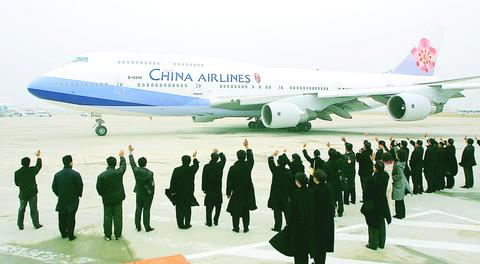
PHOTO: AP
The 243 passengers on the trip were given VIP treatment as China Airlines Chairman Lee Yun-ling (李雲寧) and high-ranking government officials including Minister of Transportation and Communications Lin Ling-san (林陵三) and MAC Vice Chairman Chen Ming-tong (陳明通) extended a warm welcome to the arrivals at the CKS Airport.
Both Lin and Chen praised the historic flight.
"Coming home for the Chinese New Year is what we traditionally do to celebrate this important holiday," Lin said at a welcoming ceremony at the airport.
"[This flight is the result] of the government's effort to enable Taiwanese businessmen and families a more convenient way to come home for such an occasion," Lin said.
"Seeing the happy faces on the passengers who have just come home, I think [the flight] has demonstrated positive interaction between the two sides of the Strait," he said.
In his speech, Chen Ming-tong pointed to President Chen Shui-bian's (
"Charter flights during the Chinese New Year are just the first step," Chen Ming-tong said. "I hope both sides of the Strait can soon negotiate on the issue of direct links in an attempt to better meet the needs of China-based Taiwanese businessmen."
Yeh Huei-te (
"It is such a good feeling to be able to travel to Taiwan from China, via Hong Kong, on the same plane," Yeh said at the airport. Yeh expressed his gratitude to those who made the trip possible.
Six Taiwanese carriers have permission to operate a total of 16 round-trip flights through Feb. 9. They are required to stop briefly in Hong Kong or Macau.
In Shanghai, a traditional Chinese lion dance was performed on the airport runway and champagne toasts were made at a ceremony to mark the flight. Chinese and Taiwanese officials waved as the plane taxied down the Pudong Airport runway.
Taiwanese officials on hand for the ceremony included KMT Legislator John Chang (章孝嚴), along with fellow KMT lawmakers Lee Chuan-chia (李全教) and Tsai Chia-fu (蔡家福), and DPP Legislator Hsu Jung-hsu (許榮淑), who arrived in Shanghai a day before to witness the historic event.
Jan Jyh-horng (詹志宏), director of the Mainland Affairs Council's Department of Planning and Research, was on the flight to Shanghai, but was unable to attend ceremonies in the city because he was engaged in talks with civil aviation officials about flight procedures. Jan, also deputy secretary-general of the Straits Exchange Foundation (SEF), expressed his gratitude to Chinese officials for their cooperation on the historic trip.
A TransAsia Airways charter flight also took off from CKS Airport yesterday and made a stop-over in Macau before arriving at Pudong Airport at 2pm. With 233 passengers on board, the plane arrived at Kaohsiung International Airport at 6:15pm and was greeted by TransAsia Airways chairman Fan Shih-chan (范自強) and airport staff.

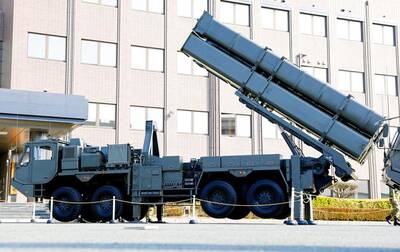
Japan has deployed long-range missiles in a southwestern region near China, the Japanese defense minister said yesterday, at a time when ties with Beijing are at their lowest in recent years. The missiles were installed in Kumamoto in the southern region of Kyushu, as Japan is attempting to shore up its military capacity as China steps up naval activity in the East China Sea. “Standoff defense capabilities enable us to counter the threat of enemy forces attempting to invade our country ... while ensuring the safety of our personnel,” Japanese Minister of Defense Shinjiro Koizumi said. “This is an extremely important initiative for

MORE POPULAR: Taiwan Pass sales increased by 59 percent during the first quarter compared with the same period last year, the Tourism Administration said The Tourism Administration yesterday said that it has streamlined the Taiwan Pass, with two versions available for purchase beginning today. The tourism agency has made the pass available to international tourists since 2024, allowing them to access the high-speed rail, Taiwan Railway Corp services, four MRT systems and four Taiwan Tourist Shuttles. Previously, five types of Taiwan Pass were available, but some tourists have said that the offerings were too complicated. The agency said only two types of Taiwan Pass would be available, starting from a three-day pass with the high-speed rail and a three-day pass with Taiwan Railway Corp. The former costs NT$2,800

NEW LOW: The council in 2024 based predictions on a pessimistic estimate for the nation’s total fertility rate of 0.84, but last year that rate was 0.69, 17 percent lower An expected National Development Council (NDC) report expects the nation’s population to drop below 12 million by 2065, with the old-age dependency ratio to top 100 percent sooner than 2070, sources said yesterday. The council is slated to release its latest population projections in August, using an ultra-low fertility model, the sources said. The previous report projected that Taiwan’s population would fall to 14.37 million by 2070, but based on a new estimate of the total fertility rate (TFR) — the average number of children born to a woman over her lifetime — the population is expected to reach 12 million by

COUNTERING HOSTILITY: The draft bill would require the US to increase diplomatic pressure on China and would impose sanctions on those who sabotage undersea cable networks US lawmakers on Thursday introduced a bipartisan bill to bolster the resilience of Taiwan’s submarine cables to counter China’s hostile activities. The proposal, titled the critical undersea infrastructure resilience initiative act, was cosponsored by Republican representatives Mike Lawler and Greg Stanton, and Democratic Representative Dave Min. US Senators John Curtis and Jacky Rosen also introduced a companion bill in the US Senate, which has passed markup at the chamber’s Committee on Foreign Relations. The House’s version of the bill would prioritize the deployment of sensors to detect disruptions or potential sabotage in real-time and enhance early warning capabilities through global intelligence sharing frameworks,


 RSS
RSS