


Indonesia's highest legislature ended its most far-reaching session in decades yesterday when legislators applauded constitutional changes to expel the military from parliament and allow voters to elect the head of state directly two years from now.
But some commentators warned that the sprawling nation still had far to go before it could become a true democracy, saying behind-the-scenes power remains with the generals and an entrenched political elite.
"These changes are just cosmetic and will not alter political life in any meaningful way," said Arbi Sanit, a prominent analyst and university professor.
Lawmakers also rejected noisy calls for Sharia law to be introduced across the world's most populous Muslim country -- bolstering Indonesia's role as a moderate Islamic bulwark against religious extremism targeted by the US-backed war on terror.
Although she has not commented on the reforms, they will probably strengthen the hand of popular President Megawati Sukarnoputri and see her voted in for a second five-year term in 2004.
On Saturday, the 700-member People's Consultative Assembly agreed to abolish by 2004 the 38 unelected seats reserved for the security forces.
The seats were granted under the dictatorship of General Suharto after he seized power from Megawati's father, Sukarno, in the 1960s and ruled until pro-democracy protests in 1998.
"The [military] is now out of practical politics," declared Amien Rais, the assembly's speaker.
Representatives of the military have themselves been anxious to withdraw from parliament because their presence has been a lightning rod for domestic and foreign critics of the armed forces, which has long been accused of human rights abuses.
Instead, senior generals are now likely to wield their power and influence in other ways, particularly in private dialogues with Megawati, said Dede Oetomo, a professor at Airlangga University in Surabaya, Indonesia's second largest city.
"It's probably easier to do it at the palace than at parliament," he said. "There is no light yet for Indonesia at the end of the tunnel."
Megawati needed the generals' support last year to oust her predecessor Abdurrahman Wahid, who had made enemies among the army brass by trying to assert civilian control over the military. Her administration has abandoned those reforms.

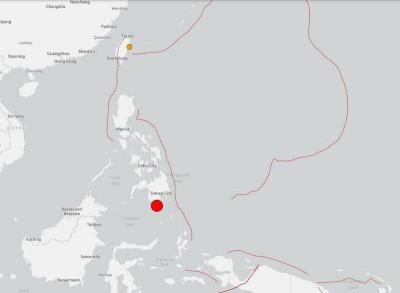
A magnitude 7.8 earthquake struck off the southern coast of Mindanao in the Philippines at 7:38am today, prompting the US Tsunami Warning System to issue an alert for neighboring countries, including Taiwan. The system issued a purple alert indicating a "tsunami threat." The potential threat zone includes Taiwan, the Philippines, Papua New Guinea, Yap and Palau. A spokesperson for Indonesia disaster mitigation agency said there were no reports of damage so far. Arlene Hollero, disaster chief of Maasim town in the Philippines' Sarangani Province, said their evacuation was underway in coastal villages and there were no reported casualties so far. DZBB radio, broadcasting from the
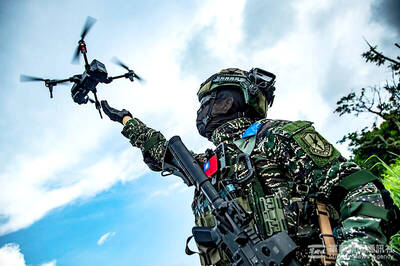
RESILIENCE: Taiwan plays a key role in semiconductors, energy, information infrastructure and advanced manufacturing, AIT Director Raymond Greene said Taiwan’s continued investment in deterrence and resilience remains vital, especially in uncrewed systems and other emerging technologies, American Institute in Taiwan (AIT) Director Raymond Greene said yesterday. Greene made the remarks at the annual National Strategic Summit on Supply Chain Resilience held by the Research Institute for Democracy, Society and Emerging Technology (DSET), a government-backed think tank. As Taiwan last year became the US’ fourth-largest trading partner and supply chain security is becoming more important, cooperation in emerging technologies continues to deepen between the two countries, he said. The US is committed to accelerating innovation, building key infrastructure, strengthening cooperation

The National Chungshan Institute of Science and Technology yesterday showcased its locally developed variants of the Vision 60 robotic patrol dog, which it plans to deploy on the nation’s outlying territories in the South China Sea. The variants were produced under the Joint Lab project — created by the institute and domestic companies — and assembled with domestically produced motors, lenses and artificial intelligence (AI) systems alongside licensed tech from the US, Missile and Rocket Systems Research Division deputy director Jen Kuo-kang (任國光) told the media event at a military base in Taipei’s Dazhi (大直) area. Taiwan has built up its strengths

RIGHT DIRECTION: Taiwan’s efforts to prevent forced labor include a proposal to ‘fully prohibit’ employers from withholding workers’ documents, an official said Taiwan is to establish a mechanism to restrict imports of goods linked to forced labor, the Executive Yuan said yesterday, after the US proposed imposing additional tariffs on Taiwanese goods over labor concerns. “The Ministry of Labor and the Ministry of Economic Affairs are to establish an interministerial review procedure,” Executive Yuan spokesperson Michelle Lee (李慧芝) said at a news briefing in Taipei. “The government is to use the Foreign Trade Act [貿易法] as the legal basis to restrict imports of goods produced with forced labor” and bring its supply chain governance more in line with international standards on human rights, resilience


 RSS
RSS