


Defying all forecasts, a senior presidential adviser won confirmation as Examination Yuan head while his proposed deputy failed to win approval by a wide margin.
Earlier in the day, the legislature also confirmed all 19 nominees for ranking posts in the body, the branch of government responsible for the civil service system.
The outcome, while cheering the DPP, creates a constitutional dilemma for President Chen Shui-bian (
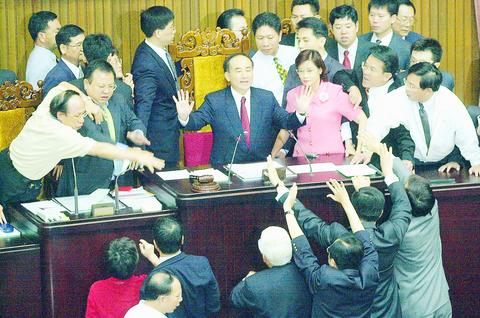
PHOTO: CHIANG YING-YING, TAIPEI TIMES
Meanwhile, the confirmation frustrated the opposition alliance.
KMT Legislative Whip Lin Yi-shih (
Yao Chia-wen (姚嘉文), a former DPP chairman and lawmaker, secured just enough ballots for his nomination as Examination Yuan president after getting the minimum 113 votes needed for confirmation. One legislator voted against him and the other 111 abstained
"I'm glad I did not fail the appointment after all," a beaming Yao said. "As I have said, a few swing votes would decide my fate."
Yao, 64, owed his narrow victory to last-minute defections by a handful of KMT legislators. Earlier, the KMT and PFP had vowed to thwart his appointment, saying his past involvement in DPP and pro-independence activities made him unqualified for the job.
The Constitution stipulates that members of the Examination Yuan should be above partisanship and independently exercise their functions in accordance with law. Yao has said he would quit the DPP and refrain from pro-independence events if he won confirmation.
True to their threats, the opposition parties barred their lawmakers from attending the afternoon vote in an indirect show of disapproval.
As on Thursday, senior mem-bers from the KMT blocked all entrances to the legislative chamber and engaged in sporadic brawls with their DPP colleagues.
KMT Legislator Tseng-Tsai Mei-tso (曾蔡美佐) arrived in the legislature at 5:20pm and was immediately surrounded by fellow lawmakers who sought to prevent her from entering the voting venue.
The blockade drew vehement protests from DPP legislators, including Chou Ching-yu (
"You have no right to deprive her the right to vote," Chou said, struggling to help Tseng break through. "No party can engage in such conduct and call itself democratic."
Tseng later made her way to the chamber but shied away from the balloting boxes. Amid the commotion, four other KMT lawmakers -- Lu Shin-ming (呂新民), Lin Nan-sheng (林南生) Yang Wen-hsin (楊文欣) and Lin Chin-chun (林進春) -- defied the no-show order and cast their ballots.
They were believed to have provided the votes needed for Yao's triumph. The DPP and the TSU control only 102 votes in the 225-seat legislature, insufficient to pass the majority requirement despite the help of seven independent lawmakers.
KMT Aboriginal lawmakers, who attended Thursday's vote, did not show up yesterday afternoon. Caucus officials said they went hunting in the mountains together.
To the surprise of many, former interior minister Chang Po-ya (張博雅) obtained only 102 ballots, 11 short of the number needed to be confirmed as Examination Yuan vice president.
Chang, 60, now a national policy adviser, insisted that many opposition lawmakers backed her nomination but abstained from the vote at the behest of their caucuses.
"Had they participated, the result would be different," she said.
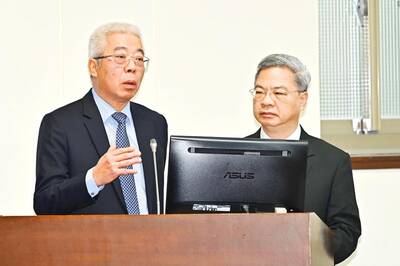
Taiwan has arranged for about 8 million barrels of crude oil, or about one-third of its monthly needs, to be shipped from the Red Sea this month to bypass the Strait of Hormuz and ease domestic supply pressures, CPC Corp, Taiwan (CPC, 台灣中油) said yesterday. The state-run oil company has worked with Middle Eastern suppliers to secure routes other than the Strait of Hormuz, through which about 20 percent of the world’s oil and liquefied natural gas typically passes, CPC chairman Fang Jeng-zen (方振仁) said at a meeting of the legislature’s Economics Committee in Taipei. Suppliers in Saudi Arabia have indicated they
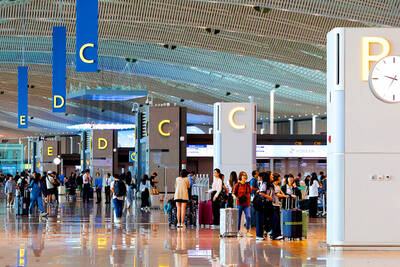
South Korea has adjusted its electronic arrival card system to no longer list Taiwan as a part of China, a move that the Ministry of Foreign Affairs said would help facilitate exchanges between the two sides. South Korea previously listed “Taiwan” as “Taiwan (China)” in the drop-down menus of its online arrival card system, where people had to fill out where they came from and their next destination. The ministry had requested South Korea make a revision and said it would change South Korea’s name on Taiwan’s online immigration system from “Republic of Korea” to “Korea (South),” should the issue not be

CCP ‘PAWN’? Beijing could use the KMT chairwoman’s visit to signal to the world that many people in Taiwan support the ‘one China’ principle, an academic said Chinese Nationalist Party (KMT) Chairwoman Cheng Li-wun (鄭麗文) yesterday arrived in China for a “peace” mission and potential meeting with Chinese President Xi Jinping (習近平), while a Taiwanese minister detailed the number of Chinese warships currently deployed around the nation. Cheng is visiting at a time of increased Chinese military pressure on Taiwan, as the opposition-dominated Legislative Yuan stalls a government plan for US$40 billion in extra defense spending. Speaking to reporters before going to the airport, Cheng said she was going on a “historic journey for peace,” but added that some people felt uneasy about her trip. “If you truly love Taiwan,

Tainan, Taipei and New Taipei City recorded the highest fines nationwide for illegal accommodations in the first quarter of this year, with fines issued in the three cities each exceeding NT$7 million (US$220,639), Tourism Administration data showed. Among them, Taipei had the highest number of illegal short-term rental units, with 410. There were 3,280 legally registered hotels nationwide in the first quarter, down by 14 properties, or 0.43 percent, from a year earlier, likely indicating operators exiting the market, the agency said. However, the number of unregistered properties rose to 1,174, including 314 illegal hotels and 860 illegal short-term rental


 RSS
RSS