


US planes bombed mountain hideouts of Osama bin Laden's fighters in eastern Afghanistan yesterday, even as they tried to negotiate surrender terms by radio.
Afghanistan's nominal president, Burhanuddin Rabbani, complained that foreign powers had imposed a new interim government due to rule his shattered country from Dec. 22, but said he backed its designated head, Hamid Karzai.
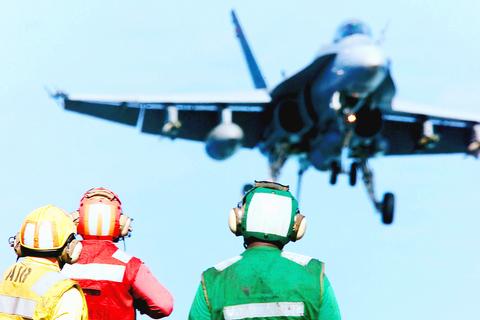
PHOTO: AP
US warplanes kept up pressure on al-Qaeda fighters still holed up in caves and bunkers in the jagged Spin Ghar mountains.
"They are talking by wireless sets," anti-Taliban commander Mohammad Amin said of negotiations conducted since early morning involving unidentified al-Qaeda members and anti-Taliban military leaders Hazrat Ali and Haji Mohammad Zaman.
"There has been no result yet," Amin said by satellite telephone from the eastern city of Jalalabad.
Anti-Taliban fighters, backed by devastating US air power and American special forces, made dramatic gains against al-Qaeda in fierce fighting on Tuesday, before calling a pause.
Zaman, a military commander, said late on Tuesday that al-Qaeda forces had promised to surrender from yesterday morning.
But by dusk yesterday, CNN was quoting Hazrat Ali as saying his forces would resume their assault unless al-Qaeda agreed to hand over bin Laden and his 20 top aides in return for free passage for their foot soldiers.
The mainly Arab al-Qaeda fighters, who are fiercely loyal to bin Laden, were demanding to be handed over to UN officials in the presence of diplomats from their own countries, Pakistan-based Afghan Islamic Press said.
Ahmed Fawzi, spokesman for UN special envoy to Afghanistan Lakhdar Brahimi, said the UN had no personnel in the area and had received no request to play a part in any such deal.
"If we do receive a request, it would be appropriately considered," he said, but added that he could not recall a precedent for any such arrangement.
Asked why the US had resumed bombing, Amin said: "Because they [al-Qaeda] haven't surrendered."
The US is not known to have approved or taken any part in any talks with al-Qaeda. US officials have said there can be no amnesty for leaders of bin Laden's network.
Zaman had no word on bin Laden, the Saudi-born militant wanted for the Sept. 11 attacks on the US.
"I cannot say anything about this, whether he is in the mountains, or he has been killed in the bombardment or is still alive," he said.
Pakistani officials said neither bin Laden nor his followers would find sanctuary in their country. "We will arrest [them] irrespective of their nationality," said a government official in North West Frontier Province, bordering eastern Afghanistan.
He said 8,000 to 9,000 army and paramilitary troops had been sent to stop Taliban or al-Qaeda fighters from crossing the border.
US Defense Secretary Donald Rumsfeld expressed concern on Tuesday that al-Qaeda and Taliban leaders could slip into Pakistan from their besieged Tora Bora cave and tunnel complex.
"It's a very complicated area to try to seal and there's just no way you can put a perfect cork in the bottle," he said, noting that US ally Pakistan was trying to shut its porous border.
UN representative Brahimi flew from Kabul to Islamabad for talks with Pakistani President Pervez Musharraf yesterday.
Brahimi met Afghan leaders in Kabul on Tuesday to discuss a smooth transfer of power to a post-Taliban interim government agreed under last week's power-sharing deal in Germany.
High on his agenda was a proposed UN-mandated multinational security force to support Karzai's government.
Afghanistan's interim Defense Minister Mohammad Fahim said on Tuesday the force should have only 1,000 troops with a "very limited" role and insisted that Northern Alliance-led security forces would remain in the capital they now control.
Brahimi said all Afghan leaders he met had told him they would support the deployment of a UN-mandated force in Kabul.
He said Rabbani, whose objections almost scuppered the Bonn deal, had agreed to hand over power to Karzai on Dec. 22.
But the disgruntled Afghan leader said yesterday that foreign powers had imposed the new interim government.
"We hope this will be the last time that foreign countries interfere in Afghanistan's affairs," he told a news conference.
Fawzi, asked earlier about Northern Alliance reservations on the multi-national force, told a news conference in Islamabad that, "There is no pressure from the UN on the Afghans, there is no pressure from the Afghans on the UN. This is a collaborative effort. We are not going to impose anything on the Afghans."
Rabbani said he had sent a Northern Alliance delegation to the Bonn talks to "discuss and negotiate," not to sign a deal.
"They signed the agreement just because they were pressured by the international community," Rabbani, 61, declared.
Nevertheless, he voiced support for Karzai. "We hope that the transfer of power will take place on Dec. 22," he said.
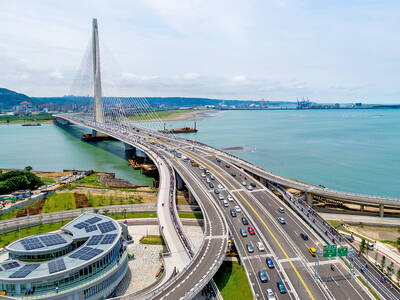
The Ministry of Transportation and Communications yesterday inaugurated the Danjiang Bridge across the Tamsui River in New Taipei City, saying that the structure would be an architectural icon and traffic artery for Taiwan. Feted as a major engineering achievement, the Danjiang Bridge is 920m long, 211m tall at the top of its pylon, and is the longest single-pylon asymmetric cable-stayed bridge in the world, the government’s Web site for the structure said. It was designed by late Iraqi-British architect Zaha Hadid. The structure, with a maximum deck of 70m, accommodates road and light rail traffic, and affords a 200m navigation channel for boats,
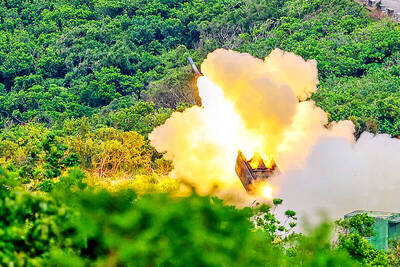
PRECISION STRIKES: The most significant reason to deploy HIMARS to outlying islands is to establish a ‘dead zone’ that the PLA would not dare enter, a source said A High Mobility Artillery Rocket System (HIMARS) would be deployed to Penghu County and Dongyin Island (東引) in Lienchiang County (Matsu) to force the Chinese military to retreat at least 100km from the coastline, a military source said yesterday. Taiwan has been procuring HIMARS and Army Tactical Missile Systems (ATACMS) from the US in batches. Once all batches have been delivered, Taiwan would possess 111 HIMARS units and 504 ATACMS, which have a range of 300km. Considering that “offense is the best defense,” the military plans to forward-deploy the systems to outlying islands such as Penghu and Dongyin so that

Taiwan Semiconductor Manufacturing Co (TSMC, 台積電), the world’s largest foundry service provider, yesterday said that global semiconductor revenue is projected to hit US$1.5 trillion in 2030, after the figure exceeds US$1 trillion this year, as artificial intelligence (AI) demand boosts consumption of token and compute power. “We are still at the beginning of the AI revolution, but we already see a significant impact across the whole semiconductor ecosystem,” TSMC deputy cochief operating officer Kevin Zhang (張曉強) said at the company’s annual technology symposium in Hsinchu City. “It is fair to say that in the past decade, smartphones and other mobile devices were

‘CLEAR MESSAGE’: The bill would set up an interagency ‘tiger team’ to review sanctions tools and other economic options to help deter any Chinese aggression toward Taiwan US Representative Young Kim has introduced a bill to deter Chinese aggression against Taiwan, calling for an interagency “tiger team” to preplan coordinated sanctions and economic measures in response to possible Chinese military or political action against Taiwan. “[Chinese President] Xi Jinping [習近平] has directed the People’s Liberation Army to be ready to invade Taiwan by 2027. China has a plan. America should have one too,” Kim said in a news release on Thursday last week. She introduced the “Deter PRC [People’s Republic of China] aggression against Taiwan act” to “ensure the US has a coordinated sanctions strategy ready should


 RSS
RSS