


Greeted by cheering residents, Northern Alliance fighters captured Afghanistan's capital, Kabul, yesterday in defiance of international pressure to stay out, after the city was abandoned by the Taliban under cover of darkness.
"We have taken Kabul," shouted one jubilant fighter as he and fellow soldiers stood in a group on a street in the city center on day 38 of the war the US launched following the Sept. 11 attacks on New York and Washington.
With the fall of Kabul, the Taliban faced another foe on the doorstep of their southern stronghold of Kandahar.
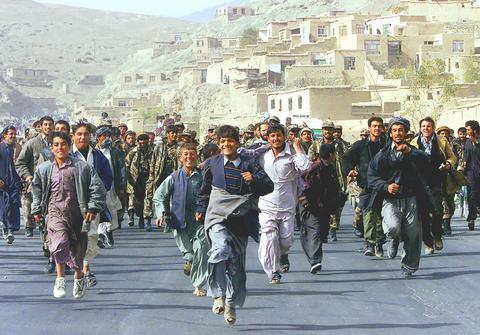
PHOTO: REUTERS
Witnesses arriving in Pakistan said thousands of anti-Taliban tribal fighters had seized a nearby airport and were advancing on the city.
In Kabul, opposition fighters entering the city shot dead a number of Taliban stragglers.
Mopping up
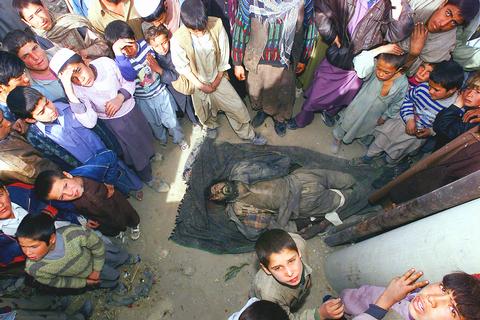
PHOTO: REUTERS
Some Arab and Chechen fighters loyal to Saudi-born fugitive Osama bin Laden clambered into trees in the city to fire on the advancing opposition soldiers. They were shot and their bodies hung in the branches or lay sprawled on the ground.
While the green, white and black flag of the United Front, or Northern Alliance was tacked to ministry gates, in Shahr-i-naw park in the city center the bloody bodies of seven black-turbaned Taliban militia lay dead, apparently executed with bullets to the head. Bank notes had been stuffed in their noses and ears and children spat at the corpses.
Opposition Defense Minister General Mohammad Fahim and Foreign Minister Abdullah Abdullah drove into the city in a black Landcruiser, followed by a column of armed military policemen dressed in dark green uniforms. Behind them came a column of hundreds of armed Northern Alliance fighters in camouflage fatigues.
Witnesses said armed men had occupied all major government buildings, many of which were looted by residents. Prisoners broke out of jails left by the Taliban.
The Taliban plundered Afghanistan's main currency market before fleeing during the night in a convoy of tanks, armored personnel carriers and battered pick-up trucks, heading for their stronghold in the southern city of Kandahar.
They took with them eight Western aid workers -- two Americans, two Australians and four Germans -- being tried on charges of promoting Christianity.
The Pakistan-based Afghan Islamic Press said the Taliban were regrouping to make a stand in Maidanshahr, a few dozen kilometers west of Kabul but gave no details and the report could not be independently confirmed.
Buoyed by the lightning capture of the north of the country over the weekend and by more than a month of blistering US air strikes on the Taliban, the Northern Alliance broke through Taliban front lines outside Kabul on Monday backed by US bombing and a fierce artillery barrage.
By dawn yesterday, their fighters had raced into the city, waving their assault rifles above their heads. Residents greeted them with shouts of "Down with the Taliban!" and "Welcome the Northern Alliance!"
Crowds came out of the city and surrounded truckloads of soldiers poised to enter. They threw plastic flowers onto tanks.
One Alliance commander, Gul Haidar, ordered his troops not to loot. "We should make sure that there is no problem for the people and no theft happens," he told his fighters.
At Bagram airport north of Kabul, US special forces troops wearing civilian clothes and sunglasses and carrying M-16 assault rifles inspected the Northern Alliance positions.
Done deal
At trenches near the airport lay the bodies of 20 Pakistani Taliban fighters. About 20 Afghan Taliban who had surrendered and who were still armed chatted with opposition soldiers.
"We did a deal a month ago with the Northern Alliance to surrender when they arrived," one Taliban commander named Tour said.
The alliance is deeply unpopular among Kabul's mainly Pashtun population due to power struggles among opposition leaders in the 1990s that unleashed almost daily rocket attacks on the city and killed about 50,000 residents.
The US wanted a broad-based deal on the structure of any post-Taliban government before the Alliance entered Kabul.
But there have been few signs of progress on such a deal. The UN says it wants an urgent meeting of Afghan leaders to discuss the country's political future.
The Northern Alliance's unstoppable surge into Kabul prompted urgent calls around the world yesterday for the creation of a broad-based government in Afghanistan.
Several countries also pressed the UN to take a much more active role in the political vacuum left by the fleeing Taliban.
"We will need to move very quickly internationally to provide the infrastructure for a broad-based interim government," British Home Secretary David Blunkett told BBC radio.
French President Jacques Chirac underlined he point.
"It's more urgent than ever that a [political] solution is put into effect very rapidly," he told reporters during a visit to Abu Dhabi.
"Nothing would be worse than a transition period where there was no coordination, a situation which would not guarantee stability."
Also See Story Inside

A signaling system malfunction disrupted high-speed rail (HSR) services beginning at 8am today, with trains temporarily reduced to three northbound and three southbound trains per hour as authorities conduct inspections. The malfunction occurred on a section of track in Miaoli County during pre-operation checks early this morning, forcing northbound and southbound trains to use a single track, the HSR operator said. The regular schedule has been replaced with three hourly trains offering only nonreserved seating in each direction, stopping at every station, it said, adding that business class cars would still have reserved seating. Departures from terminal stations are scheduled at the top

Taiwan is still in the process of assessing the possibility of recruiting workers from Eswatini, the Ministry of Foreign Affairs said yesterday, adding that its goal is to help Eswatini upgrade its vocational training centers. If there are plans to recruit workers from Eswatini, safeguarding national security, protecting public health and ensuring the employment rights of Taiwanese would be prerequisites, Department of West Asian and African Affairs Director-General Yen Chia-liang (顏嘉良) told a news conference. Key considerations would also include filling labor shortages in specific industries, and fostering bilateral professional and technical exchanges, he said. Yen was asked about the progress of labor

VERBOSE VESSELS: A CGA cutter and a China Coast Guard exchanged verbal barbs for more than a day in Taiwanese-controlled waters before the Chinese vessel left The Taiwanese and Chinese coast guards had a standoff near the strategically located Pratas Islands (Dongsha Islands, 東沙群島) in the north of the South China Sea, the Coast Guard Administration (CGA) said yesterday. The two sides engaged in intense radio exchanges over sovereignty claims during the 33-hour standoff. China Coast Guard vessel 3501 eventually left the restricted waters, 26.6 nautical miles (49.2km) west of the Pratas Islands, at 5pm yesterday, the CGA said. Lying approximately between southern Taiwan and Hong Kong, the Taiwan-controlled Pratas are seen by some security experts as vulnerable to Chinese attack due to their distance — more than
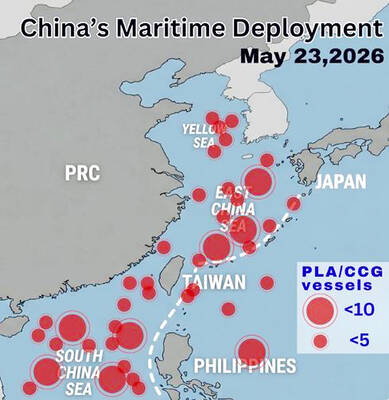
WARNING: China should stop engaging in actions that undermine regional peace and stability, as it would only build resentment among people across the Strait, the CGA said China has deployed more than 100 navy, coast guard and other vessels in waters from the Yellow Sea to the South China Sea and the western Pacific since US President Donald Trump and Chinese President Xi Jinping (習近平) met in Beijing, National Security Council Secretary-General Joseph Wu (吳釗燮) said yesterday. “In this part of the world, #China is the one & only PROBLEM wrecking the #StatusQuo & threatening regional peace & stability,” Wu wrote on X. In a separate post, he said Beijing was coercing Taiwan’s maritime domain, calling it illegal and provocative, after the Coast Guard Administration (CGA) expelled a


 RSS
RSS