


A Cambodian court released yesterday the reputed leader of the infamous "Bamboo Union" (
Chen Chi-li (陳啟禮), 58, thought to be the spiritual leader of the Bamboo Union's 10,000 members worldwide, and Taiwanese national Lia Ming-in, 28, were convicted of possession of illegal weapons and sentenced to three years in prison.
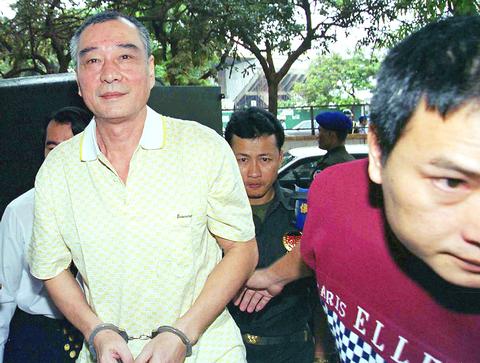
PHOTO: REUTERS
The court released the two defendants after citing the one year they had already spent in Phnom Penh's National Military Police Headquarters since a raid on Chen's home in July last year.
The judge suspended the other two years of his sentence, dismissed charges of involvement in organized crime and using North Korean diplomatic license plates.
"He used illegal weapons because of fear for his own security," said Judge Yia Sakorn, who presided over the trial. "The three were not involved with organized crime."
Quong Ouquing, 45, from China, who was also charged in the case, was sentenced to just over one year in prison but was released after completing his sentence.
"The defendant has sacrificed his own money for the public interest, such as the renovation of public places in the city and helping the poor," Judge Yia Sakorn said. "This point the court opted to take into consideration."
Chen smiled after the verdict was announced and signaled to reporters with a nod of his head that he was satisfied with the verdict and would stay in Cambodia.
"This is the first just verdict in Cambodia," said Som Chan Dyna, one of the defense lawyers in the case. "Chen Chi-li will continue to stay in Cambodia and continue to promote Chinese and foreign investment in Cambodia."
Observers said that the suspected gang leader's prominence in government and business circles may have influenced the court's decision. Chen has received the prestigious title "Okhna" bestowed on prominent businessmen who benefit the community and is confirmed to have been an advisor to Senate President Chea Sim.
"Chinese investors and a request made by the Chinese Investment Association in Cambodia said that as long as one of their most important men was still in prison, the number of Chinese investors and investment capital will drop," Som Chan Dyna said.
Chen is wanted on criminal charges in Taiwan, but the two countries have no diplomatic relations or an extradition treaty.
A Taiwanese court in 1985 convicted the suspected gang leader of murder in the 1984 slaying of dissident writer Henry Liu (
He was sentenced to life in prison, but released after six years and fled to Cambodia in 1997 to avoid a crackdown in Taiwan on organized crime.
Chen and the two other men were arrested last year in a raid on his Phnom Penh home. According to the police report, a large cache of automatic weapons, including AK-47s and a grenade launcher, were found at the home. Police also seized US$4,000 in cash and two vehicles.
Since fleeing Taiwan in 1997, Chen has lived freely in Cambodia with the apparent blessing of high-ranking government officials.

‘NO SECURITY RISK’: The Railway Bureau reassured the public that the technicians’ activities were limited to technical guidance and did not involve sensitive systems The Railway Bureau yesterday said it had invited eight Chinese technicians to assist with an airport MRT construction project. The bureau issued the confirmation after an Internet user said Chinese nationals had entered the construction zone of Taiwan Taoyuan International Airport’s Terminal 3 project. They asked why “individuals from an enemy state” were allowed access to such a major national infrastructure project, which raised serious concerns over Taiwan’s industrial safety, sensitive systems and information security. The bureau’s Northern Region Engineering Branch Office said subcontractor Taiwan Handle Industrial Co (台灣手把工業) of the Taoyuan airport MRT’s “Contract No. CU05 Project A14 Station Civil, MEP &

The National Chungshan Institute of Science and Technology yesterday showcased its locally developed variants of the Vision 60 robotic patrol dog, which it plans to deploy on the nation’s outlying territories in the South China Sea. The variants were produced under the Joint Lab project — created by the institute and domestic companies — and assembled with domestically produced motors, lenses and artificial intelligence (AI) systems alongside licensed tech from the US, Missile and Rocket Systems Research Division deputy director Jen Kuo-kang (任國光) told the media event at a military base in Taipei’s Dazhi (大直) area. Taiwan has built up its strengths

NOT IMMEDIATE: Taiwan has a chance to appeal the proposed 10 percent tariff before it starts, while other countries face a 12.5 percent tariff from the trade office Taiwan is among 60 economies determined by the US to have failed to impose or enforce a ban on the importation of goods produced with forced labor, according to a notice released on Tuesday by the Office of the US Trade Representative (USTR), which proposed imposing an additional 10 percent or more tariff on them. The USTR in a statement said that following an investigation, it had determined under Section 301 of the Trade Act of 1974 that the failure of the 60 economies to impose and effectively enforce a prohibition on the importation of goods produced with forced labor is
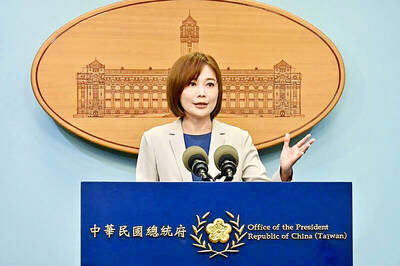
TIT-FOR-TAT: The US allegedly revoked the visa of a Chinese national working at Xinhua News Agency in the US in response to Beijing’s expulsion of Vivian Wang The Presidential Office yesterday condemned China for expelling a New York Times correspondent from Beijing following the newspaper’s interview with President William Lai (賴清德), saying the move highlighted Beijing’s suppression of press freedom and its threat to international news media. Taiwan has noted a series of recent incidents in which Beijing used similar tactics to “threaten and pressure international media outlets and journalists,” Presidential Office spokeswoman Karen Kuo (郭雅慧) said in a statement. “This concerns not only press freedom and freedom of expression, but also the safety of journalists, and Taiwan and relevant partners are paying close attention to the situation,” she


 RSS
RSS