


Fourteen months after being voted out of office, the KMT is set to convene its national congress today and tomorrow.
The congress is widely hoped to rejuvenate the party and prepare it for its next big challenge, the year-end legislative elections.
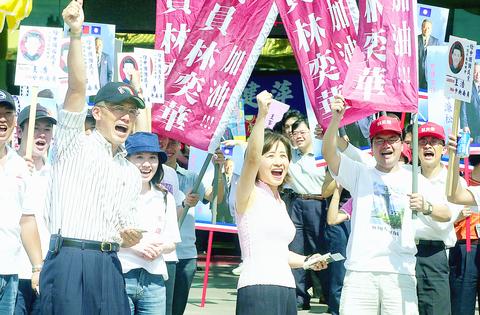
PHOTO: LIAO RAY-SHANG, TAIPEI TIMES
"It [the congress] is a rally whose main aim is to consolidate party unity," KMT Chairman Lien Chan (連戰) told a group of overseas supporters on the eve of the forum.
"The party has a rosy outlook about its future," Lien said.
A total of 2,001 party officials and delegates from Taiwan and overseas will attend the two-day meeting. The congress will discuss proposals to amend internal rules as well as to elect members of the party's Central Committee and Central Standing Committee.
"The gathering will also provide opportunity for members to brainstorm strategy for winning the year-end elections," Lien said.
Lien, whose presidential election bid last year suffered a humiliating defeat, said: "Take heart and have confidence in the party. I'm optimistic."
All five sitting vice chairpersons -- Vincent Siew (
Of the 210 Central Committee candidates, only 97 are incumbents, with the majority of seats set aside for representatives from different sectors of society.
"For the first time, 22 China-based Taiwan businessmen are candidates in line with the party's resolve to diversify its leadership," KMT Secretary-general Lin Fong-cheng (林豐正) told a news conference.
Nearly 1,500 party delegates will vote on the slate of the Central Committee whose members for the first time are empowered to confirm the party's legislative candidates-at-large.
Stressing the importance of reform and democracy, Lin said the congress will also discuss proposals to exclude sexual offenders from seeking public office in the future.
"The proposed revision marks an additional concrete step by the party to help improve the quality of the country's politics," Lin said.
The KMT has been blamed for its ties to organized crime and big-money interests. To shake off the image, the party earlier this year introduced an exclusionary clause to its nominating codes that bars figures with underworld connections from contesting elected office.
The 210 Central Committee members will elect 31 deputies among themselves to the Central Standing Committee that used to be dominated by ranking Cabinet officials before the KMT lost the presidency to the DPP.
"In the past, members holding key government posts were also responsible for drafting the party's policies," Lin noted. "The duty now resides with the central policy committee and the party's think tank -- both of which assign heavy weight to opinion polls."
The transfer of power has increasingly tipped the balance in favor of the party's legislative caucus. Today, 12 fellow legislators sit on the party's highest decision-making organ, compared to less than five when the KMT was in control of government.
To prevent the Taiwan Solidarity Union (台灣團結聯盟) from stealing the limelight, the party has advised against any campaign to expel former chairman Lee Teng-hui (李登輝), who has lent his support to the new political party.
"A grassroots member, Lee should not be the focus of the forthcoming event," said Chao Shou-po (
Feng Chih-yi (方智怡), an overseas delegate, had earlier vowed to call for Lee's expulsion during the congress but later said she would leave the matter to the discretion of the Central Standing Committee.
Apparently to appease the pro-Lee faction, the party has said it will continue with the "Taiwan first" policy introduced by the former KMT leader.
"Without abandoning the `Taiwan first' policy, the party will make saving the economy and promoting ethnic harmony its main appeals in the run-up to the December polls," Lin said.
Analysts said the KMT, if able to avert fratricidal infighting, would remain a key player in politics.
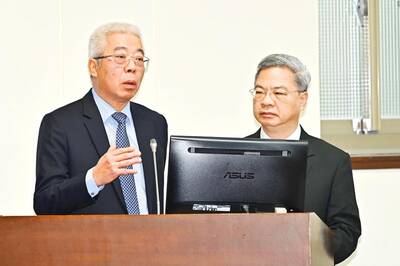
Taiwan has arranged for about 8 million barrels of crude oil, or about one-third of its monthly needs, to be shipped from the Red Sea this month to bypass the Strait of Hormuz and ease domestic supply pressures, CPC Corp, Taiwan (CPC, 台灣中油) said yesterday. The state-run oil company has worked with Middle Eastern suppliers to secure routes other than the Strait of Hormuz, through which about 20 percent of the world’s oil and liquefied natural gas typically passes, CPC chairman Fang Jeng-zen (方振仁) said at a meeting of the legislature’s Economics Committee in Taipei. Suppliers in Saudi Arabia have indicated they
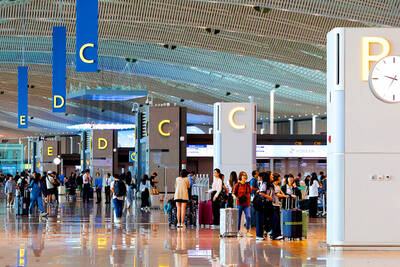
South Korea has adjusted its electronic arrival card system to no longer list Taiwan as a part of China, a move that the Ministry of Foreign Affairs said would help facilitate exchanges between the two sides. South Korea previously listed “Taiwan” as “Taiwan (China)” in the drop-down menus of its online arrival card system, where people had to fill out where they came from and their next destination. The ministry had requested South Korea make a revision and said it would change South Korea’s name on Taiwan’s online immigration system from “Republic of Korea” to “Korea (South),” should the issue not be
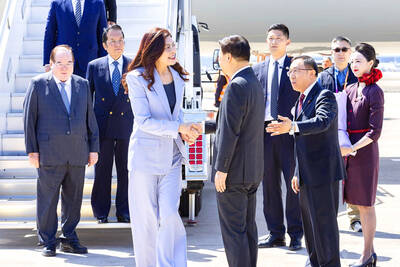
CCP ‘PAWN’? Beijing could use the KMT chairwoman’s visit to signal to the world that many people in Taiwan support the ‘one China’ principle, an academic said Chinese Nationalist Party (KMT) Chairwoman Cheng Li-wun (鄭麗文) yesterday arrived in China for a “peace” mission and potential meeting with Chinese President Xi Jinping (習近平), while a Taiwanese minister detailed the number of Chinese warships currently deployed around the nation. Cheng is visiting at a time of increased Chinese military pressure on Taiwan, as the opposition-dominated Legislative Yuan stalls a government plan for US$40 billion in extra defense spending. Speaking to reporters before going to the airport, Cheng said she was going on a “historic journey for peace,” but added that some people felt uneasy about her trip. “If you truly love Taiwan,

Tainan, Taipei and New Taipei City recorded the highest fines nationwide for illegal accommodations in the first quarter of this year, with fines issued in the three cities each exceeding NT$7 million (US$220,639), Tourism Administration data showed. Among them, Taipei had the highest number of illegal short-term rental units, with 410. There were 3,280 legally registered hotels nationwide in the first quarter, down by 14 properties, or 0.43 percent, from a year earlier, likely indicating operators exiting the market, the agency said. However, the number of unregistered properties rose to 1,174, including 314 illegal hotels and 860 illegal short-term rental


 RSS
RSS