


Formosa Plastics Group Chairman Wang Yung-ching (王永慶) yesterday echoed Beijing's demand that Taiwan accept the "one China" principle and repeated his call that all curbs on investment across the Strait be lifted to bolster the flagging local business environment.
Wang, 84, and one of Taiwan's richest industrialists, backed his reasoning by taking a swipe at the government, saying present social and political conditions are more chaotic than the corruption of the KMT government of 40 years ago.
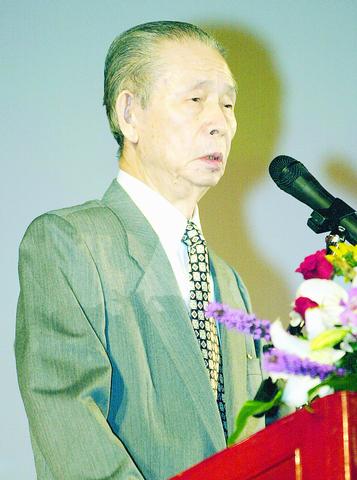
PHOTO: SUNG CHIH-HSING, TAIPEI TIMES
"Taiwan's people should calmly accept the `one China' principle and from this position of equality both sides can cooperate to enjoy long-lasting mutual benefits," said Wang, who was speaking at a biotech promotional event in Taipei.
"There is no hatred between the two sides. ... both sides share common roots," he said.
But the government was quick to rebuff Wang's overtures, with the Mainland Affairs Council issuing a statement saying Taiwan could not agree to accept the "one China" principle.
"Under the Chinese interpretation of `one China,' the Republic of China doesn't exist," the statement said.
The council said that handling the "one China" problem would require both sides to first temporarily shelve the dispute to create a more favorable atmosphere before mutual resolution of the issue.
Wang, who has often offered scathing words to the government over political bickering, justified his call for the move by saying the social and political landscape was in a state of general turmoil and the economy is suffering severely because of it.
"All of Taiwan's businesses are facing a slump and the hollowing out of industries," Wang said.
The only way "to turn this crisis into opportunity is for Taiwan firms to make a concerted move together into China," Wang said.
Vital to facilitating this move, according to Wang, would be replacing the "no haste, be patient" (
Currently, the Taiwan government imposes a limit of US$50 million on any single investment in China and totally bans investment in high-tech and infrastructure projects.
Despite restrictions on investments in China, Taiwan investors have poured more than US$60 billion into the mainland since rapprochement began in the late 1980s, attracted by cheap land and labor as well as a common language and culture. Funds are routed through Hong Kong or a third country.
Wang has long been a strong critic of the "no haste" policy which forced his company to drop a US$6 billion investment in 1992 to build a chemical complex in China's Fujian Province.
Wang drew criticism from independence-minded lawmakers for his remarks but also qualified support from the opposition.
Tsai Huang-liang (蔡煌瑯), executive secretary of the ruling DPP, roundly condemned Wang's remarks saying the "one China" principle equalled stripping Taiwan of its national sovereignty and status.
But, predictably, Wang's remarks -- or at least interpretations of what he said -- received more favorable responses from among the generally pro-unification opposition parties.
Lee Cheng-chong (李正宗), KMT party secretary, said that if Wang's "one China" comment was said in the spirit of the 1992 consensus of "one China, each to his own interpretation" (一中各表) the KMT of course welcomed the remark.
People First Party (親民黨) convener Chou Hsi-wei (周錫瑋) said Wang's speech was "very rational," urging the "new government" to return to the 1992 consensus and "stop looking at Chinese people with hatred and causing ethnic rifts within Taiwan."

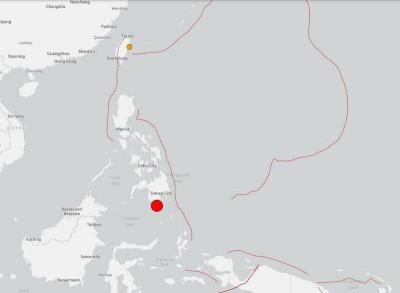
A magnitude 7.8 earthquake struck off the southern coast of Mindanao in the Philippines at 7:38am today, prompting the US Tsunami Warning System to issue an alert for neighboring countries, including Taiwan. The system issued a purple alert indicating a "tsunami threat." The potential threat zone includes Taiwan, the Philippines, Papua New Guinea, Yap and Palau. A spokesperson for Indonesia disaster mitigation agency said there were no reports of damage so far. Arlene Hollero, disaster chief of Maasim town in the Philippines' Sarangani Province, said their evacuation was underway in coastal villages and there were no reported casualties so far. DZBB radio, broadcasting from the

RESILIENCE: Taiwan plays a key role in semiconductors, energy, information infrastructure and advanced manufacturing, AIT Director Raymond Greene said Taiwan’s continued investment in deterrence and resilience remains vital, especially in uncrewed systems and other emerging technologies, American Institute in Taiwan (AIT) Director Raymond Greene said yesterday. Greene made the remarks at the annual National Strategic Summit on Supply Chain Resilience held by the Research Institute for Democracy, Society and Emerging Technology (DSET), a government-backed think tank. As Taiwan last year became the US’ fourth-largest trading partner and supply chain security is becoming more important, cooperation in emerging technologies continues to deepen between the two countries, he said. The US is committed to accelerating innovation, building key infrastructure, strengthening cooperation

The National Chungshan Institute of Science and Technology yesterday showcased its locally developed variants of the Vision 60 robotic patrol dog, which it plans to deploy on the nation’s outlying territories in the South China Sea. The variants were produced under the Joint Lab project — created by the institute and domestic companies — and assembled with domestically produced motors, lenses and artificial intelligence (AI) systems alongside licensed tech from the US, Missile and Rocket Systems Research Division deputy director Jen Kuo-kang (任國光) told the media event at a military base in Taipei’s Dazhi (大直) area. Taiwan has built up its strengths

RIGHT DIRECTION: Taiwan’s efforts to prevent forced labor include a proposal to ‘fully prohibit’ employers from withholding workers’ documents, an official said Taiwan is to establish a mechanism to restrict imports of goods linked to forced labor, the Executive Yuan said yesterday, after the US proposed imposing additional tariffs on Taiwanese goods over labor concerns. “The Ministry of Labor and the Ministry of Economic Affairs are to establish an interministerial review procedure,” Executive Yuan spokesperson Michelle Lee (李慧芝) said at a news briefing in Taipei. “The government is to use the Foreign Trade Act [貿易法] as the legal basis to restrict imports of goods produced with forced labor” and bring its supply chain governance more in line with international standards on human rights, resilience


 RSS
RSS