


Nantou District Prosecutors Office yesterday indicted Nantou County Commissioner Peng Pai-hsien (
Five county officials and 11 businessmen were indicted along with Peng.
Authorities continued to question Peng throughout the day and into the evening yesterday. As of press time, it was not yet decided whether Peng would be released on bail or continue to be held for further questioning. Peng has already been in detention for two months.
The prosecution said it requested the harsh sentence for Peng because he had taken advantage of the misfortune of others to make money for himself, as well as the fact that there were multiple charges against Peng.
Outside the district court offices, Peng's supporters rallied all day yesterday for his release. Riot police were called in to keep an eye on the situation but the protests remained peaceful.
Prosecutors alleged that Peng and his close aides had misappropriated over NT$13 million in quake relief funds.
"After the quake, many people willing to donate money were not aware of the distinctions between government relief funds and [Peng's] New Nantou (新南投) Foundation and the Nantou County Construction and Development Foundation (南投縣建設發展基金會)," Nantou divisional head prosecutor Hsu Sung-kuei (
"Peng and his confidential secretary, Cheng Su-ching (
In the latter case, the money defrauded amounted to some NT$13.52 million, Hsu said.
But those close to Peng refuted the charges.
"This is an absolutely absurd indictment; we cannot accept it," said Cheng Su-ching in an interview with TVBS.
She said after the quake, people were uneasy donating money to the government relief efforts because they thought that giving money to a private fund would be better for quake victims since the government response was bound to be slow.
"It was under these circumstance that we offered them the option of donating to the Nantou County Construction and Development Foundation," Cheng said.
She stressed that the foundation was committed to reconstruction work.
"We did not take a cent from the foundation funds, nor did the foundation get a cent from the county government or any governmental relief fund," she said.
Stella Chen (陳婉真), director of the county's Social Affairs Bureau, also said "the prosecution is misleading the public by indicating the foundations as if the money had come straight out of Peng's own pockets."
The prosecution has also alleged that Peng was behind bid rigging in several post-quake reconstruction projects, including that of the county government's temporary office building.
The indictment says Peng bypassed public bidding procedures and awarded the contracts to companies he favored and in exchange for political support.
The prosecution also requested a 10-year sentence for Cheng Su-ching, 10 years for Chen Ming-chuan, 20 years for the county government advisor Pai Hsi-min (白錫旼), 15 years for the county government's contractor for construction design Wu Cheng-hsun (吳政勳) and seven years for the county government's policy planning unit director Tsai Pi-yun (蔡碧雲).
Peng, a political independent, was once a close associate of President Chen Shui-bian (陳水扁), when both were DPP lawmakers. Peng withdrew from the DPP in 1997 when he decided to run for the post of commissioner after he was not nominated by the party.
Peng won the election by a narrow margin ahead of his KMT and DPP opponents.

South Korea has adjusted its electronic arrival card system to no longer list Taiwan as a part of China, a move that the Ministry of Foreign Affairs said would help facilitate exchanges between the two sides. South Korea previously listed “Taiwan” as “Taiwan (China)” in the drop-down menus of its online arrival card system, where people had to fill out where they came from and their next destination. The ministry had requested South Korea make a revision and said it would change South Korea’s name on Taiwan’s online immigration system from “Republic of Korea” to “Korea (South),” should the issue not be

Tainan, Taipei and New Taipei City recorded the highest fines nationwide for illegal accommodations in the first quarter of this year, with fines issued in the three cities each exceeding NT$7 million (US$220,639), Tourism Administration data showed. Among them, Taipei had the highest number of illegal short-term rental units, with 410. There were 3,280 legally registered hotels nationwide in the first quarter, down by 14 properties, or 0.43 percent, from a year earlier, likely indicating operators exiting the market, the agency said. However, the number of unregistered properties rose to 1,174, including 314 illegal hotels and 860 illegal short-term rental
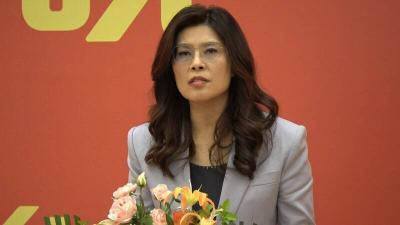
Both sides of the Taiwan Strait share a political foundation based on the “1992 consensus” and opposition to Taiwanese independence, Chinese Nationalist Party (KMT) Chairwoman Cheng Li-wun (鄭麗文) today said during her meeting with Chinese President Xi Jinping (習近平). Both sides of the Strait should plan and build institutionalized and sustainable mechanisms for dialogue and cooperation based on that foundation to make peaceful development across the Strait irreversible, she said. Peace is a shared moral value across the Strait, and both sides should move beyond political confrontation to seek institutionalized solutions to prevent war, she said. Mutually beneficial cross-strait relations are what the
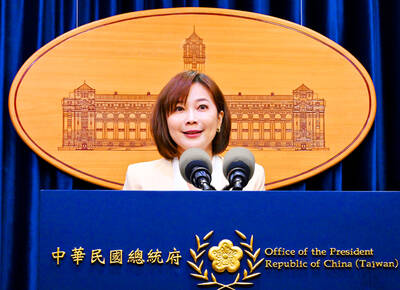
ECONOMIC COERCION: Such actions are often inconsistently applied, sometimes resumed, and sometimes just halted, the Presidential Office spokeswoman said The government backs healthy and orderly cross-strait exchanges, but such arrangements should not be made with political conditions attached and never be used as leverage for political maneuvering or partisan agendas, Presidential Office spokeswoman Karen Kuo (郭雅慧) said yesterday. Kuo made the remarks after China earlier in the day announced 10 new “incentive measures” for Taiwan, following a landmark meeting between Chinese President Xi Jinping (習近平) and Chinese Nationalist Party (KMT) Chairwoman Cheng Li-wun (鄭麗文) in Beijing on Friday. The measures, unveiled by China’s Xinhua news agency, include plans to resume individual travel by residents of Shanghai and China’s Fujian


 RSS
RSS