


Tang Fei (
A source at the Presidential Office told the Taipei Times that Vice Premier Chang Chung-hsiung (
"Recent legislative question-and-answer sessions and other administrative affairs have worn me out. I have resigned, and the president has accepted the fact. I shall be leaving my post tomorrow," Tang said last night at a press conference after meeting with the president. He thanked the president for his understanding.
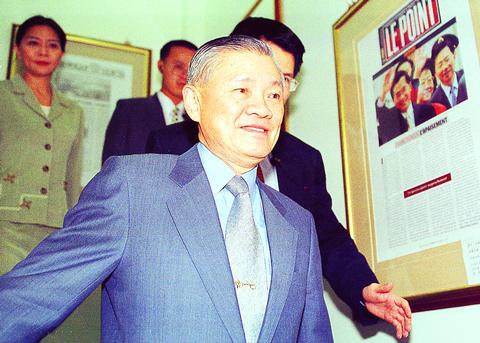
PHOTO: CHUANG CHUNG-LUNG, TAIPEI TIMES
Last night Minister of Finance Shea Jia-dong (
Tang added that over the past three to four weeks, he had made offers to resign from his post during private weekly meeting with the president. Chen, however, did not entertain those requests, Tang said.
This is the second time that Tang has publicly offered his resignation. The last time he did so was in the wake of the Pachang Creek (
During the tragedy, four riverbed workers were washed away by rising floodwaters while awaiting a rescue helicopter which never arrived.
The Presidential Office last night called a press conference to relay the president's comments on the matter.
"After previously declining to accept Tang's resignation, the president has decided that it would be better for Tang, his wife and all the people of Taiwan if he were to give up his post as premier," said acting secretary-general to the Presidential Office, Chen Che-nan (
"Therefore, the president has granted Tang's request upon compassionate grounds," the spokesman said, adding that Chen was very grateful for the premier's assistance over the past four months.
He added that the president hoped Tang could again serve his country after resting for a while.
Tang said yesterday that his resignation had nothing to do with the controversial Fourth Nuclear Power Plant, but that the nuclear issue had indeed posed a great challenge to the "Chen-Tang administration."
Political observers had previously speculated that Tang would quit over the issue sooner or later.
Editor-in-chief of the Taipei Times Antonio Chiang (司馬文武), however, argued that Tang did not quit over the nuclear controversy, or for health reasons.
"Tang realized that his mission to maintain political stability [during the transfer of power] was complete, and therefore it was time to step down. The main reason he resigned was because he was aware that he lacked financial and economic expertise -- the Cabinet's top administrative priorities, Chiang said."
Chiang added that if Tang were to continue as premier, other obstacles would arise to hinder the Chen-Tang administration and neither would benefit from such an extended political relationship
Meanwhile, Tang's resignation cast further doubt on the future of the Fourth Nuclear Power Plant.
In the wake of Tang's resignation, KMT Chairman Lien Chan (連戰) and PFP Chairman James Soong (宋楚瑜) both called for urgent meetings within their parties.
"The president violates the spirit of the ROC Constitution, disrespects the premier's power, and ignores the expectations of the people. That is why Tang stepped down," KMT spokesman Jason Hu (胡志強) said at a press conference last night, adding the KMT was satisfied with Tang's performance as premier.
"Tang's resignation has brought about an unprecedented constitutional crisis and political instability," Soong said at a press conference.
Meanwhile, financial officials last night said that the National Stabilization Fund (
Military spokesman Huang Sui-sheng (

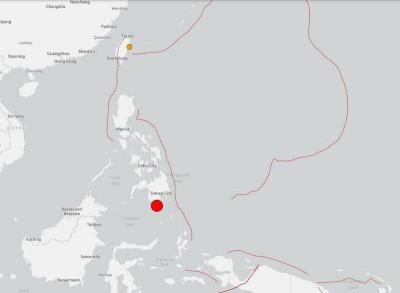
A magnitude 7.8 earthquake struck off the southern coast of Mindanao in the Philippines at 7:38am today, prompting the US Tsunami Warning System to issue an alert for neighboring countries, including Taiwan. The system issued a purple alert indicating a "tsunami threat." The potential threat zone includes Taiwan, the Philippines, Papua New Guinea, Yap and Palau. A spokesperson for Indonesia disaster mitigation agency said there were no reports of damage so far. Arlene Hollero, disaster chief of Maasim town in the Philippines' Sarangani Province, said their evacuation was underway in coastal villages and there were no reported casualties so far. DZBB radio, broadcasting from the

RESILIENCE: Taiwan plays a key role in semiconductors, energy, information infrastructure and advanced manufacturing, AIT Director Raymond Greene said Taiwan’s continued investment in deterrence and resilience remains vital, especially in uncrewed systems and other emerging technologies, American Institute in Taiwan (AIT) Director Raymond Greene said yesterday. Greene made the remarks at the annual National Strategic Summit on Supply Chain Resilience held by the Research Institute for Democracy, Society and Emerging Technology (DSET), a government-backed think tank. As Taiwan last year became the US’ fourth-largest trading partner and supply chain security is becoming more important, cooperation in emerging technologies continues to deepen between the two countries, he said. The US is committed to accelerating innovation, building key infrastructure, strengthening cooperation

The National Chungshan Institute of Science and Technology yesterday showcased its locally developed variants of the Vision 60 robotic patrol dog, which it plans to deploy on the nation’s outlying territories in the South China Sea. The variants were produced under the Joint Lab project — created by the institute and domestic companies — and assembled with domestically produced motors, lenses and artificial intelligence (AI) systems alongside licensed tech from the US, Missile and Rocket Systems Research Division deputy director Jen Kuo-kang (任國光) told the media event at a military base in Taipei’s Dazhi (大直) area. Taiwan has built up its strengths
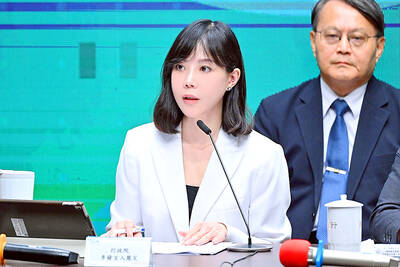
RIGHT DIRECTION: Taiwan’s efforts to prevent forced labor include a proposal to ‘fully prohibit’ employers from withholding workers’ documents, an official said Taiwan is to establish a mechanism to restrict imports of goods linked to forced labor, the Executive Yuan said yesterday, after the US proposed imposing additional tariffs on Taiwanese goods over labor concerns. “The Ministry of Labor and the Ministry of Economic Affairs are to establish an interministerial review procedure,” Executive Yuan spokesperson Michelle Lee (李慧芝) said at a news briefing in Taipei. “The government is to use the Foreign Trade Act [貿易法] as the legal basis to restrict imports of goods produced with forced labor” and bring its supply chain governance more in line with international standards on human rights, resilience


 RSS
RSS