


With just seven days to go, the DPP's presidential candidate received perhaps the biggest possible psychological boost to his campaign yesterday with the endorsement of Academia Sinica President Lee Yuan-tseh (
The nation's premier academic, winner of the 1986 Nobel Prize for Chemistry, met with Chen Shui-bian (
Chen said the committee will focus on tackling Taiwan's "black gold" political problems and maintaining stability in the cross-strait relationship while pursuing reform.
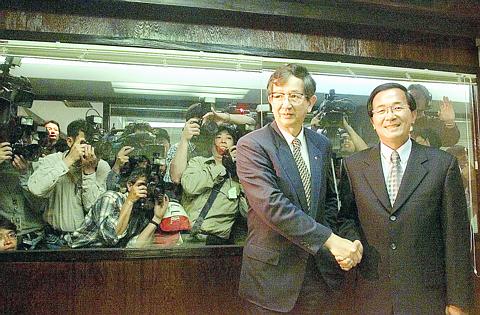
PHOTO: AP
"I admire Chen for his determination to carry out all kinds of reforms and to eradicate `black gold' politics," Lee said. "I will help Chen to govern our country if he is elected, to promote Taiwan's development."
Lee has long been touted as the most popular potential figure in a future government. All three major presidential candidates have tried to get his support.
Lee had previously been ambiguous when asked whether he would support Chen, but he finally decided to openly endorse the DPP candidate yesterday after an hour's meeting in private. He then faced a media mob to explain his decision which, he said, was motivated by having seen too many known members of organized crime groups stumping for other candidates.
"The election campaign has recently gotten bad. I am worried about the future direction of our country, after seeing so many gangsters campaigning for candidates," Lee said.
"I convinced my friends that we should come out openly to state our position on this ... to let people know that there are not only gangsters [involved in politics]. There are also people with ideals and the determination to pursue reform who are willing to stand by their candidates," he said.
Chen was quick to capitalize on the media opportunity himself.
"President Lee Yuan-tseh has promised to join my advisory committee," he beamed to the packed room of reporters and photographers. "I have also received promises from Taiwan High-Speed Railway Corp chairperson Nita Ing (殷琪), Chi Mai president Shi Wen-lung (許文龍), Evergreen chairman Chang Jung-fa (張榮發), and current National Security Advisor Chen Pi-chao (陳必照)."
Chen said these heavyweights were only the first few on his complete advisors' list, and that he would publicize more names gradually before election day.
"In addition, Lee Yuan-tseh suggested I invite current presidential advisor Hsiao Hsin-huang (
Lee also praised Chen for his progress in learning to become a national leader during the past few years, especially on the cross-strait issue.
"Chen advocates the same ideals as I do, to place national interests above personal or political interests," Lee said.
"This historic mission tells us that we should be more respectful and tolerate all different ethnic groups on both sides of the Taiwan Strait," Chen chimed.
Reporters were not about to let Lee get off so lightly, however, and repeatedly questioned him on the DPP's pro-independence stance.
Lee responded by stressing that he no longer agreed with characterizations of many senior politicians as "extremist," saying such simplified slogans simply misled voters.
"Many people at the grassroots level in Taiwan say they do not want to be bullied anymore," Lee said. "It's the same with the people in China."
"I will therefore dedicate myself to doing everything I can to improve the cross-strait relationship," Lee said.
As if the endorsement needed further amplification, Lee said, "To those candidates who are not capable of reform, I have nothing to discuss with them."
Reaction from the KMT was low key. Lien Chan's spokesman yesterday refused to regard Lee as "pro-Chen Shui-bian," saying Lien has always consulted Lee on state affairs and will continue to do so if elected.
In a news conference held yesterday afternoon, Alex Tsai (蔡正元), a Lien spokesman, said that what Lee Yuan-tseh had emphasized was his "sincere intention to seek reform," not support for any particular candidate -- and that Lien advocates reform.
As for what Lee had said about "black gold" politicians joining "some candidates'" campaigns, Tsai said: "We welcome whomever comes to our campaign rallies. We cannot ask them to produce a certificate proving they are law-abiding people."

PROVOCATIVE: Chinese Deputy Ambassador to the UN Sun Lei accused Japan of sending military vessels to deliberately provoke tensions in the Taiwan Strait China denounced remarks by Japan and the EU about the South China Sea at a UN Security Council meeting on Monday, and accused Tokyo of provocative behavior in the Taiwan Strait and planning military expansion. Ayano Kunimitsu, a Japanese vice foreign minister, told the Council meeting on maritime security that Tokyo was seriously concerned about the situation in the East China and South China seas, and reiterated Japan’s opposition to any attempt to change the “status quo” by force, and obstruction of freedom of navigation and overflight. Stavros Lambrinidis, head of the EU delegation to the UN, also highlighted South China Sea

SILENCING CRITICS: In addition to blocking Taiwan, China aimed to prevent rights activists from speaking out against authoritarian states, a Cabinet department said The Ministry of Foreign Affairs (MOFA) yesterday condemned transnational repression by Beijing after RightsCon, a major digital human rights conference scheduled to be held in Zambia this week, was abruptly canceled due to Chinese pressure over Taiwanese participation. This year’s RightsCon, the world’s largest conference discussing issues “at the intersection of human rights and technology,” was scheduled to take place from tomorrow to Friday in Lusaka, and expected to draw 2,600 in-person attendees from 150 countries, along with 1,100 online participants. However, organizers were forced to cancel the event due to behind-the-scenes pressure from China, the ministry said, expressing its “strongest condemnation”
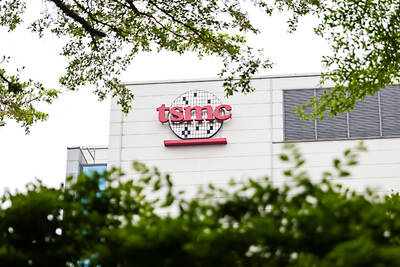
Taiwan Semiconductor Manufacturing Co (TSMC, 台積電), the world’s largest contract chipmaker, said it expects its 2-nanometer (2nm) chip capacity to grow at a compound annual rate of 70 percent from this year to 2028. The projection comes as five fabs begin volume production of 2-nanometer chips this year — two in Hsinchu and three in Kaohsiung — TSMC senior vice president and deputy cochief operating officer Cliff Hou (侯永清) said at the company’s annual technology symposium in Silicon Valley, California, last week. Output in the first year of 2-nanometer production, which began in the fourth quarter of last year, is expected to
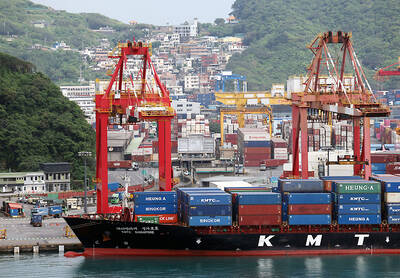
Taiwan’s economy grew far faster than expected in the first quarter, as booming demand for artificial intelligence (AI) applications drove a surge in exports, spilling over into investment and consumption, the Directorate-General of Budget, Accounting and Statistics (DGBAS) said yesterday. GDP growth was 13.69 percent year-on-year during the January-to-March period, beating the DGBAS’ February forecast by 2.23 percentage points and marking the most robust growth in nearly four decades, DGBAS senior official Chiang Hsin-yi (江心怡) told a news conference in Taipei. The result was powered by exports, which remain the backbone of Taiwan’s economy, Chiang said. Outbound shipments jumped 51.12 percent year-on-year to


 RSS
RSS