


US lawmakers slammed the Clinton administration Tuesday for taking an overly accommodating stance toward Beijing, despite White House comments that China's threat to use force to unify with Taiwan was of "grave concern."
In a white paper released Monday, China for the first time explicitly stated that it would use military force against Taiwan if it "indefinitely delays reunification." Beijing's belligerence prompted strong reaction from Washington.
In testimony to the Senate on Tuesday, Stanley Roth, Assistant Secretary of State for East Asian and Pacific Affairs, said the white paper was an attempt by Beijing to set the "one-China" framework of cross-strait dialogue before the election of Taiwan's new president next month.
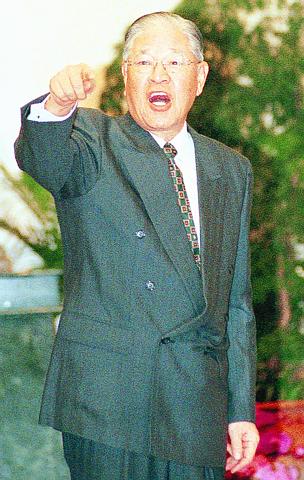
PHOTO: LEE HUNG-MING, LIBERTY TIMES
"The white paper reveals the anxiety in China about the outcome of Taiwan's election. Therefore, China was indicating their concern that whoever it is, he had best stick to the `one-China' policy and come back to the table on cross-strait dialogue," Roth said.
The US, Roth said, is urging for restraint on both sides and calling for pragmatism to restart talks after the presidential election.
"What's been very striking to me has been the moderate degree of the cross-strait issues in the Taiwan election campaign," Roth told the Senate.
"We're at a moment where all three major candidates in Taiwan have been trying to emphasize pragmatic flexible positions that could get the two parties back to the negotiating table," he said.
Roth suggested that both sides move beyond the semantics of "one-country, two systems." He urged China to come up with a more pragmatic approach, also telling the Senate that Taiwan is not interested in the Hong Kong model for reunification.
On Capital Hill, US lawmakers slammed the Clinton administration for what they see as a weak response to China's threat.
Republican Representative Ben Gilman berated the adminis-tration's policy of constructive engagement with China.
Clinton's "policy of accommodation toward Beijing is providing to be ineffective and is destabilizing the region," Gilman said, adding that "a firmer stance toward Beijing is required."
Gilman, also the chairman of the House International Relations Committee visited Taiwan last August and is a staunch supporter of the Taiwan Security Enhancement Act (TSEA) which seeks to improve military ties between the US and Taiwan and provide congressional oversight of executive decisions on Taiwan's arms purchases.
Senator John Kerry, a Democrat from Massachusetts, said Beijing's statement is "unacceptable" and that the administration had the responsibility to make sure that China "does not misinterpret where we are ... in one way or other."
"They fired missiles in 1996 and they are firing rhetoric this time to intimidate Taiwan's voters," Kerry said.
Political analysts in Washington, meanwhile, said China's white paper would exacerbate the tension between the pro-detente White House and anti-China hardliners on Capital Hill.
The Feb. 23 Taiwan defense review chaired by Republican Senator Jesse Helms was postponed because the administration declined to send a witness and as well as a failure of bipartisan negotiations last Friday.
Congressional aides from the US House of Representatives' International Relations Committee speculated that the hearing may be delayed until after Taiwan's March 18 election.
Ralph Clough, a China analyst from Johns Hopkins' School of Advanced International Studies, said the white paper is expected to create problems for the administration's discussion of TSEA and the granting of permanent Normal Trade Relations to China -- a condition of China's entering the World trade organization.
"Although the white paper would not change the fundamental in relations between the US, China and Taiwan, it comes at a bad time with a bad judgement of the domestic politics of both Taiwan and the US," Clough said.
US State Department spokesman James Rubin said the United States has conveyed its view to China and urged Beijing for more restraint.
"We have communicated to China ... the importance we attach to urging China as well as Taiwan to refrain from actions or statements that increase tensions, making dialogue more difficult to achieve," Rubin said.
Rubin said the US regards China's threat on what it sees as Taiwan's foot-dragging on reunification as a "new and troubling formulation," one that is counterproductive to creating cross-strait dialogue.
He was also quick to affirm that China's heightened belligerence "would not be a decisive factor in a military decision about a particular weapons system."
Department of Defense (DOD) spokesman Ken Bacon downplayed the possibility of US military intervention by saying Beijing's threat "is only rhetoric at this stage."
"We plan no change in force dispositions, no change in our naval dispositions in the area at this stage," Bacon said, adding the DOD will be watching the situation very closely.
The White House indicated on Monday that it would respond "appropriately" if China's actions appeared as a threat, as it did during the missile crisis of 1996 when it despatched two carrier battle groups to waters off Taiwan.

‘NO SECURITY RISK’: The Railway Bureau reassured the public that the technicians’ activities were limited to technical guidance and did not involve sensitive systems The Railway Bureau yesterday said it had invited eight Chinese technicians to assist with an airport MRT construction project. The bureau issued the confirmation after an Internet user said Chinese nationals had entered the construction zone of Taiwan Taoyuan International Airport’s Terminal 3 project. They asked why “individuals from an enemy state” were allowed access to such a major national infrastructure project, which raised serious concerns over Taiwan’s industrial safety, sensitive systems and information security. The bureau’s Northern Region Engineering Branch Office said subcontractor Taiwan Handle Industrial Co (台灣手把工業) of the Taoyuan airport MRT’s “Contract No. CU05 Project A14 Station Civil, MEP &

The National Chungshan Institute of Science and Technology yesterday showcased its locally developed variants of the Vision 60 robotic patrol dog, which it plans to deploy on the nation’s outlying territories in the South China Sea. The variants were produced under the Joint Lab project — created by the institute and domestic companies — and assembled with domestically produced motors, lenses and artificial intelligence (AI) systems alongside licensed tech from the US, Missile and Rocket Systems Research Division deputy director Jen Kuo-kang (任國光) told the media event at a military base in Taipei’s Dazhi (大直) area. Taiwan has built up its strengths

NOT IMMEDIATE: Taiwan has a chance to appeal the proposed 10 percent tariff before it starts, while other countries face a 12.5 percent tariff from the trade office Taiwan is among 60 economies determined by the US to have failed to impose or enforce a ban on the importation of goods produced with forced labor, according to a notice released on Tuesday by the Office of the US Trade Representative (USTR), which proposed imposing an additional 10 percent or more tariff on them. The USTR in a statement said that following an investigation, it had determined under Section 301 of the Trade Act of 1974 that the failure of the 60 economies to impose and effectively enforce a prohibition on the importation of goods produced with forced labor is

TIT-FOR-TAT: The US allegedly revoked the visa of a Chinese national working at Xinhua News Agency in the US in response to Beijing’s expulsion of Vivian Wang The Presidential Office yesterday condemned China for expelling a New York Times correspondent from Beijing following the newspaper’s interview with President William Lai (賴清德), saying the move highlighted Beijing’s suppression of press freedom and its threat to international news media. Taiwan has noted a series of recent incidents in which Beijing used similar tactics to “threaten and pressure international media outlets and journalists,” Presidential Office spokeswoman Karen Kuo (郭雅慧) said in a statement. “This concerns not only press freedom and freedom of expression, but also the safety of journalists, and Taiwan and relevant partners are paying close attention to the situation,” she


 RSS
RSS