


It's official: the Taipei Times is one of the world's best-designed newspapers.
The Society of Newspaper Design (SND) announced on Tuesday in Providence, Rhode Island, the results of its 1999 competition. It chose three overall winners and 36 finalists, including the Taipei Times.
It is believed to be the first time a newspaper based in Asia, outsiude of Australia, has won one of the SND's overall design awards. The Australian was the only other newspaper from Asia in the group of 36 this year.
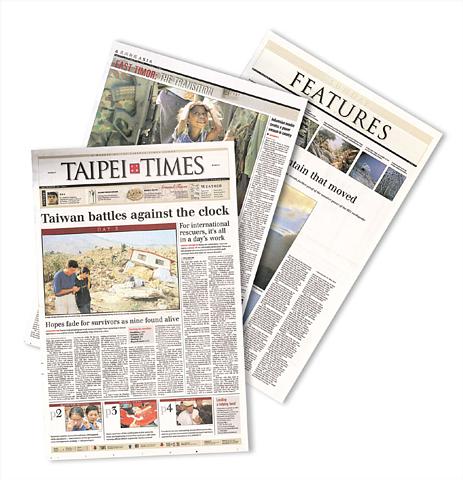
More than 14,000 entries were submitted for the prestigious awards, and the judges' panel culled these to 321 -- from 29 countries -- for the final assessment of best overall design.
The three standouts were Die Zeit and Die Woche, both from Germany, and Mural, from Zapopan, Mexico.
Other English-language finalists included the New York Times and the Detroit Free Press from the US, the Globe and Mail and the National Post from Canada, and the Independent and The Guardian from the UK.
Among non-English-language newspapers, the Liberty Times won awards for three of its features pages.
The awards have become a benchmark recognition of design excellence in the publishing industry worldwide. In its press release, the Society of Newspaper Design noted, however, that design extends well beyond the use of typography, graphics and photography. Its panel of five judges "evaluated writing, storytelling, use of resources, execution, headlines, and `voice'."
The awards will be presented at the SND's annual conference, which is being held this year in Minneapolis, Minnesota, in August.

‘NO SECURITY RISK’: The Railway Bureau reassured the public that the technicians’ activities were limited to technical guidance and did not involve sensitive systems The Railway Bureau yesterday said it had invited eight Chinese technicians to assist with an airport MRT construction project. The bureau issued the confirmation after an Internet user said Chinese nationals had entered the construction zone of Taiwan Taoyuan International Airport’s Terminal 3 project. They asked why “individuals from an enemy state” were allowed access to such a major national infrastructure project, which raised serious concerns over Taiwan’s industrial safety, sensitive systems and information security. The bureau’s Northern Region Engineering Branch Office said subcontractor Taiwan Handle Industrial Co (台灣手把工業) of the Taoyuan airport MRT’s “Contract No. CU05 Project A14 Station Civil, MEP &

The National Chungshan Institute of Science and Technology yesterday showcased its locally developed variants of the Vision 60 robotic patrol dog, which it plans to deploy on the nation’s outlying territories in the South China Sea. The variants were produced under the Joint Lab project — created by the institute and domestic companies — and assembled with domestically produced motors, lenses and artificial intelligence (AI) systems alongside licensed tech from the US, Missile and Rocket Systems Research Division deputy director Jen Kuo-kang (任國光) told the media event at a military base in Taipei’s Dazhi (大直) area. Taiwan has built up its strengths
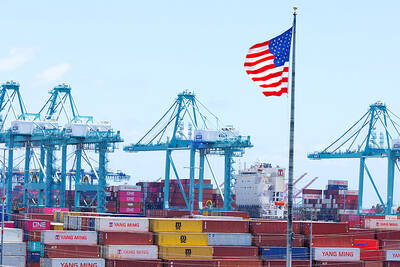
NOT IMMEDIATE: Taiwan has a chance to appeal the proposed 10 percent tariff before it starts, while other countries face a 12.5 percent tariff from the trade office Taiwan is among 60 economies determined by the US to have failed to impose or enforce a ban on the importation of goods produced with forced labor, according to a notice released on Tuesday by the Office of the US Trade Representative (USTR), which proposed imposing an additional 10 percent or more tariff on them. The USTR in a statement said that following an investigation, it had determined under Section 301 of the Trade Act of 1974 that the failure of the 60 economies to impose and effectively enforce a prohibition on the importation of goods produced with forced labor is
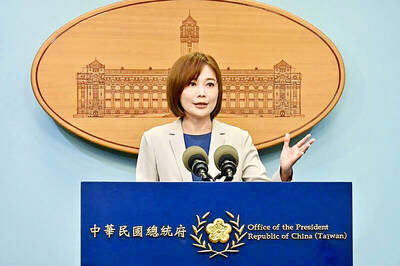
TIT-FOR-TAT: The US allegedly revoked the visa of a Chinese national working at Xinhua News Agency in the US in response to Beijing’s expulsion of Vivian Wang The Presidential Office yesterday condemned China for expelling a New York Times correspondent from Beijing following the newspaper’s interview with President William Lai (賴清德), saying the move highlighted Beijing’s suppression of press freedom and its threat to international news media. Taiwan has noted a series of recent incidents in which Beijing used similar tactics to “threaten and pressure international media outlets and journalists,” Presidential Office spokeswoman Karen Kuo (郭雅慧) said in a statement. “This concerns not only press freedom and freedom of expression, but also the safety of journalists, and Taiwan and relevant partners are paying close attention to the situation,” she


 RSS
RSS