


Former justice minister Liao Cheng-hao (廖正豪) announced his resignation from the KMT yesterday, in what is interpreted as a gesture of support for independent presidential candidate James Soong (宋楚瑜).
Liao made his announcement at a news conference yesterday, but stopped short of formally declaring his support for Soong. "I will explain things in detail at the right time," he said.
Liao is widely expected to take up the post of Soong's campaign manager.
Liao's resignation came one day before the opening ceremony for Soong's national campaign headquarters in Taipei and one day after former Legislative Yuan speaker Liu Sung-fan (
The KMT reacted angrily to Liao's resignation.
"I'm afraid Mr Liao might be questioned about severely criticizing the party and quitting the party at this sensitive moment," party spokesman Huang Hui-chen (黃輝珍) said.
Liao, a member of a powerful Chiayi County family, is believed to have snubbed the KMT partly because of his highly publicized row with Premier Vincent Siew (
DPP Secretary-General You Hsi-kun called both Liao and Liu "frustrated politicians" and said the impact of Liao's resignation will be minimal.
Liao's support will not significantly increase popular support for Soong's camp, You said.
You also called Soong's campaign team "an adventurist composition of frustrated politicians," rather than an alliance based on political concepts.

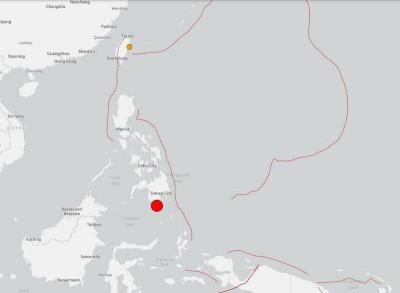
A magnitude 7.8 earthquake struck off the southern coast of Mindanao in the Philippines at 7:38am today, prompting the US Tsunami Warning System to issue an alert for neighboring countries, including Taiwan. The system issued a purple alert indicating a "tsunami threat." The potential threat zone includes Taiwan, the Philippines, Papua New Guinea, Yap and Palau. A spokesperson for Indonesia disaster mitigation agency said there were no reports of damage so far. Arlene Hollero, disaster chief of Maasim town in the Philippines' Sarangani Province, said their evacuation was underway in coastal villages and there were no reported casualties so far. DZBB radio, broadcasting from the

RESILIENCE: Taiwan plays a key role in semiconductors, energy, information infrastructure and advanced manufacturing, AIT Director Raymond Greene said Taiwan’s continued investment in deterrence and resilience remains vital, especially in uncrewed systems and other emerging technologies, American Institute in Taiwan (AIT) Director Raymond Greene said yesterday. Greene made the remarks at the annual National Strategic Summit on Supply Chain Resilience held by the Research Institute for Democracy, Society and Emerging Technology (DSET), a government-backed think tank. As Taiwan last year became the US’ fourth-largest trading partner and supply chain security is becoming more important, cooperation in emerging technologies continues to deepen between the two countries, he said. The US is committed to accelerating innovation, building key infrastructure, strengthening cooperation

The National Chungshan Institute of Science and Technology yesterday showcased its locally developed variants of the Vision 60 robotic patrol dog, which it plans to deploy on the nation’s outlying territories in the South China Sea. The variants were produced under the Joint Lab project — created by the institute and domestic companies — and assembled with domestically produced motors, lenses and artificial intelligence (AI) systems alongside licensed tech from the US, Missile and Rocket Systems Research Division deputy director Jen Kuo-kang (任國光) told the media event at a military base in Taipei’s Dazhi (大直) area. Taiwan has built up its strengths

RIGHT DIRECTION: Taiwan’s efforts to prevent forced labor include a proposal to ‘fully prohibit’ employers from withholding workers’ documents, an official said Taiwan is to establish a mechanism to restrict imports of goods linked to forced labor, the Executive Yuan said yesterday, after the US proposed imposing additional tariffs on Taiwanese goods over labor concerns. “The Ministry of Labor and the Ministry of Economic Affairs are to establish an interministerial review procedure,” Executive Yuan spokesperson Michelle Lee (李慧芝) said at a news briefing in Taipei. “The government is to use the Foreign Trade Act [貿易法] as the legal basis to restrict imports of goods produced with forced labor” and bring its supply chain governance more in line with international standards on human rights, resilience


 RSS
RSS