


President Boris Yeltsin walked out of a European security summit yesterday in a show of defiance of international condemnation of Russia's military assault on Chechnya.
His abrupt exit, more than two hours ahead of his planned flight home, followed an angry dispute over linking signature of a key charter at the 54-nation Organization for Security and Cooperation in Europe (OSCE) summit to the conflict in the breakaway Caucasian republic.
"Since there is no signing ceremony today, we have decided to leave a bit earlier. We are leaving directly now," spokesman Dmitry Yakushkin told reporters.
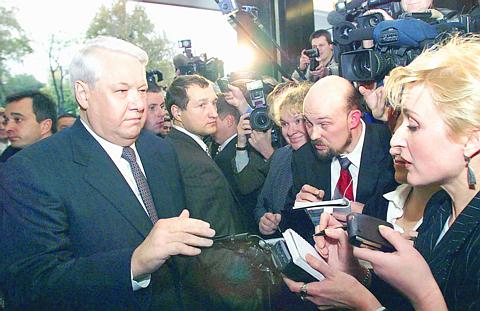
PHOTO: AFP
French officials said Yeltsin had spent barely five minutes at a meeting with French President Jacques Chirac and German Chancellor Gerhard Schroeder before cutting the talks short.
Both European leaders had used public summit speeches to slam Yeltsin's seven-week-old military offensive and urge him to seek a political solution to his conflict with Islamic rebels.
"He said he was going home to deal with Chechnya," said French presidential spokeswoman Catherine Colonna.
The West had earlier delayed the planned signing of a European Security Charter for the 21st century to demand references to Chechnya in today's final declaration at the OSCE summit.
A combative Yeltsin, on a rare outing from the Kremlin, rejected a barrage of condemnation of the air and artillery assault on Chechnya in his speech and vowed to press on with what he calls a counter-terrorism operation.
He pledged no negotiations with people he branded "bandits" and "killers" and told other leaders at the opening summit session that they had "no right to criticize Russia."
"We do not accept the advice of so-called objective critics of Russia. Those people do not understand that we simply must stop the spread of this cancer and prevent its growths from spreading across the world," Yeltsin said.
Yeltsin held bilateral talks with US President Bill Clinton after they had both addressed the summit but failed to resolve differences over the Chechnya crisis.
"He was very vigorous and so was I," Clinton told reporters of the talks. "We have a very good personal chemistry, but it didn't stop us from our clear disagreement here."
In his public speech, Clinton tempered his criticism of the military campaign with a strong expression of understanding for Yeltsin's dilemma in combating what he called terrorism.
West European leaders were more outspoken, branding Russia's action disproportionate, indiscriminate and destabilizing.
Chirac called the consequences of the onslaught for civilians unacceptable. "The current offensive is a tragic error for the whole of the region," he said.
Schroeder had declared: "War is the wrong means to combat terrorism.... The massive use of force which above all harms the civilian population therefore has to stop."
The offensive has killed hundreds of civilians and put more than 200,000 Chechens to flight. It dominated day one of the Istanbul summit, meant to plot principles and a role for the OSCE in the 21st century.
Plans to sign a landmark European Security Charter yesterday at the summit were postponed, prompting accusations by Russia that the West was holding the text hostage over Chechnya.
Russian officials have said Moscow wants no reference at all to Chechnya in any of the OSCE declarations. Western delegations are pushing for language on the proportionate use of force and the protection of civilians in the summit's final declaration.
Russian Foreign Minister Igor Ivanov, left behind by Yeltsin to handle the diplomatic fallout, told journalists: "There is an attempt to link the signing of the charter with the summit's final declaration. Some participants are trying to put formulas unacceptable to Russia, including on Chechnya, into the declaration. This link is improper."
As the OSCE wrestled with the Chechnya crisis, the UN high commissioner for refugees, Sadako Ogata, heard refugees from the rebel province tell of their plight.

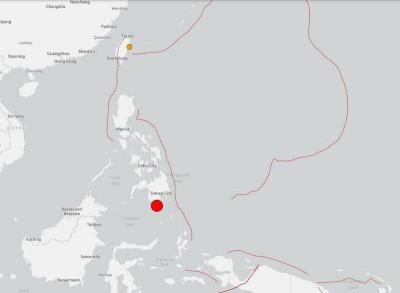
A magnitude 7.8 earthquake struck off the southern coast of Mindanao in the Philippines at 7:38am today, prompting the US Tsunami Warning System to issue an alert for neighboring countries, including Taiwan. The system issued a purple alert indicating a "tsunami threat." The potential threat zone includes Taiwan, the Philippines, Papua New Guinea, Yap and Palau. Philippine authorities were assessing the damage from the quake, with the office of civil defense seeking to verifying initial reports that 15 people had been killed and 129 injured in the region, mostly from falling debris. Arlene Hollero, disaster chief of Maasim town in the Philippines' Sarangani Province,
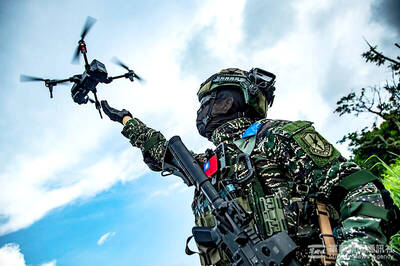
RESILIENCE: Taiwan plays a key role in semiconductors, energy, information infrastructure and advanced manufacturing, AIT Director Raymond Greene said Taiwan’s continued investment in deterrence and resilience remains vital, especially in uncrewed systems and other emerging technologies, American Institute in Taiwan (AIT) Director Raymond Greene said yesterday. Greene made the remarks at the annual National Strategic Summit on Supply Chain Resilience held by the Research Institute for Democracy, Society and Emerging Technology (DSET), a government-backed think tank. As Taiwan last year became the US’ fourth-largest trading partner and supply chain security is becoming more important, cooperation in emerging technologies continues to deepen between the two countries, he said. The US is committed to accelerating innovation, building key infrastructure, strengthening cooperation

The National Chungshan Institute of Science and Technology yesterday showcased its locally developed variants of the Vision 60 robotic patrol dog, which it plans to deploy on the nation’s outlying territories in the South China Sea. The variants were produced under the Joint Lab project — created by the institute and domestic companies — and assembled with domestically produced motors, lenses and artificial intelligence (AI) systems alongside licensed tech from the US, Missile and Rocket Systems Research Division deputy director Jen Kuo-kang (任國光) told the media event at a military base in Taipei’s Dazhi (大直) area. Taiwan has built up its strengths

RIGHT DIRECTION: Taiwan’s efforts to prevent forced labor include a proposal to ‘fully prohibit’ employers from withholding workers’ documents, an official said Taiwan is to establish a mechanism to restrict imports of goods linked to forced labor, the Executive Yuan said yesterday, after the US proposed imposing additional tariffs on Taiwanese goods over labor concerns. “The Ministry of Labor and the Ministry of Economic Affairs are to establish an interministerial review procedure,” Executive Yuan spokesperson Michelle Lee (李慧芝) said at a news briefing in Taipei. “The government is to use the Foreign Trade Act [貿易法] as the legal basis to restrict imports of goods produced with forced labor” and bring its supply chain governance more in line with international standards on human rights, resilience


 RSS
RSS