


Following a week-long guessing game, independent presidential candidate James Soong (
Speaking at a packed press conference, Soong highly commended Chang for his spirit of caring about Taiwanese society, as well as his medical expertise, outstanding management skills and a macroscopic perspective in scientific circles.
"The question of political party affiliation was the only question I have never asked Chang," Soong said, stressing the non-partisan consultation process for his choice.
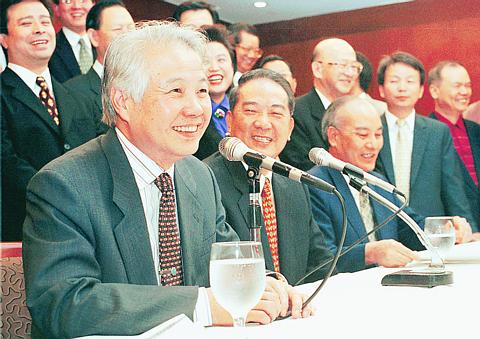
PHOTO: CHEN CHENG-CHANG, TAIPEI TIMES
Soong admitted he had already begun to search for an appropriate running-mate sometime between May and June.
"A suitable candidate must match expectations of my political ideas respecting team-work consciousness," Soong said.
Nevertheless, he said, his ideas have had to confront a backlash with reality, due to electoral considerations of winning the presidential race.
"I have had to take regional, party and ethnic background into account," Soong said.
Chang is a specialist in cardiac surgery, a native Kaohsiung City resident and a son-in law of former Tainan City Mayor Hsin Wen-ping (辛?戭? -- who was campaign manager for Lee Teng-hui (
When asked if he could draw on his surgical skills in politics, Chang replied: "I believe that under an environment of teamwork, I can come up to speed quickly. After the presidential voting next March 18, there should be no doubts anymore as to my ability."
Citing the words of Formosa Plastics Group chairman Wang Yung-ching (
Chang said he had personally delivered his decision to Wang Wednesday night. "Wang was apparently astonished by my move -- he kept silent for several moments, and then advised me to be prepared to make sacrifices for the island."
His comments, however, produced stern denials from officials at Formosa Plastics.
FPG general manager Wang Yung-tsai (?y揖牘b), -- Wang Yung-ching's brother -- said yesterday his brother "was very unhappy about Chang's announcement. Our company has never gotten involved in politics, and if Chang is determined to take part in the impending presidential campaign, he has no other alternative but to resign his post at Chang Gung immediately."
Meanwhile, Vice President Lien Chan(
"In democracies, it is normal for a presidential candidate to choose his running-mate -- it is not worth any particular attention," said Lien Chan's spokesman, Ting Yuan-chao (
Critics, meanwhile, said compared with the other two tickets -- the KMT's Lien-Siew pairing and DPP's pairing of Chen Shui-bian (
Julian Kuo (3?翰G), a political strategist from Soochow University, said Chang's academic background and the fact he is a native Taiwanese could offset Soong's weakness in being mainland-born.
"The Soong-Chang ticket has complementary aspects, such as a symbolic balancing between northern and southern Taiwan and more significantly, a middle ground between native Taiwanese and mainland-born Chinese," Kuo said.
"Such a veiled, unstated demonstration of approval by the Wang family over Chang's cooperation with Soong, means that the native Wang family -- who had earlier pledged to support Lien Chan -- has attempted to back both sides of the presidential race; perhaps other conglomerates may follow in Wang's path," Kuo said.
"If that happens, it would have great negative impact on Lien's campaign," said Kuo, referring to the solid conglomerate support Lien now enjoys.
Kuo said there is another trump card in Soong's hand to defend against a possible attack over his mainlander identity.
"If Soong can preserve his popularity at the number one spot in the presidential race sometime around next January, then Soong could possibly declare the current senior advisor to Presidential Office Wu Poh-hsiung (
"In this way, Soong could justifiably claim he has already made a government crossing both partisan and ethnic boundaries."
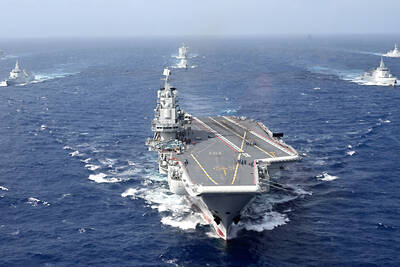
PROVOCATIVE: Chinese Deputy Ambassador to the UN Sun Lei accused Japan of sending military vessels to deliberately provoke tensions in the Taiwan Strait China denounced remarks by Japan and the EU about the South China Sea at a UN Security Council meeting on Monday, and accused Tokyo of provocative behavior in the Taiwan Strait and planning military expansion. Ayano Kunimitsu, a Japanese vice foreign minister, told the Council meeting on maritime security that Tokyo was seriously concerned about the situation in the East China and South China seas, and reiterated Japan’s opposition to any attempt to change the “status quo” by force, and obstruction of freedom of navigation and overflight. Stavros Lambrinidis, head of the EU delegation to the UN, also highlighted South China Sea

SILENCING CRITICS: In addition to blocking Taiwan, China aimed to prevent rights activists from speaking out against authoritarian states, a Cabinet department said The Ministry of Foreign Affairs (MOFA) yesterday condemned transnational repression by Beijing after RightsCon, a major digital human rights conference scheduled to be held in Zambia this week, was abruptly canceled due to Chinese pressure over Taiwanese participation. This year’s RightsCon, the world’s largest conference discussing issues “at the intersection of human rights and technology,” was scheduled to take place from tomorrow to Friday in Lusaka, and expected to draw 2,600 in-person attendees from 150 countries, along with 1,100 online participants. However, organizers were forced to cancel the event due to behind-the-scenes pressure from China, the ministry said, expressing its “strongest condemnation”
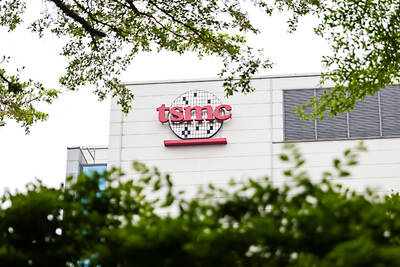
Taiwan Semiconductor Manufacturing Co (TSMC, 台積電), the world’s largest contract chipmaker, said it expects its 2-nanometer (2nm) chip capacity to grow at a compound annual rate of 70 percent from this year to 2028. The projection comes as five fabs begin volume production of 2-nanometer chips this year — two in Hsinchu and three in Kaohsiung — TSMC senior vice president and deputy cochief operating officer Cliff Hou (侯永清) said at the company’s annual technology symposium in Silicon Valley, California, last week. Output in the first year of 2-nanometer production, which began in the fourth quarter of last year, is expected to
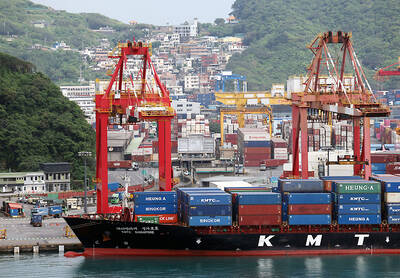
Taiwan’s economy grew far faster than expected in the first quarter, as booming demand for artificial intelligence (AI) applications drove a surge in exports, spilling over into investment and consumption, the Directorate-General of Budget, Accounting and Statistics (DGBAS) said yesterday. GDP growth was 13.69 percent year-on-year during the January-to-March period, beating the DGBAS’ February forecast by 2.23 percentage points and marking the most robust growth in nearly four decades, DGBAS senior official Chiang Hsin-yi (江心怡) told a news conference in Taipei. The result was powered by exports, which remain the backbone of Taiwan’s economy, Chiang said. Outbound shipments jumped 51.12 percent year-on-year to


 RSS
RSS