


The Hsintien Line of Taipei's Mass Rapid Transit (MRT) system is to open today and, despite last-minute glitches, residents, officials and traffic experts yesterday had high hopes for the the line's ability to improve the commute from Taipei County to Taipei City.
The line connects Hsintien City in Taipei County, via Taipei Railway Station in the city center, with the coastal town of Tamshui.
On Tuesday -- the first day the Taipei Rapid Transit Corporation (TRTC) began new transference mechanisms in preparation for the line -- computer failures and insufficient information for MRT staff and passengers made for delays and confusion.
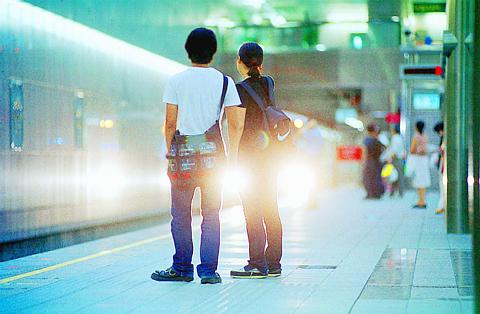
PHOTO: CHEN CHENG-CHANG, TAIPEI TIMES
Passengers travelling from Chungho's Nanshih Chiao station to Tamshui station must now transfer lines at any one of the stops between Kuting and Peitou. Previously, they could travel directly between the two stops.
The southern section of the Hsintien line, from Kuting to Hsintien station, will open today. Passengers will be able to travel directly from Hsintien to Tamshui without changing trains.
Although minor improvements were seen during yesterday's morning rush hour, train delays and breakdowns began Tuesday morning
During the Tuesday evening's rush hour, the computer system which controls the speed and timing of trains broke down, with drivers forced to switch between manual and automatic controls in order to stop and start at stations, local media reported.
Because the main computer could not give out speed signals, trains were delayed up to 20 minutes. In some stations, there were reports of one-minute gaps between trains travelling in the same direction. Rapid stops and starts in tunnels sent passengers lurching during the afternoon rush, reports said.
Many passengers complained that they did not know that the new transfer system began on Tuesday and that signs on trains were unclear where they should transfer.
The situation appeared to have improved somewhat during yesterday's morning rush hour.
TRTC president Richard Chen (
TRTC sent extra staff members to MRT station platforms yesterday to help guide passengers transferring trains, Chen said.
Trains were running closer to schedule yesterday, with the longest wait on the Chungho line at nine minutes during the morning rush hour.
Residents along the southern section of the Hsintien line said these defects made tomorrow's inauguration of the new line seem shaky.
Chung Yu-ping (鍾瑜?), resident near the Chichang station, said: "I had planned to travel to Tamshui from the Hsintien station tomorrow, but these problems made me a bit worried ... Besides, whenever I pass by the Chichang station, I feel that the station still looks a bit unprepared for tomorrow's opening."
Even so, residents, officials and experts said they are still looking forward to the opening of the new line -- which, they said, not only brings Taipei city and county closer together but should help revitalize the Hsintien area by making it more accessible.
Su Tseng-chang (蘇-s昌), Taipei County Commissioner, told the Taipei Times that the new line will "greatly" improve the commute from Taipei County to Taipei City.
"Travelling from Hsintien to Taipei railway station by car or bus can take you up to eighty minutes, but MRT passengers on the new line will spend only 18 minutes or so," Su said.
Hsu Lin-chiu (
Lin Neng-pai (
Citing similar situations after the opening of the Chungho and Tamshui lines as examples, Lin predicted that many residents near the line would take the MRT to work instead of driving their own vehicles into the city, cutting down on traffic congestion.
The opening of the line can also benefit the Hsintien area economically, Lin said.
"Since the line will shrink the distance from Hsintien to downtown Taipei, companies which look for cheaper rent may move into Hsintien and this will gradually bring prosperity to Hsintien," Lin added.
Su said the new line is expected to bring 30,000 tourists over the weekends to the famous sightseeing spot of Pitan (
To attract more visitors to Hsintien, Su said: "We've started to renovate the Pitan suspension bridge -- the site many used to visit when in love, including me and Premier Vincent Siew (蕭萬長) -- and to add facilities in the scenic area"
See Also:
MRT

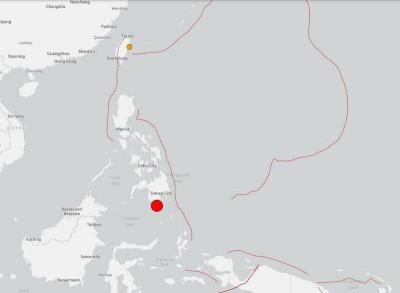
A magnitude 7.8 earthquake struck off the southern coast of Mindanao in the Philippines at 7:38am today, prompting the US Tsunami Warning System to issue an alert for neighboring countries, including Taiwan. The system issued a purple alert indicating a "tsunami threat." The potential threat zone includes Taiwan, the Philippines, Papua New Guinea, Yap and Palau. There were no immediate reports of major damage in the Philippines or Indonesia. The quake struck at a depth of 10km, said the German Research Centre for Geosciences, which had earlier pegged the earthquake at magnitude 8.2. Phivolcs, the Philippine agency, said the quake was magnitude 7 and

RESILIENCE: Taiwan plays a key role in semiconductors, energy, information infrastructure and advanced manufacturing, AIT Director Raymond Greene said Taiwan’s continued investment in deterrence and resilience remains vital, especially in uncrewed systems and other emerging technologies, American Institute in Taiwan (AIT) Director Raymond Greene said yesterday. Greene made the remarks at the annual National Strategic Summit on Supply Chain Resilience held by the Research Institute for Democracy, Society and Emerging Technology (DSET), a government-backed think tank. As Taiwan last year became the US’ fourth-largest trading partner and supply chain security is becoming more important, cooperation in emerging technologies continues to deepen between the two countries, he said. The US is committed to accelerating innovation, building key infrastructure, strengthening cooperation

The National Chungshan Institute of Science and Technology yesterday showcased its locally developed variants of the Vision 60 robotic patrol dog, which it plans to deploy on the nation’s outlying territories in the South China Sea. The variants were produced under the Joint Lab project — created by the institute and domestic companies — and assembled with domestically produced motors, lenses and artificial intelligence (AI) systems alongside licensed tech from the US, Missile and Rocket Systems Research Division deputy director Jen Kuo-kang (任國光) told the media event at a military base in Taipei’s Dazhi (大直) area. Taiwan has built up its strengths

RIGHT DIRECTION: Taiwan’s efforts to prevent forced labor include a proposal to ‘fully prohibit’ employers from withholding workers’ documents, an official said Taiwan is to establish a mechanism to restrict imports of goods linked to forced labor, the Executive Yuan said yesterday, after the US proposed imposing additional tariffs on Taiwanese goods over labor concerns. “The Ministry of Labor and the Ministry of Economic Affairs are to establish an interministerial review procedure,” Executive Yuan spokesperson Michelle Lee (李慧芝) said at a news briefing in Taipei. “The government is to use the Foreign Trade Act [貿易法] as the legal basis to restrict imports of goods produced with forced labor” and bring its supply chain governance more in line with international standards on human rights, resilience


 RSS
RSS