

I like to think of myself as a fairly laid-back person. Other people’s behavior is not my business. There is one notable exception: my gym nemesis.
He brings his computer to the gym and takes work conference calls at full volume. He has four to six pairs of dumbbells around him at all times — then doesn’t put them away. Intellectually I understand he is a fragile, flawed human like the rest of us, but in my gut I sometimes wonder if he arrived here from another galaxy.
Life is full of unspoken rules, and the gym is no different. The heavy weights, sweaty people and mysterious machines can make it daunting to figure out how to behave. So we asked fitness experts for their thoughts on gym etiquette — their biggest pet peeves as well as the behaviors that might seem intimidating, but are actually fine.
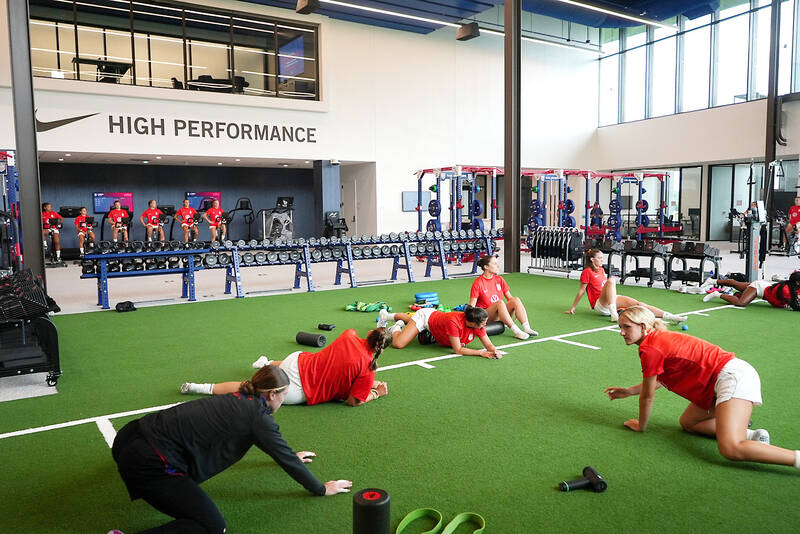
Photo: Reuters
Good gym etiquette is less about following a long list of rules than it is simple respect, says Mathew Forzaglia, a fitness professional and educator. “Respect the equipment, respect other people’s time and space, and respect the shared environment,” he says.
GYM DON’TS
DON’T LEAVE A MESS
Whether it’s leaving a bench covered in your sweat, or not re-racking weights after you use them, failing to clean and reset equipment after you use it is not only a hygiene issue, it’s potentially unsafe.
Leaving out heavy plates or dumbbells “creates an accessibility issue for people who physically can’t move the weight someone else abandoned,” says Amanda Katz, a New York City-based personal trainer and run coach.
As for wiping off your sweat, “it’s common courtesy and takes just a few seconds,” Forzaglia says. “No one wants to lie down on a bench covered in someone else’s sweat.”
DON’T HOARD EQUIPMENT
If you’re planning to do a complex circuit training routine that involves having access to six machines at once, save it for a home workout or tweak it to be more sequential.
“You can’t claim the cable machine and the leg press and three sets of dumbbells,” says Laura Girard, certified personal trainer, strength coach and founder of The Energy Academy in New York City. “Learn to share.”
DON’T OFFER UNSOLICITED ADVICE
It can feel intoxicating to think you know better than others. Spot someone across the gym doing deadlifts with what you think is bad form, and it might be tempting to go over and give them a few tips. Don’t.
“Unless someone is in immediate danger, I don’t think it’s appropriate to offer coaching to strangers,” Katz says. Most of us are not fitness professionals, and even if we are, we don’t know why someone might be training the way they are.
“There are countless reasons an exercise might look different than expected — from injury rehabilitation to a coach’s programming,” Katz says.
Other people’s bodies and how they train them are not your business. “Never assume you know somebody’s goals or body better than they do,” Girard says.
DON’T BE LOUD
Whether it’s playing your pump-up playlist sans headphones, grunting loudly through exercises — or, as I encountered in my gym just the other week, a man shouting “LET’S GO!” before every set of shoulder shrugs — being loud is not fair or pleasant for your fellow gym-goer.
“Everyone deserves their own playlist and to not have their nervous system frayed by a random shout when they’re already doing something vulnerable and uncomfortable,” Girard says.
PHONE ETIQUETTE
Resting between sets is normal and fine — more on this later. But monopolizing a machine because you’re scrolling social media, answering e-mails or taking calls is not.
“The gym is for training,” Forzaglia says. “If you need to catch up on your phone, step outside for a minute.”
Don’t show up late to a group class
“I understand that life happens and sometimes you’re running late,” says Jessie Diaz-Herrera, co-founder and fitness instructor at Power Plus Wellness in New York City. But walking into a class 15 or 20 minutes late can be extremely disruptive to other participants, and potentially present a safety issue “if the instructor has already gone through the warm-up or explained the movements”, she says.
GYM OKAYS
DO TALK TO PEOPLE
While unsolicited advice is never welcome, this doesn’t mean you have to completely ignore other people at the gym.
“Most people at the gym are either also new, or love the gym and would be happy to chat your ear off,” Girard says.
As long as you don’t interrupt someone in the middle of a set, Girard says it’s “totally OK to approach for a quick form check or help with equipment.” (But wait for a go-ahead or an invitation from them to strike up a longer conversation.)
It’s also fine to politely ask someone how many sets they have left, or if you can work in between their sets, Forzaglia says.
“Most experienced gym-goers appreciate respectful communication,” he says. “I’d much rather someone ask than stand around waiting or skip an exercise because they felt uncomfortable speaking up.”
DO REST BETWEEN SETS
Although you shouldn’t disappear into your phone for long stretches, resting on or around equipment for a minute or two between sets of exercise is normal and expected.
“Rest is part of strength training and Hiit protocols, and most people understand that,” Katz says. “You don’t need to rush through your workout to look like you belong or keep your heart rate up unless it’s the intention of the session.”
DO RECORD YOURSELF
Recording your workout is not inherently rude, Diaz-Herrera says. “A lot of people use videos to check their form, track their progress or create content,” she says.
The important thing is to not intentionally film others.
If you think you might be in someone’s video and don’t want to be, Diaz-Herrera says it’s absolutely OK to ask whether you appear in frame, and if they mind moving the camera or cropping you out.
“That’s not being difficult or making a big deal out of it,” she says. “It’s just communicating and respecting each other’s space.”
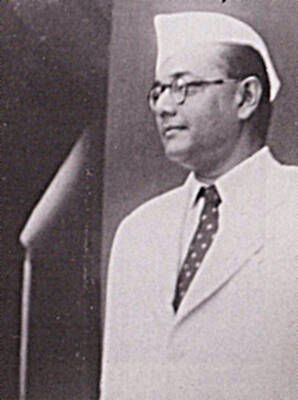
Aug. 17 to Aug. 23 Subhas Chandra Bose was meant to be in Taiwan for no more than two hours. After refueling at today’s Songshan Airport in Taipei, the Mitsubishi Ki-21 bomber carrying the Indian independence leader took off for Japan — and crashed almost immediately. It was Aug. 18, 1945, three days after Japan announced its surrender to the Allies. Bose, who advocated armed struggle to free India from British rule, had worked closely with Imperial Japan. He was attempting to reach the Soviet Union via Manchuria in the hope of gaining support

The Tzu Chi Foundation, the globally known Buddhist charity, announced on July 21, 2021 that it had signed a deal to purchase 5 million doses of the Pfizer-BioNTech (BNT) COVID-19 vaccine. It said that the vaccine doses would be donated to the government’s COVID vaccine program. In October the Centers for Disease Control (CDC) made a public announcement thanking the Buddhist foundation and others for the 889,200 doses of the BNT vaccine they had collectively donated. FRAUD Earlier this month, the public was stunned to learn that prosecutors had indicted former Changhua Bar Association chairwoman, Chen Yu-hsuan (陳昱瑄), and others on suspicion

These few weeks will decide who ends up on the ballot, and who does not, in this year’s elections. Registration closes on Sep. 4, but until then, politicians may drop in or drop out of the race. Both the pan-green Democratic Progressive Party and the its supporters (DPP) and the pan-blue Chinese Nationalist Party (KMT) have nominated 19 candidates for 22 of the top-level mayor and county commissioner posts. The KMT is also promoting a “great opposition alliance” in the remaining three, backing two independents and one candidate from the KMT-aligned Taiwan People’s Party (TPP). For more context and a

An interesting essay in the spring issue this year of International Security by Kerby Davis and Eugene Gholz explores the possibilities and outcomes of simulated missile attacks by the People’s Republic of China (PRC) on Taiwan’s ports to carry out a blockade. “Substantively,” they conclude in Blockade by Fire: China’s Potential to Blockade Taiwan Using Missile Attacks on Ports, “our article raises serious concern about Taiwan’s vulnerability to Chinese military coercion. Even if Taiwan and the United States take steps to better prepare for a Chinese blockade, they face a greater threat from China than analysts previously believed.” The authors


 RSS
RSS