

In 2009, the tech billionaire Peter Thiel published an essay with the portentous title The Education of a Libertarian, in which he announced: “I no longer believe that freedom and democracy are compatible.” Since the 1920s, he wrote, “the vast increase in welfare beneficiaries and the extension of the franchise to women” had rendered the notion of “capitalist democracy” an oxymoron. To be fair, Thiel still seems happy to exercise his freedom to extract money from democracies, via his co-founding of Palantir, which was lately given lots of money by the government.
Thiel calls himself, as many such do, a “classical liberal,” but Daron Acemoglu argues that his ilk still has much in common with left-liberals. All of them, he writes, agree on “the desirability of basic individual rights and freedoms (including the right not to be coerced and the freedoms of expression, religion, association and choice); constraints on power, especially political power; and broad protections for equality before the law.”
On his telling, by the mid-20th century democracy with liberal characteristics had amply proved its worth: blue-collar labor was generously rewarded, and there was a sense of “shared prosperity.”
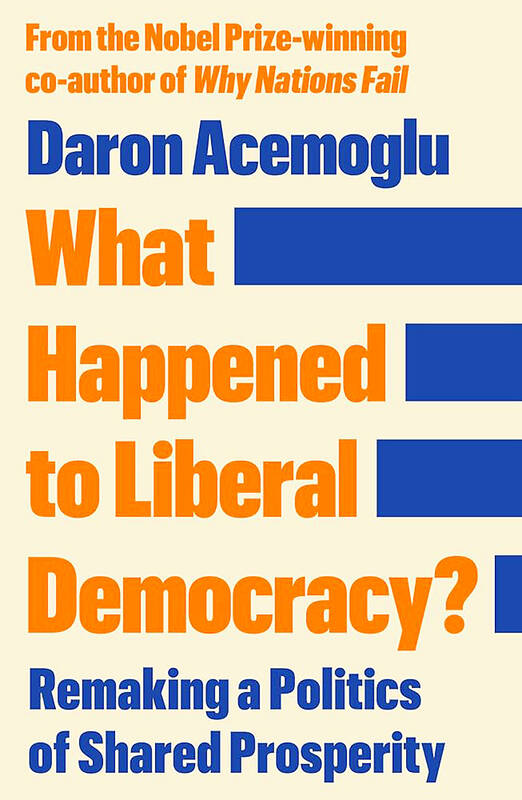
But now, he argues, liberal democracy is in a crisis, largely owing to the abandonment of the working class by liberalism’s “progressive” wing. In post-industrial Europe and the US, the left ceased to speak of economic class and spoke instead of identity. It is a similar diagnosis to that offered by the French sociologist Didier Eribon in his Retour a Reims, and indeed by Bernie Sanders, who has spoken of “a Democratic party which has abandoned working-class people,” but Acemoglu is happier to wield culture-war rhetoric even as he deplores the culture wars. He accuses the left, for example, of being obsessed with both “social engineering” (via diversity initiatives) and “thought policing,” which is impossible (he means speech policing).
His solution is a new contract of “working-class liberal democracy,” which concentrates on improving the standard of living of the least educated or skilled. This is to be done by focusing on economic growth (reducing, for example, the regulatory hoops one must apparently jump through to become a hairdresser or a masseur), encouraging more community decision-making (possibly imitating the citizens’ assemblies used in the Republic of Ireland) and making social media companies responsible, as publishers, for the messages they promote to users (good luck!). He suggests legislating in favor of “worker AI,” by which employees could use expert systems based on machine-learning to help them be more productive, so that nurses, for instance, could take more medical decisions. (He doesn’t report having consulted doctors on this idea.)
Acemoglu is a smooth and intelligent writer, and there is much in here to fascinate, particularly when he is on home turf: there is a brilliant explanation of why the American tax code perversely incentivizes automation and job destruction, and how the enviable happiness of Norway and Sweden, far from being a result of some innate Nordic wisdom, followed deliberate economic reforms enacted as recently as the 1930s. He is also laudably ready to admit when there is no “ready-made answer” to liberalism’s tensions — between, say, a value of community cohesion and a value of welcoming others who are different.
But his expansive rhetoric does lead to some internal inconsistencies. Acemoglu denounces throughout the progressive-liberal elites in exactly the same way as modern populists do (Farage-like, he even says liberalism’s troubles have reached “boiling point”). Yet, having eased the reader through a potted history of the ideas of Rousseau, Hobbes, Locke, Mill, Kant, Voltaire et al, he concedes that liberalism itself was the invention of a small bunch of clever people: “an ideology created by a highly learned group of philosophers.”
So maybe elites are good, sometimes? And Acemoglu can hardly escape the charge that his own book — one written by a Nobel-winning economist, no less — is itself an example of the kind of top-down “elite debates” he claims to think are sterile. Nor should he try to, because the charge would be stupid; indeed, the kind of thing that an elite billionaire like Peter Thiel would say.
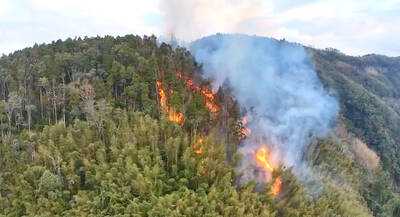
It is forest fire season in Europe and North America, and the news is filled with harrowing images of disastrous fires filling the air with smoke. What about Taiwan? Taiwan has a unique forest fire profile. Unlike other nations, where the threat peaks in the dry summer months, that period is wet. Instead, major forest fires typically occur during October to April, when the country is drier. Moreover, “high temperatures are not the primary drivers of forest fires” as a study in Theoretical and Applied Climatology noted. Rather, the consensus is that dryness is the trigger of forest fires here, with

When Gary Melyan, a longtime Taiwan resident who died on July 7 at age 83, arrived in Taipei for the second time in 1971, he was a graduate student trying to complete a doctoral thesis on the Taiping Rebellion. Wanting to assemble some fellow academics for a regular meal, he initiated a Saturday lunch, which quickly shifted to Saturday dinner. Then, sometime in 1974 or 1975, it became a weekly Wednesday night meal. Melyan never finished his PhD, but the weekly Wednesday dinner, now known as the Wednesday Night Old Farts (WNOF), has continued for more than half a century

The next three weeks will be intense for the Chinese Nationalist Party (KMT) and Democratic Progressive Party (DPP) ahead of candidate registration for this year’s local nine-in-one elections. Registration opens Aug. 31 and ends on Sept. 4. The Central Election Commission (CEC) will vet the candidates and if they pass muster, the formal list of candidates will be released on Oct. 16. Election day is Nov. 28. Both parties are afraid of breakaway party members running as independents, challenging their nominees and splitting the vote. KMT Chair Cheng Li-wun (鄭麗文) is in overdrive, and the DPP has enlisted former president
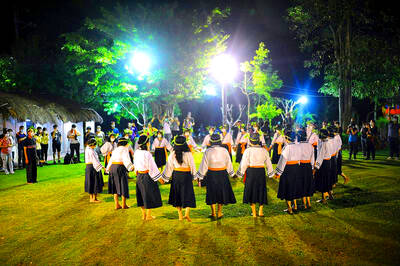
Aug.10 to Aug.16 Yuko remembers getting into frequent fights with children from neighboring villages who called him huana (番仔), a derogatory term for Indigenous people meaning “savage.” “I was mad because they made fun of me. I had no idea that it had anything to do with my identity,” the Pataran (北投洋) resident in Tainan’s Jiali District (佳里) told me when I visited in 2019. Yuko’s experience was not unusual among the Siraya and other Pingpu (plains Indigenous) groups, who hid their Indigenous identity amid stigma and discrimination, leaving later generations unaware of their ancestry. When anthropologist Melissa J. Brown


 RSS
RSS