

It is forest fire season in Europe and North America, and the news is filled with harrowing images of disastrous fires filling the air with smoke. What about Taiwan?
Taiwan has a unique forest fire profile. Unlike other nations, where the threat peaks in the dry summer months, that period is wet. Instead, major forest fires typically occur during October to April, when the country is drier. Moreover, “high temperatures are not the primary drivers of forest fires” as a study in Theoretical and Applied Climatology noted. Rather, the consensus is that dryness is the trigger of forest fires here, with wind speed, not temperature, the key wild card that is shaped by human-driven climate change. Another study in the same journal of the 1991-2021 period observed, forest fires have increased 3.8 times, with severe dry months occurring more frequently. The situation is worsening over time.
A 2024 study in the Journal of Applied Meteorology and Climatology of fire conditions in Taiwan observes that wildfire probability rises due to “prolonged droughts during the summer and fall enhance fuel aridity, deplete groundwater, and deteriorate vegetation.” It also says that tracking groundwater conditions prior to droughts enables prediction of wildfires, because the presence of groundwater lowers the possibility of fires.
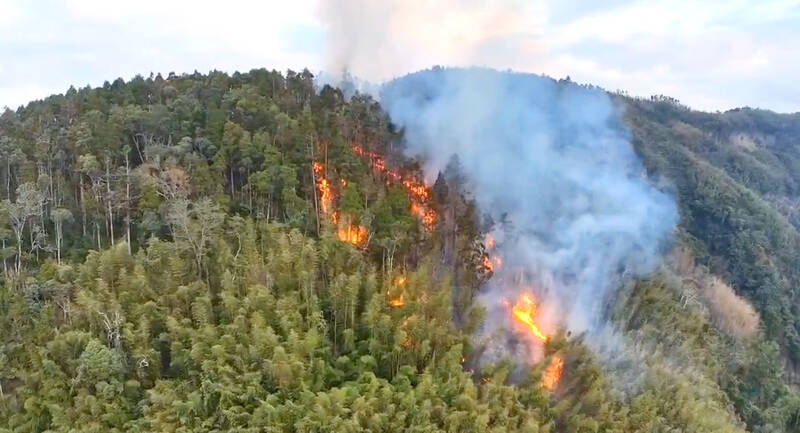
Photo courtesy of a reader
A forest fire in Yunlin in January above Caoling offers a glimpse of the kinds of threats offered by forest fires. The fire was difficult to contain because of the lack of water sources and the steep slope. Once contained, the burnt out area, devoid of live vegetation, became a landslide risk to the local infrastructure. A larger fire a month later struck Nantou County, requiring aircraft from the Army’s Aviation and Special Forces command and the National Air Service Corps (NASC) of the Ministry of the Interior (MOI) to suppress it.
NASC was formed in 2004, partly in response to the Pachang Creek (八掌溪) disaster in Chiayi County in 2000, when the government failed to mount an air rescue of four men trapped by rising waters. They were eventually swept to their deaths, causing public outrage and massive changes in the search and rescue system.
HUMAN-CAUSED FIRES
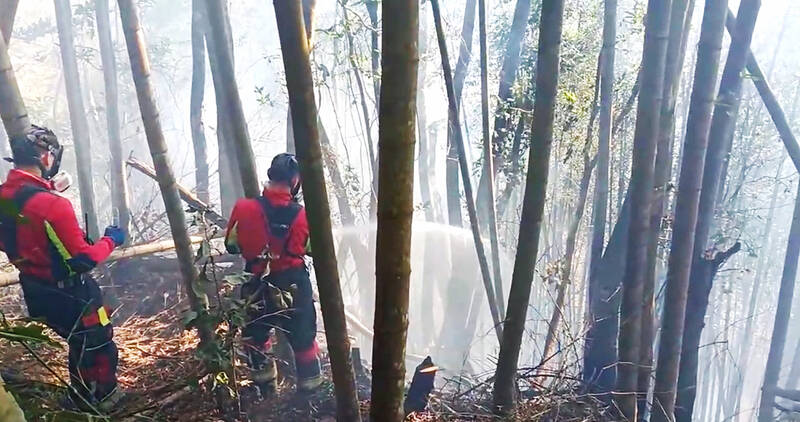
Photo courtesy of Chen Jung-bin
The vast majority of forest fires are caused by the direct action of humans: arson, campfires, burning of incense sticks, trash burning, construction, and so forth. The Deputy Minister of the Council of Agriculture, Huang Chin-cheng (黃金城), in 2021 warned people to be especially careful during the tomb sweeping season, noting that nearly 40 percent of fires over the previous eight years (125 incidents), occurred during March and April.
Because outsiders penetrating the mountain forests is relatively new, forest fires are seen as a recent threat. Nevertheless, the government’s forestry agency considers it a serious threat, and much energy is expended on preventing human behaviors that cause fires. Prevention is also a priority because the rugged, remote terrain creates special challenges for fighting forest fires.
The recent novelty of forest fires has other implications. “While Taiwan faces challenges akin to other wildfire-prone regions, wildfires remain relatively unfamiliar to Taiwanese society as environmental incidents,” says a paper last year in the International Journal of Disaster Risk Reduction on strategic decision-making in forest fire control. It also notes that forest fire management tends to prioritize stability even where overall benefits are reduced, and tends to be risk-averse, both traits of bureaucracies the world over. A 2022 Environmental Impact Assessment column by Steven Crook in this paper says that “For much of the postwar period, the main goal of forest management in Taiwan was timber production.” According to forestry scientist Lin Chau-chin (林朝欽), who Crook interviewed for the column, this means that fire management “totally ignores” the role of fire in forest ecosystems.
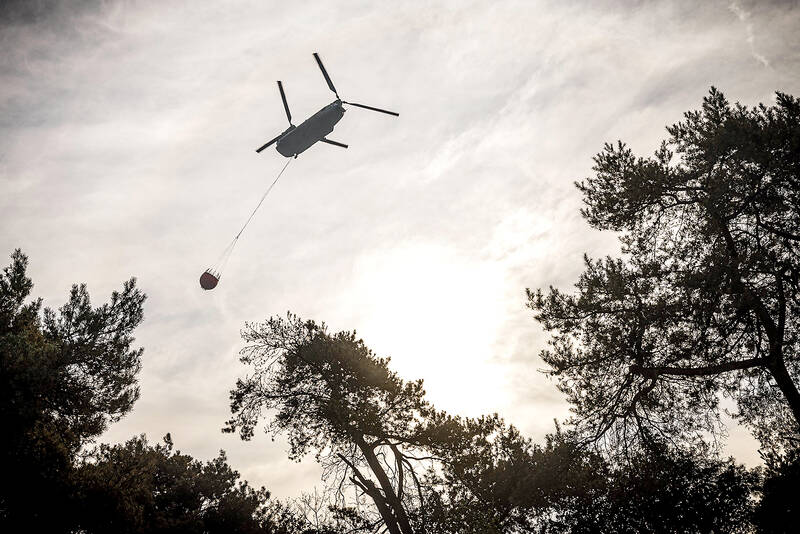
Photo: EPA
Lin also argues that climate change is making forest fires more difficult to suppress, citing the May 2021 fires in Yushan that were fought for 12 days. Consuming 70 hectares of forest, they were finally put out not by people, but by two days of heavy rains. The fires were (of course) started by human beings, apparently arson related to illegal logging, according to media reports.
The Yushan fire recalled another famed forest fire, the 1993 Tataka Fire (塔塔加) that impact 280 hectares of trees and took six days to put out. “Fortunately,” said an old Taiwan Panorama piece, “most of the afforestation areas that burned contained pulp trees, whose economic value is not very high.” Fourteen years after the fire, vegetation still had not recovered.
To fight forest fires, the Forestry and Nature Conservation Agency operates an overall command center, with district offices hosting subordinate commands. It also hosts a total of 43 emergency firefighting teams and 78 general firefighting teams, along with 35 observation stations. All those facilities require warm bodies.
DEMOGRAPHIC CRISIS
Rising fire threat is one of the many urgent issues bumping up against the demographic crisis. Taipei Times report in November last year said that the nation is short 2,000 firefighters for fighting building fires, while a May article from Merit Times put the gap at 6,000. The Taipei Times’ article said that fire squads in urban areas are short-staffed and heavily overworked, under especially brutal pressure since they usually do double duty as emergency medical responders, and in some areas perform trivial tasks such as snake catching. Ratios of fire fighters to the general population are much lower than elsewhere in developed Asia.
It should be noted that even if the mountain firefighters are fully staffed, such staffing can only come at the expense of urban units, since the pool of individuals willing to become firefighters is not large, and they must pass a battery of tests that weed out many candidates. The demographic strain on the firefighting system as a whole will only grow as Taiwan faces longer dry periods in the future.
There is an obvious answer to the shortage of firefighting personnel in the face of rising fire threats in the lowlands and in the mountain forests: migrant workers. And there is an obvious answer to the source of migrant workers: runaways. What better way to integrate them back into the system than to bring them in with an amnesty if they become volunteer firefighters or even work in support roles, carrying water, pruning brush to create firebreaks or fire-spotting. Thousands of them are already present in the mountains and are familiar with local areas.
Firefighting is only the most dramatic area where migrant workers could be applied, more mundane tasks are already seeing their use. International students, who are sadly often treated as de facto migrant workers, are already being considered for bus driving in cities and intercity buses after graduation. That need too is driven by labor shortages.
However, having immigrant workers in the role of firefighter, a visible social role important for society, will put a dent in Taiwan’s xenophobia and racism, a major stumbling block to permitting inflows of immigrant workers. For a nation facing chronic labor shortages in every labor domain, such tolerance will be a key to its survival.
Notes from Central Taiwan is a column written by long-term resident Michael Turton, who provides incisive commentary informed by three decades of living in and writing about his adoptive country. The views expressed here are his own.
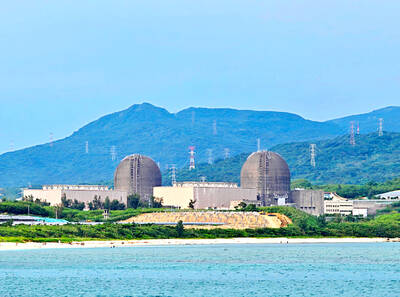
The referendum, the regulator and the budget settle whether Taiwan wants reactors. Fuel fabrication, enrichment and the back end decide whether it can run them. Taiwan pays to store nuclear fuel in the US that it has never burned. Taiwan Power Co (Taipower, 台電) bought the bundles for the Lungmen Nuclear Power Plant in New Taipei City’s (新北市) Gongliao District (貢寮), which never opened; lawmakers ordered them shipped back to the manufacturer in 2018, and the last 120 left in March 2021. Keeping them there costs the utility NT$100 million to NT$200 million a year, chairman Tseng Wen-sheng (曾文生) said in

The next three weeks will be intense for the Chinese Nationalist Party (KMT) and Democratic Progressive Party (DPP) ahead of candidate registration for this year’s local nine-in-one elections. Registration opens Aug. 31 and ends on Sept. 4. The Central Election Commission (CEC) will vet the candidates and if they pass muster, the formal list of candidates will be released on Oct. 16. Election day is Nov. 28. Both parties are afraid of breakaway party members running as independents, challenging their nominees and splitting the vote. KMT Chair Cheng Li-wun (鄭麗文) is in overdrive, and the DPP has enlisted former president

Every functioning country on Earth maintains a national archive to preserve its official records. In Taiwan, that institution is the National Archives Administration (檔案管理局, NAA), a unit of the government’s National Development Council. Since September last year, part of the NAA’s purpose-built headquarters in New Taipei City’s Linkou District (林口) has been open to the public. The National Archives (國家檔案館) store and showcase documents generated through the day-to-day operations of government agencies. Covering defense, education, economic development, health, and other policy sectors, what’s displayed here will appeal to anyone with an interest in the country’s history — although having some Chinese

In August of 1939 Nazi Germany and the Soviet Union concluded an agreement on credit that enabled trade between the two dictatorships to boom. This was followed by two economic agreements in February of 1940 and January of 1941. By the summer of 1940 the Soviet Union “had become the most important supplier of raw materials” to Germany, accounting for almost a third of its oil imports. A year later Nazi Germany invaded the Soviet Union, its most important trade partner. This history, and that of Imperial Japan, which at one point pursued belligerent policies that were to bring it into


 RSS
RSS