


Nested in Taiwan’s historical Walled City, a new exhibition invites visitors into the worlds of architect Chan Yi-chung (詹益忠) and illustrator Lin Li (林俐).
During his opening remarks, National Taiwan Museum (NTM) Director Chen Teng-chin (陳登欽) said that the exhibition, A Living Museum: Sketches of the World Through the Gaze, blends macro-architectural observation and micro-life experiences.
Passersby are invited to pause their busy day and enter the space to travel through time and space between Chan’s architectural records and Li’s travel illustrations.
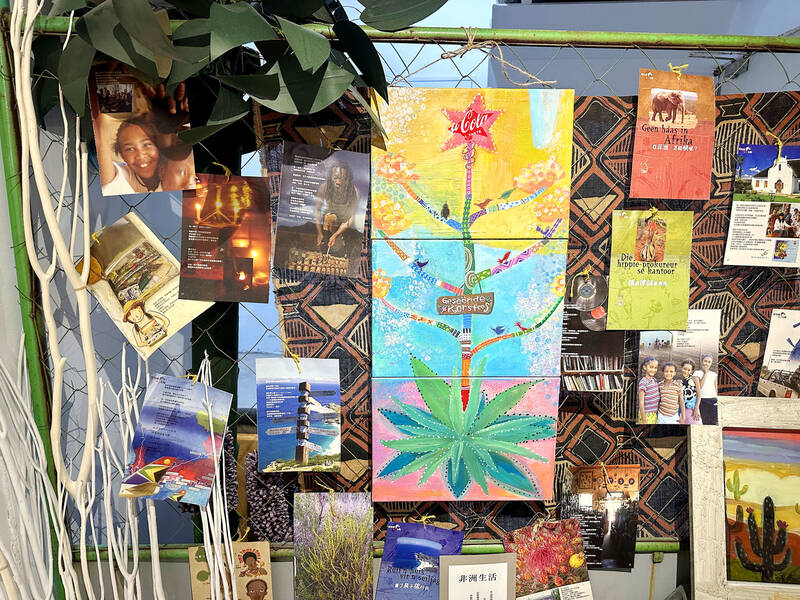
Photo: Bonnie White
REDEFINING CULTURAL MEMORY
Founded in 1908, during Japanese colonial rule, the National Taiwan Museum is Taiwan’s oldest. Its collections are rooted in natural science, conservation and history.
With the Small Living Room, launched in February as the NTM’s latest extension, the museum shifts scale.
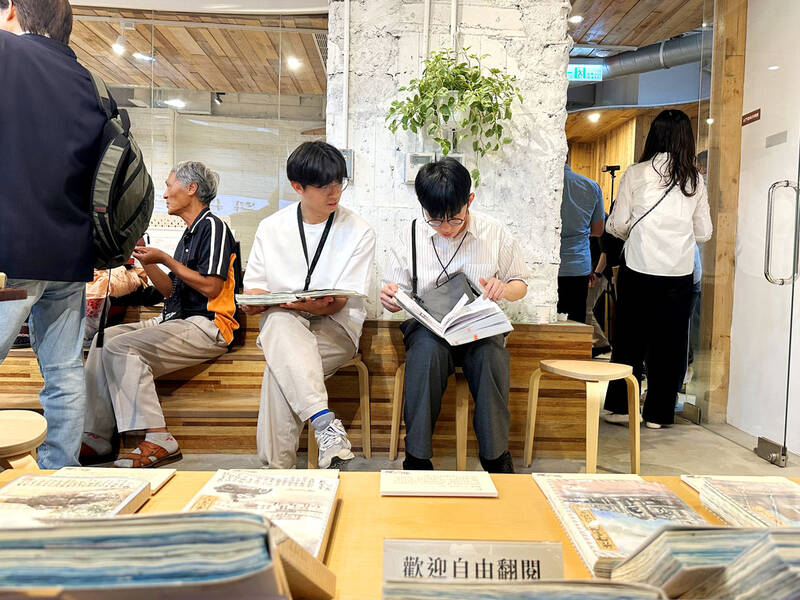
Photo: Bonnie White
It leaves the glass case behind and enters a setting closer to a home, a studio and a place where people might stop on their way somewhere else.
“The major purpose of this space is simply to create a space for people to get in touch with art and cultural topics,” said Phaedra Fang (方慧詩), assistant researcher at the NTM.
ARCHITECTURAL WONDERS
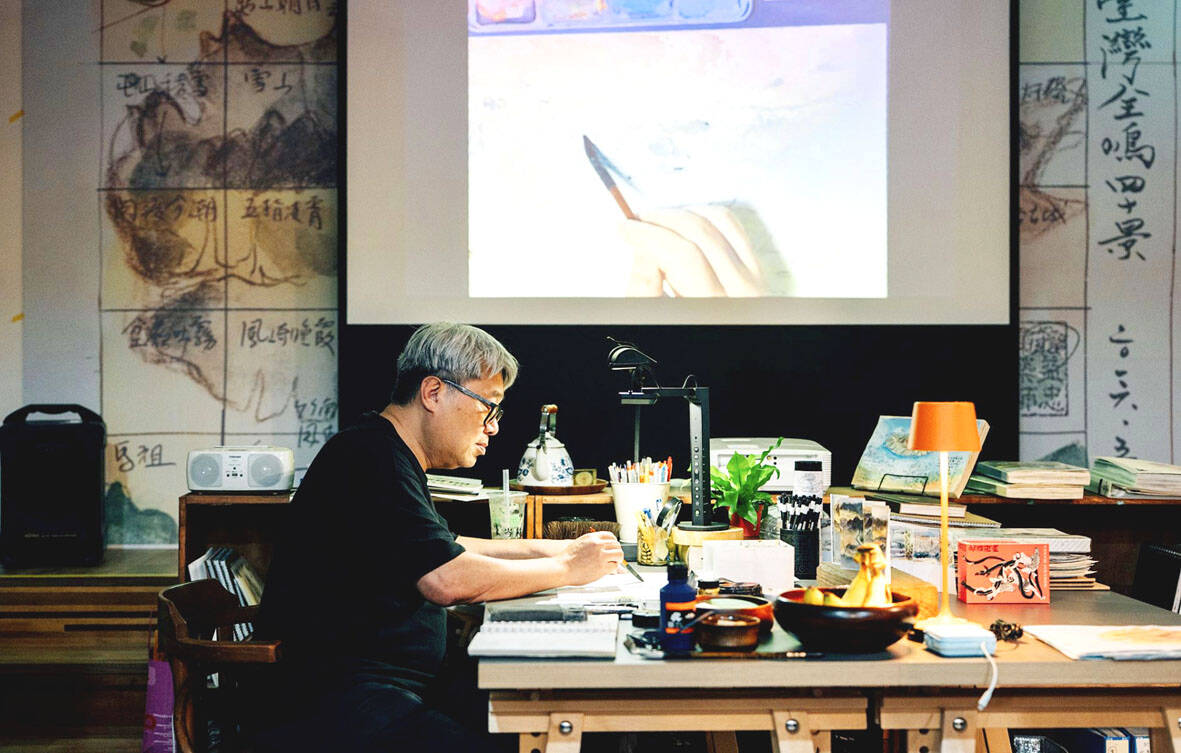
Photo: Bonnie White
Chan, who was responsible for the historical site renovation of the NTM’s South Gate area, animates living environments and old buildings through colorful paintings and technical sketches.
Each structure holds labor, damage, repair and memory.
Stacks of journals fill the first room of the exhibition. Visitors are encouraged to sit, lean in, turn the pages and follow the movement of Chan’s hand.
Seated on wooden stools and benches, they move through his colorful watercolors, detailed meeting notes and fine-lined building sketches as if traveling across time through his records.
The room feels less like an exhibition hall than a workshop still in use.
Pens, papers, fruit, a plant and a lamp gather around Chan’s desk. The scene suggests that the artist has stepped away and might return at any moment.
Lucky for us, he does. Chan will host illustration sessions on Tuesdays, Thursdays and Saturdays at 2pm, offering visitors a glimpse into his creative process.
If Chan’s room asks visitors to look at what remains in place, Lin’s room follows what moves.
ILLUSTRATING TRAVEL STORIES
Artist Lin Li is famous for her vibrant, landmark-filled illustrations. For this exhibition, she converted the space into a time capsule, inviting visitors to travel along her illustrated memories.
Her space gathers travel sketches, paintings, notes, objects and traces from the road.
Blending colorful paintings, engaged art and interactive installations, Li’s work challenges traditional travel experiences.
Taiwanese often speak too much about food when they travel, while missing how other societies learn, gather and live, Lin said.
Lin does not begin a journey with a guidebook. Before she visits a country, she reads their literature and watches their movies — the rest to be discovered on the journey.
Her sketches of Europe and Africa are based on days spent moving through public libraries, opera houses, grocery stores, streets and churches.
Boarding passes, hotel card holders and other readily available media become part of the exhibition. They show travel not as arrival, but as collection of encounters.
After seeing Europeans leave candles in churches, Lin created a place where visitors can choose one of her colorful handcrafted candles, roll a wish inside and place it into gravel-filled pots.
At the back of her room, a kitchen-like corner waits near a window.
A table sits where light enters from the garden outside. It feels like the end of a journey, when people put down their bags and begin to speak.
While Chan records places before they vanish. Lin gathers moments before they fade. Both artists use drawing to hold what time keeps moving past.
The exhibition does not ask visitors to hurry through. It asks them to sit, turn a page, follow a line, read a trace and notice how memory is made by hand.


Taiwan’s English education system is being pulled apart by three opposing forces. Bilingual Nation 2030 pulls students toward English and global communication. Artificial Intelligence (AI) readiness pulls them toward digital judgment, verification and AI-mediated work. But Taiwan’s old exam culture pulls them back toward memorization, grammar drills, timed reading and correct answers. If the education system keeps using old exams to define success, it risks producing graduates who are neither genuinely bilingual nor genuinely AI-ready, but trained for tasks machines can already perform. The first force is Bilingual Nation 2030. Launched in 2018, the policy aimed to “help Taiwan’s workforce connect

“Taiwan’s Opposition Leader Comes to US With a Message Straight Out of Beijing” read a May 31 headline in the Wall Street Journal. Top US administration officials and members of Congress almost certainly read the WSJ, and if there was a bullet point takeaway that people in Washington should absorb ahead of Chinese Nationalist Party (KMT) Chair Cheng Li-wun’s (鄭麗文) arrival in DC on June 9, that headline is it. The last few columns have discussed this very topic, and the timing is not coincidental. While those top officials likely do not read the Taipei Times, judging by the number
With weighty, anxiety-inducing geopolitical topics dominating the headlines, checking in on the wild and weird state of local politics can take some of the edge off. This November’s elections will determine who will be in charge of fixing potholes in your neighborhood, not the potholes in Taiwan’s complicated geopolitical space. Recently, after an online interview with a Taipei-based journalist, I commented that Taipei journalists never go further than the MRT can take them. He laughed and agreed. Naturally, the Taipei mayoral race is eating up much of the press attention. TAIPEI CITY Democratic Progressive Party (DPP) candidate Puma Shen (沈伯洋) has
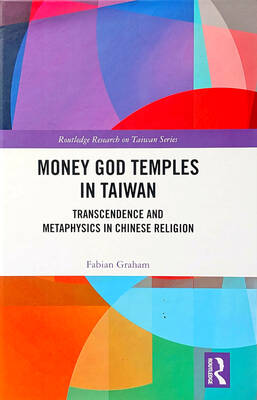
As someone who normally steers clear of books with “transcendence” or “metaphysics” in their subtitles, this reviewer — a casual observer of local belief systems since the 1990s — found Fabian Graham’s Money God Temples in Taiwan a challenging read. Those who’ve only dipped their toes into temple culture will likely need to parse several sections with special care if they’re to keep up with the author, a British ethnographic researcher whose previous books have investigated religious practices among ethnic Chinese in Southeast Asia. This scholarly volume examines a facet of Taiwan’s religious landscape that didn’t exist a century ago, and


 RSS
RSS