

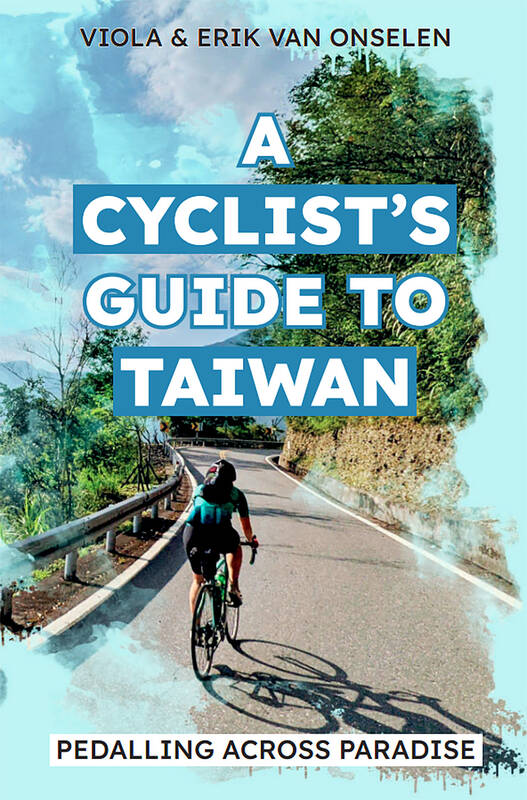
It’s surprising, given how many foreign velocipedists say they’ve been profoundly inspired by Taiwan, that so few cycling-focused English-language books about the country have appeared. Online booksellers list almost nothing apart from Mark Tovell’s Taiwan: Roads Above the Clouds (“A ‘love letter to Formosa,’” reviewed April 25, 2024). This new offering, however, goes quite a long way to making up that deficit.
Compiled by a couple from that great cycling nation, the Netherlands, this guide describes 50 numbered routes around the country. The authors — who recently completed PhDs at Taiwanese universities — have made a commendable effort to give each region its due: N1 to N11 are north of Hsinchu County; W1 to W10 are in the west (a grouping of counties that others might refer to as “Central Taiwan”; E1 to E10 are in and around Hualien; S1 to S10 are in the south (which in this book includes Taitung and its islands, plus Penghu County); while X1 to X9 are seasonable or otherwise special routes.
The shortest route is S6, a 20km circumnavigation of Green Island. The longest is X5, a “spicier version of the classic North-South Taiwan Lighthouse Challenge (一日雙塔).” The Chinese name of that annual event translates as “one day, two lighthouses,” as riders try to cover the 520km within 28 hours. The van Onselens sensibly advise those thinking of taking their modified route from Fugui Cape Lighthouse (富貴角燈塔) in the north to Eluanbi Lighthouse (鵝鑾鼻燈塔) in the south “to set aside at least five days to fully enjoy” its 700km. During this epic pedal, they’ll need to climb through Yangmingshan National Park (陽明山國家公園), tackle the North Cross-Island Highway (北橫公路), and go up and over Highway 23 for total elevation gains of 8,500m. Most of the book’s other routes are between 100km and 150km in length.
Because color photos accompany each outline, directions and brief coverage of highlights is for many of the routes compressed into less than 400 words. The authors do as good a job as can be expected given the space available. The text is clear in both senses of the word: the font is highly readable, while the wording is uncomplicated and to the point.
The same can’t be said for the maps, unfortunately. They’re attractive yet the place names are too small for comfortable reading. For each route, however, there’s a QR code through which you can download a map. This saves you the trouble of squinting, as well as the modest weight of the actual book if you prefer to travel ultralight. Every entry comes with Google Maps Plus Codes for three or four points of interest, typically one of which is a place where riders can find coffee, ice cream and other restoratives.
The introductory chapter of A Cyclist’s Guide to Taiwan rightfully praises Taiwan’s roads for being “impressively well-maintained, even in the most remote mountain areas.” But there’s no mention of feral dogs, even though most regular riders say they’ve had to speed up to get away from aggressive canines. I was also surprised that the writeup for W7 — from Shuili (水里) in Nantou County to Tataka (塔塔加) inside Yushan National Park — fails to warn cyclists that gravel trucks can make the lower part of the New Central Cross-Island Highway (新中橫公路) a scary place for those on two wheels.
W9 connects Chiayi City with Alishan (阿里山) via Provincial Highway 18, which is the road used by all tour buses and public buses as well as the majority of private vehicles. Having been up that way many times (but never by bicycle, I’ll admit), I’d recommend taking the narrower and much quieter Road 159A (159甲) as far as Shihjhuo (石棹), and only using Highway 18 for the final 26km when there’s no alternative. In the pages of this newspaper, Michael Turton called 159A “the prettiest road on the island” (“Cover your eyes: the Tourism Bureau is at it again” Sep. 6, 2021). Overall, however, it’s hard to find fault with the selection of routes.
The book says cyclists can find information about road closures and traffic conditions on the Web site of the Freeway Bureau. This has to be a mistake, as bikes aren’t allowed on freeways or expressways. Around two years ago, the official English name of what A Cyclist’s Guide to Taiwan calls the East Rift Valley (花東縱谷) was changed to the East Longitudinal Valley (which is correct; it’s not a true rift valley).
Some of the references to government units are out of date. Taiwan Railway Administration (TRA) is now Taiwan Railway Corp (TR). The Tourism Bureau has been upgraded to the Tourism Administration, and the Central Weather Bureau likewise promoted to Central Weather Administration. Perhaps only civil servants — or individuals, like this reviewer, who spend part of each workweek proofreading government publications — will notice or care. Everyone else should find this guide useful and/or inspirational. It might even spur the writing of a few more Taiwan cycling books.
A Cyclist’s Guide to Taiwan is available at several bike stores around the country and can be ordered online. See: onsgo.org for details.

Mark Carney built a global profile this year by standing up to US President Donald Trump. If some prediction-market traders and prominent admirers are right, the Canadian prime minister could end the year with the Nobel Peace Prize and Time magazine’s Person of the Year. Carney briefly became the favorite Monday for the 2026 Nobel Peace Prize on Kalshi, a US-based prediction market, when traders on the exchange put his chances at 14 percent. His odds later fell, illustrating the highly speculative nature of the wagering. There is no public evidence Carney is on the Nobel Committee’s secret shortlist for the prize

There was a time, a few decades ago, when the men who owned the world’s biggest pornography businesses were happy to be famous. They paraded a lifestyle they hoped looked glamorous, appearing in public dressed in silk pajamas or with a woman in swimwear on each arm. Porn moguls like Hustler’s Larry Flynt or Playboy’s Hugh Hefner were household names. “Say what you want about these old perverts, who once set the tone of our sexual culture, but at least you knew who they were and what they were selling,” Patricia Nilsson writes in her new book, Guilty Pleasure: The Pornification

Speculation started to fly last month that Chinese Nationalist Party (KMT) candidates running in the November elections wanted to keep their distance from party Chair Cheng Li-wun (鄭麗文). That some in the KMT were concerned that Cheng’s firm ideological adherence to the “one China principle” is no secret. There had already been pushback from within the party on issues ranging from the budget to defense, as well as over some of her more hardline comments. The timing made sense, however. The KMT party congress unity love fest wrapped up at the end of July. Through the primaries and up to

The spectacular rise of the Taiwan Stock Exchange (TWSE) in recent months has fueled great excitement among individual stock traders. Gate News reported that the stock market swelled 59 percent in the first half of this year, with margin trading volume surging nearly 20 percent. Local newspapers tell stories of stock buying “on the margin” by individual investors, often with dire results. The implication is that small investors are teetering on the brink of disaster should there be a market “correction.” How real is this threat? This scenario actually occurred this summer. In July the market fell nearly 4,000 points. “The


 RSS
RSS