


The Marshall Islands has introduced a national universal basic income (UBI) scheme that offers payments via cryptocurrency, alongside more traditional methods, which experts say is the first scheme of its kind in the world.
Under the program, every resident citizen of the Marshall Islands will receive quarterly payments of about US$200 as part of a government effort to ease cost of living pressures. The first instalments were paid late last month and recipients can choose whether the money is paid into a bank account, by check or delivered as cryptocurrency on the blockchain through a government-backed digital wallet.
“We the government want to make sure no one is left behind,” Marshall Islands’ minister for finance David Paul said.
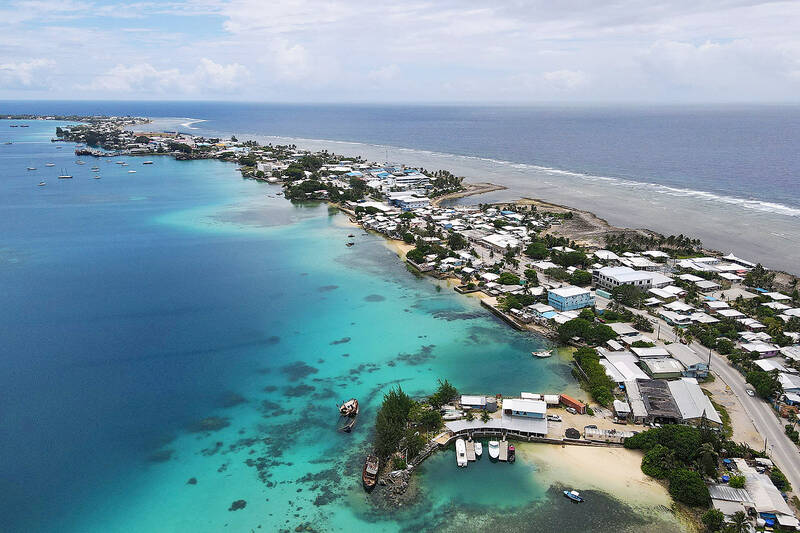
Photo: Reuters
“US$200 per person per quarter, which is about US$800 a year, does not compel you to quit your job … but it’s actually like a morale booster for people.”
An archipelago in the Pacific Ocean, the Marshall Islands lies between Hawaii and Australia, and has a population of about 42,000. Paul said the payments were intended as a “social safety net” as the country faces rising costs and citizens leaving.
The UBI scheme is financed by a trust fund created under an agreement with the US, which in part aims to compensate the Marshall Islands for decades of American nuclear testing. The fund holds more than US$1.3 billion in assets, with the US committing a further US$500 million through to 2027.

Photo: Reuters
Huy Pham, associate professor and crypto-fintech lead at RMIT University, said the Marshall Islands scheme “is the world first for a national rollout of a UBI program.” He said the use of blockchain technology is “unique in terms of a nation-wide implementation.”
The cryptocurrency delivery option — which involves the transfer of a digital token known as a stablecoin, pegged to the US dollar — was designed to address the practical challenge of delivering the money across hundreds of remote islands.
“We saw the opportunity in what the blockchain has to offer,” Paul said.

Photo: Reuters
Blockchain is best known as the technology behind bitcoin and other cryptocurrencies, but can also be used to store and transfer more traditional assets — like government bonds — which the Marshall Islands is using to underpin their digital payment scheme.
But according to Pham, digital payments alone do not necessarily provide financial inclusion, especially in a country like the Marshall Islands where Internet connectivity is patchy and frequently disrupted.
“Improving Internet coverage, improving smartphone penetration — all these kinds of things are the minimum for a blockchain-based economy,” he said.
Most recipients are choosing to receive payments through conventional channels. According to the Marshall Islands Social Security Administration, about 60 percent of the first round of payments were deposited directly into bank accounts, with the remainder issued as paper checks. Only a small number of people — about 12 so far, officials say — have signed up to receive payments on their digital wallet
Anelie Sarana, the finance manager involved in the rollout, said over the past year her team has travelled to the outermost islands of the country to register people in the scheme.
Sarana said many recipients were using the money immediately for basic needs, like food and essentials, while others used the US$200 to pay for celebrations to commemorate the annual Gospel Day holiday which coincided with the first distribution.
“I know they’re happy, because you can see in the streets, there’s so much traffic, it’s like there’s a big something happening,” she said.
This is not the first time the Marshall Islands has experimented with using cryptocurrency. In 2018, the government attempted to create a national cryptocurrency known as the Sovereign, or SOV. The plan ultimately stalled after warnings from the International Monetary Fund (IMF).
The IMF has cautioned that while the technology underpinning the latest scheme is innovative, the blockchain-based delivery of universal basic income carries “financial, fiscal, legal, reputational and financial integrity risks,” particularly if governance and oversight are not robust.
Monique Taylor, a lecturer in world politics at the University of Helsinki, said it was hard to predict if the Marshall Islands’ experiment with a universal basic income and a cryptocurrency delivery system would succeed.
“Universal income schemes are rare, particularly at national scale, and there are no direct precedents that combine this fiscal architecture with a digital delivery component in a small island state,” she said.
But, she believed the scheme did present benefits for small island nations.
“In a geographically dispersed island state where conventional banking infrastructure can be limited, a digital wallet may lower frictions and make transfers more accessible, particularly in outer atolls,” she said.

Exceptions to the rule are sometimes revealing. For a brief few years, there was an emerging ideological split between the Democratic Progressive Party (DPP) and Chinese Nationalist Party (KMT) that appeared to be pushing the DPP in a direction that would be considered more liberal, and the KMT more conservative. In the previous column, “The KMT-DPP’s bureaucrat-led developmental state” (Dec. 11, page 12), we examined how Taiwan’s democratic system developed, and how both the two main parties largely accepted a similar consensus on how Taiwan should be run domestically and did not split along the left-right lines more familiar in

As I finally slid into the warm embrace of the hot, clifftop pool, it was a serene moment of reflection. The sound of the river reflected off the cave walls, the white of our camping lights reflected off the dark, shimmering surface of the water, and I reflected on how fortunate I was to be here. After all, the beautiful walk through narrow canyons that had brought us here had been inaccessible for five years — and will be again soon. The day had started at the Huisun Forest Area (惠蓀林場), at the end of Nantou County Route 80, north and east

This month the government ordered a one-year block of Xiaohongshu (小紅書) or Rednote, a Chinese social media platform with more than 3 million users in Taiwan. The government pointed to widespread fraud activity on the platform, along with cybersecurity failures. Officials said that they had reached out to the company and asked it to change. However, they received no response. The pro-China parties, the Chinese Nationalist Party (KMT) and Taiwan People’s Party (TPP), immediately swung into action, denouncing the ban as an attack on free speech. This “free speech” claim was then echoed by the People’s Republic of China (PRC),

Specialty sandwiches loaded with the contents of an entire charcuterie board, overflowing with sauces, creams and all manner of creative add-ons, is perhaps one of the biggest global food trends of this year. From London to New York, lines form down the block for mortadella, burrata, pistachio and more stuffed between slices of fresh sourdough, rye or focaccia. To try the trend in Taipei, Munchies Mafia is for sure the spot — could this be the best sandwich in town? Carlos from Spain and Sergio from Mexico opened this spot just seven months ago. The two met working in the


 RSS
RSS