


Sobs could be heard across Hong Kong’s Victoria Park last weekend as hundreds of migrant workers mourned victims of Hong Kong’s worst fire in decades and prayed for missing friends.
Many found themselves in limbo after the disaster.
At least 10 of the 146 people killed in the fire that devastated the high-rise towers of Wang Fuk Court were migrant workers, an often overlooked segment of the workforce.
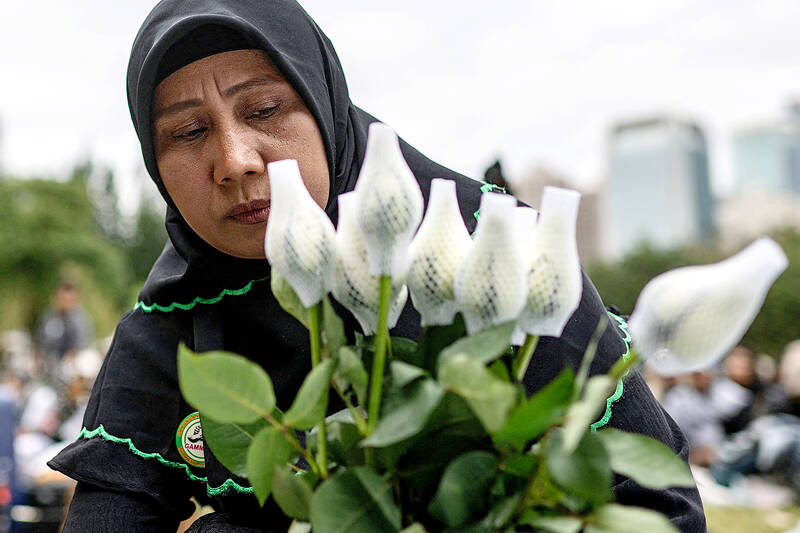
Photo: AFP
Dozens more are unaccounted for, according to information from consulates.
Hong Kong is home to nearly 370,000 migrant domestic workers, predominantly women from the Philippines and Indonesia caring for infants and the elderly in a city with an ageing population.
Migrant workers typically have Sundays off and prayers were held in neighbourhoods across the city. Attendees spoke of friends who had gone missing and how support efforts for survivors at times fell short.
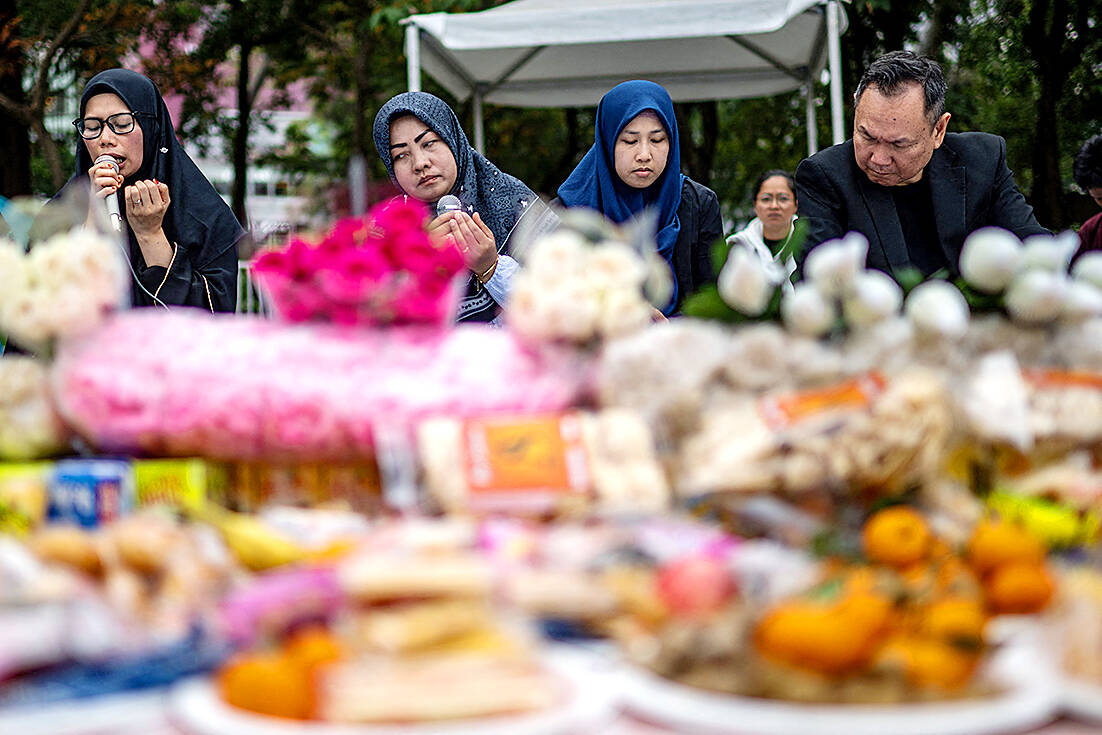
Photo: AFP
Sudarsih, an Indonesian woman who has worked in Hong Kong for 15 years, said two of her friends were still missing.
“God bless, they will be found quickly and are safe,” she said.
Those at the Victoria Park event sang hymns and prayed near a banner on the ground that read: “Dearly departed ones: highest respect and recognition to the loyalty and bravery of migrant domestic workers.”
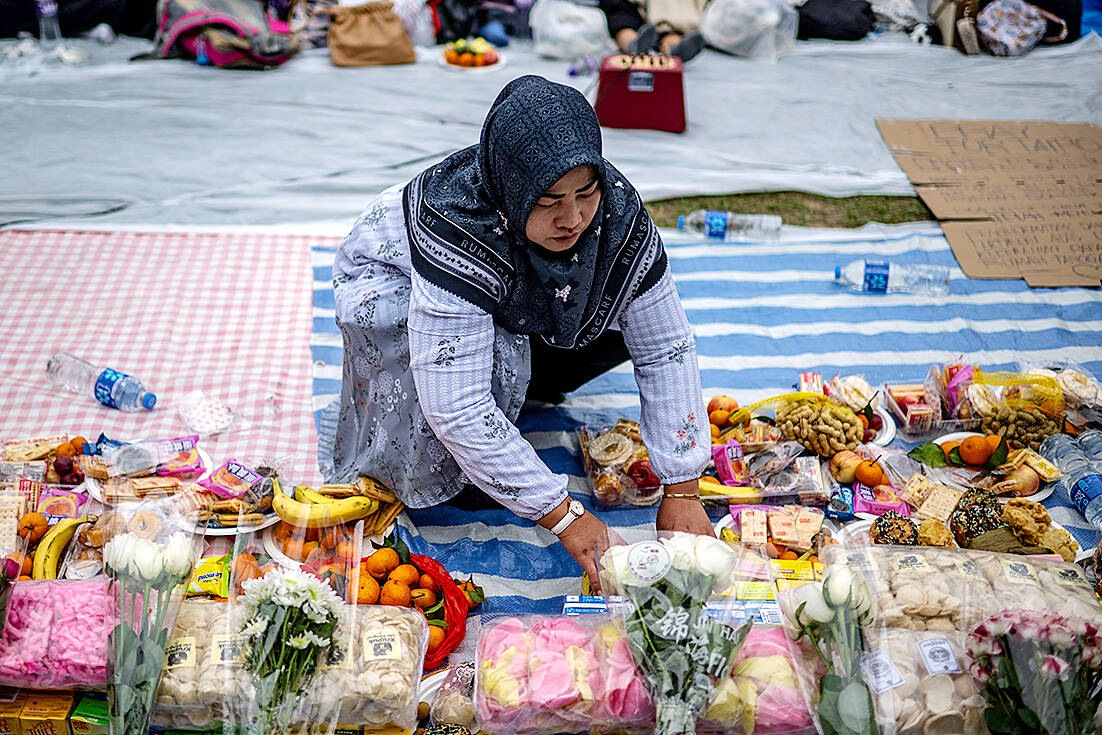
Photo: AFP
Dwi Sayekti, 38, said she hoped the disaster would be the “first and last.”
“I hope in the future, it doesn’t happen again. And all of those who lost their lives in Tai Po can be found,” she said in a broken voice.
Across town, in Hong Kong’s central business district, around 100 Filipino workers held a prayer meeting at their usual Sunday gathering spot with glittering office buildings looming overhead.
“We are praying that hopefully there will be no more casualties in this fire tragedy,” said Dolores Balladares, chairwoman of United Filipinos in Hong Kong.
DUTY
Many of the well-wishes were directed towards Rhodora Alcaraz, a young woman from the Philippines who started working in Hong Kong just a few days before the tragedy.
In an unverified but widely circulated account of events, Alcaraz shielded her employer’s three-month-old infant with her body when the fire broke out.
When firefighters found them in the smoke-filled apartment, she was still cradling the baby.
Alcaraz was reportedly admitted to an intensive care unit, though her latest condition has not been confirmed.
Fellow migrant worker Michelle Magcale said she felt “so sad” and “speechless” upon hearing the news.
“I can’t express how sad it is,” the 49-year-old said.
“On behalf of her duty, on behalf of her responsibility, she saved one more life... we are thankful for that,” she added.
Balladares, the Filipino group leader, said, “We also salute her because she gave her best... to protect the family.”
Manila’s consulate in Hong Kong said a woman named Maryan Pascual Esteban was killed in the fire, leaving behind a 10-year-old son and her family in Cainta, Rizal.
One Filipino national was injured and the status of seven others had yet to be verified, the consulate added.
Jakarta’s consulate said nine Indonesians were killed in the fire with one injured and 42 others currently unaccounted for.
SUPPORT NEEDED
More than 50 survivors have sought help from the Asian Migrants’ Coordinating Body, according to spokeswoman Shiela Tebia.
Tebia said the women urgently needed clothing, especially underwear, adding that their ID cards and passports had been burned.
They are “still processing, and some actually cannot sleep well... they are also traumatised,” Tebia said.
“But despite that condition, they still need to support their employer because their employer is also grieving.”
Tebia said the consulates have promised help for victims but specifics were lacking.
Sringatin, chair of Indonesian Migrant Workers Union, said the consulate could not provide information in a timely manner, while her group tried to “make people less panicked.”
Family members of each deceased victim will receive HK$200,000 (US$25,700) in government assistance.
But that was only an “initial step,” Edwina Antonio, the executive director at Bethune House migrant women’s refuge, said.
“What about those who survived?” she said. “[Those] who are still in Hong Kong, they lost everything that they have.”
Antonio urged the government to include migrant workers when offering financial assistance, because they are “often the only breadwinners of their families,” she said.


Taiwan’s English education system is being pulled apart by three opposing forces. Bilingual Nation 2030 pulls students toward English and global communication. Artificial Intelligence (AI) readiness pulls them toward digital judgment, verification and AI-mediated work. But Taiwan’s old exam culture pulls them back toward memorization, grammar drills, timed reading and correct answers. If the education system keeps using old exams to define success, it risks producing graduates who are neither genuinely bilingual nor genuinely AI-ready, but trained for tasks machines can already perform. The first force is Bilingual Nation 2030. Launched in 2018, the policy aimed to “help Taiwan’s workforce connect

“Taiwan’s Opposition Leader Comes to US With a Message Straight Out of Beijing” read a May 31 headline in the Wall Street Journal. Top US administration officials and members of Congress almost certainly read the WSJ, and if there was a bullet point takeaway that people in Washington should absorb ahead of Chinese Nationalist Party (KMT) Chair Cheng Li-wun’s (鄭麗文) arrival in DC on June 9, that headline is it. The last few columns have discussed this very topic, and the timing is not coincidental. While those top officials likely do not read the Taipei Times, judging by the number

With weighty, anxiety-inducing geopolitical topics dominating the headlines, checking in on the wild and weird state of local politics can take some of the edge off. This November’s elections will determine who will be in charge of fixing potholes in your neighborhood, not the potholes in Taiwan’s complicated geopolitical space. Recently, after an online interview with a Taipei-based journalist, I commented that Taipei journalists never go further than the MRT can take them. He laughed and agreed. Naturally, the Taipei mayoral race is eating up much of the press attention. TAIPEI CITY Democratic Progressive Party (DPP) candidate Puma Shen (沈伯洋) has
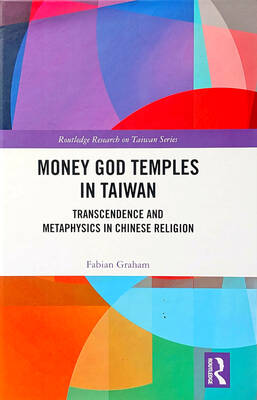
As someone who normally steers clear of books with “transcendence” or “metaphysics” in their subtitles, this reviewer — a casual observer of local belief systems since the 1990s — found Fabian Graham’s Money God Temples in Taiwan a challenging read. Those who’ve only dipped their toes into temple culture will likely need to parse several sections with special care if they’re to keep up with the author, a British ethnographic researcher whose previous books have investigated religious practices among ethnic Chinese in Southeast Asia. This scholarly volume examines a facet of Taiwan’s religious landscape that didn’t exist a century ago, and


 RSS
RSS