


Spicy, scarlet red Sichuan food isn’t normally my suggestion for a first date. But hear me out, if you can both handle a three-chili rating, this spot could be the one.
The vibe is intimate and in-the-know cool, the food is fantastic and will spur many a conversation, the cocktail list is wacky and fun — and they do offer free mouthwash in the restroom.
Old Seat (老位) is tucked down an unassuming alleyway in the bustling Zhongxiao Dunhua (忠孝敦化) area, warm red lighting and fairy lights leading the way. It’s elegant, overtly hipster and even our table by the service hatch was uninterrupted. It can book out up to a week in advance, even on a weekday.
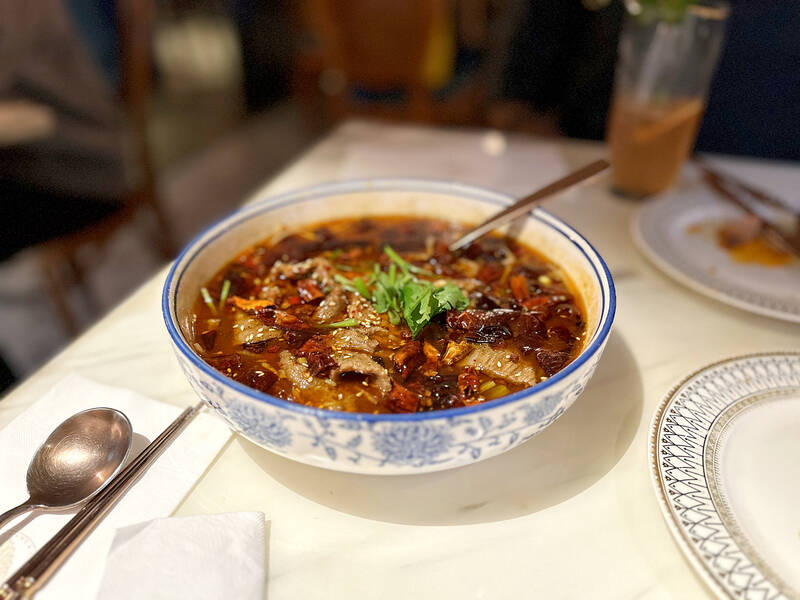
Photo: Hollie Younger, Taipei Times
Unlike most Sichuan spots in Taipei, Old Seat leans stylish, intimate and cocktail-forward — more date night than chain franchise or mom-and-pop canteen.
To preface, I do have a high spice tolerance. It has waned since moving to Taipei, where I initially thought all assumptions I wanted “not spicy” were racial profiling, before I realized Taiwan has a near-on national aversion to spicy food. I was a little nervous, but nothing here proved insurmountable.
We begin with a cocktail from one of the wackiest menus I’ve seen in a while. Many contain Kaoliang liquor or local tea, but we opt for the “Meditation on the Nine Realms: Farewell to a Chaotic World” (NT$400) — yes, really — a homemade winter melon tea vodka, ginger ale and lemon. It’s light and refreshing, perhaps a good choice before what’s to come. But the winter melon, one of my favorite flavors, didn’t really sing.
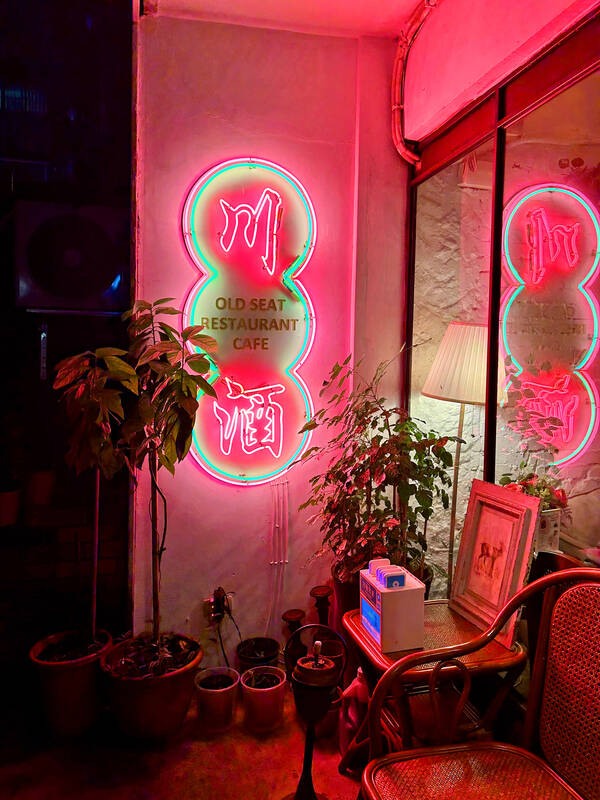
Photo: Hollie Younger, Taipei Times
We also grab a “Lover’s Gaze: Sipping Aiyu Jelly,” (NT$380) with gin, Cointreau, kumquat and honey, with chewy blocks of aiyu jelly you sip up through a boba tea straw. This was a cool idea, but a little bitter, and too much Cointreau turned the taste to pure margarita for me.
I recommend everyone start with the “mouth-watering chicken” (口水雞) (NT$390). A Sichuan classic served cold, glistening slices of boneless chicken are served swimming in a bath of ruby red spicy mala (麻辣) mouth-numbing chili oil, topped with peanuts and cilantro.
It’s not technically served as an appetizer here, but it’s a fantastic introduction to any good Sichuan meal and won’t go cold as you peruse the menu and sip on your bizarre cocktail concoction. The spice is balanced equally hot and cooling, with fresh cilantro making for the perfect bite.
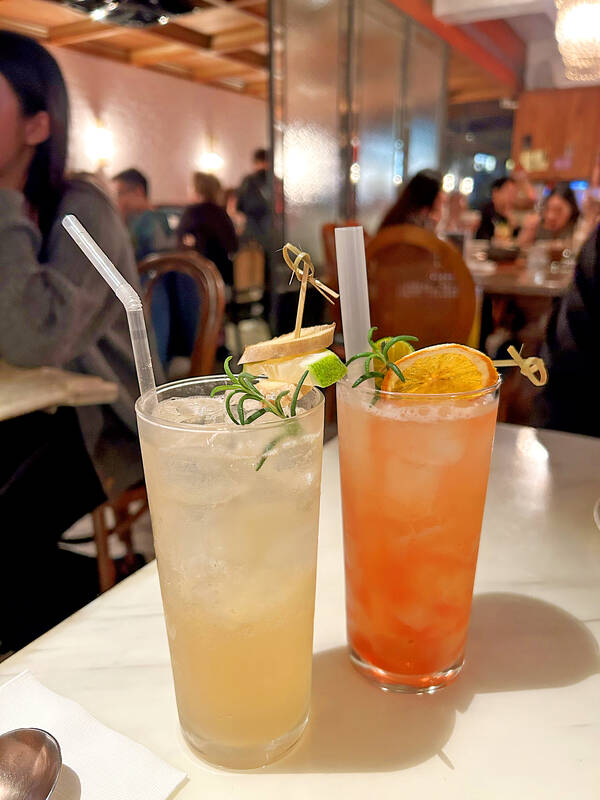
Photo: Hollie Younger, Taipei Times
For mains, we opt for the “Signature Boiled Sliced Beef” (NT$490), boiled not in water, but smoky chilies, numbing peppercorns and an intense chili oil until it packs a hefty punch worthy of its three-chili rating.
This dish seems to feature on every table. Though it looks like a soup, beware. Diners pick out the tender slices of beef and bean sprouts to eat over rice. Do not drink that oil unless you’re looking for a bad night.
This works perfectly as a recommended signature dish, it’s fiery, unique and a Sichuan staple. The heat was manageable but intense, and didn’t seem pared down for Taipei taste buds.
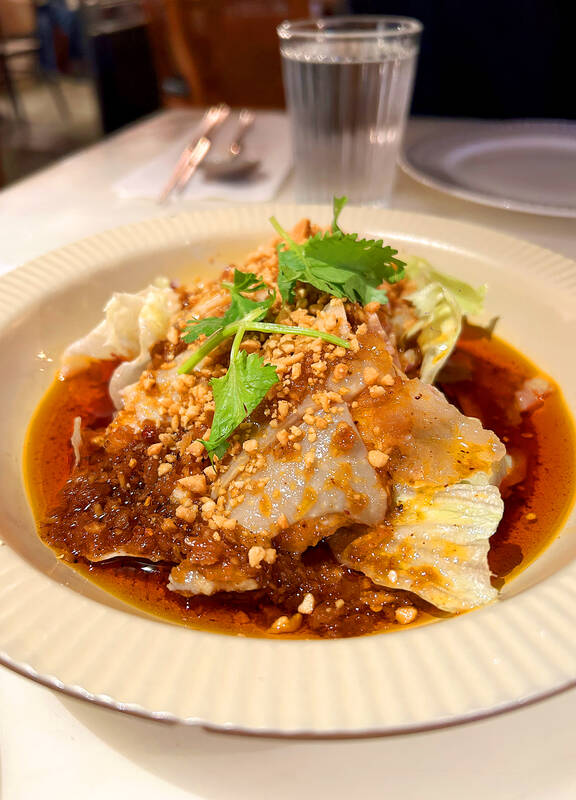
Photo: Hollie Younger, Taipei Times
Next, we head to the “vegetable dishes” section, which appears hilariously non-vegetarian, for the “Classic Stir-Fried Minced Pork with Pickled Chilies” (NT$320), another recommended menu item. Pickling the chilies takes a lot of the biting heat out, but best bet they did add some extra spice and fresh red chilies back in. This was great, no notes. It’s lower spice content serves as a nice reprise.
Lastly, we opt for the “Old Seat Numbing Dan Dan Noodles” (NT$180). This is where we begin to doubt Old Seat’s heat-rating system. A two-chili rating, they said. This blew our heads off, not just with mala spice but eye-watering, sidesplitting heat.
We order two Taiwan beers to wash it down and wonder if we should’ve stuck to the white rice. The portion was also enough to feed a family of four. If you can handle it, it was good, but perhaps I’ve tasted better elsewhere in the city.
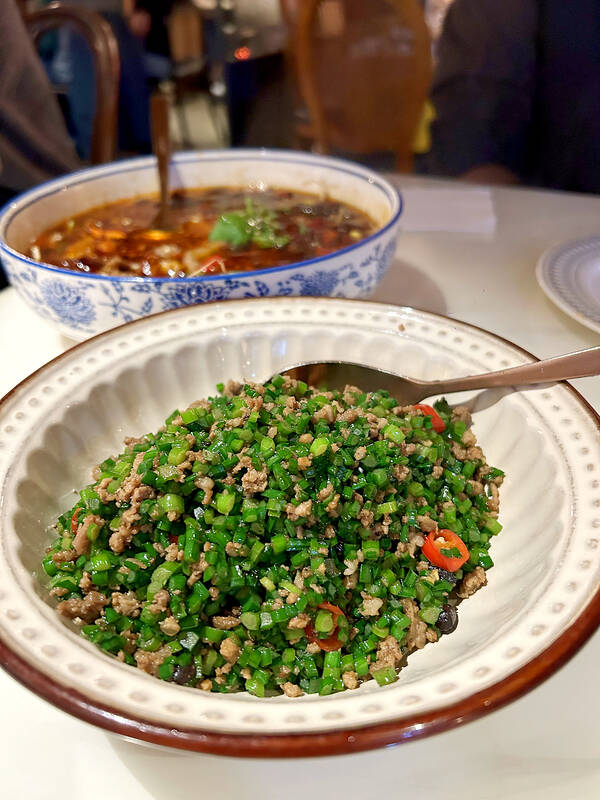
Photo: Hollie Younger, Taipei Times
In hindsight, a lighter main dish to balance the meal — or some rice — would’ve topped the meal off nicely. But the portions here are almost double what we expected, giving a fair CP value and plenty of leftovers.
If you stick to the recommended dishes on the menu, you won’t go far wrong. It’s authentic Sichuan, doesn’t pull back on the punches and has a real cool-girl downtown vibe.
Ajay Verma, a consultant gastroenterologist at Kettering general hospital in Northamptonshire, says our gut is a “complex machine.” “It is constantly providing us with the nutrition we need, initially to grow and develop, and then for us to survive, thrive and repair from injury and illness.” How can we keep it functioning well? Put simply: “Make sure what you put into it is balanced, and that you clear out its waste products adequately,” Verma says. “In a general gastroenterology clinic, the most common conditions we see are irritable bowel syndrome (IBS), gastroesophageal reflux disease, inflammatory bowel disease and constipation,” says Nisha

And so, in the wake of US President Donald Trump’s trip to the People’s Republic of China (PRC), all the experts on the Strait of Hormuz suddenly became experts on US-China-Taiwan relations. The Internet has certainly expanded human knowledge. Lots of these sudden experts made noise this week about Trump’s words after the meeting with PRC dictator Xi Jin-ping (習近平). Trump is going to sell out Taiwan! Longtime Taiwan commentator J. Michael Cole summed the situation up neatly in the Guardian: “We need to keep in mind that he has a tendency to say many things — sometimes contradicting himself within

Last week US President Donald Trump was asked by a reporter whether he would speak on the phone to the President of Taiwan. “l’ll speak to him. I speak to everybody. We have that situation very well in hand,” Trump said. This marked the second time in a couple of weeks he had said he would talk to the President of Taiwan. In 2016 he famously took a call from then-president Tsai Ing-wen (蔡英文), when he was president-elect. Despite warnings that the apocalypse was nigh because of a phone call, the world quickly forgot about the conversation between two democratically-elected presidents.
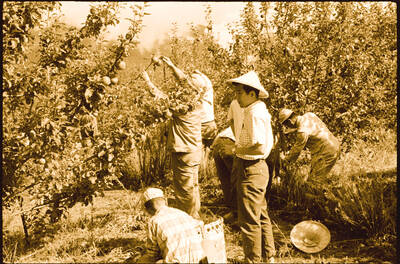
May 25 to May 31 Few believed that apples could be cultivated on a commercial scale in Taiwan’s high mountains. When horticulturalist Cheng Chao-hsiung (程兆熊) first proposed the idea in 1955, both American and Taiwanese colleagues dismissed it as implausible, arguing that temperate fruit could not be reliably grown on a subtropical island, especially on rugged terrain. However, it was this terrain in the Central Mountain Range where many Chinese Civil War veterans were resettled in the late 1950s. With limited job prospects and no family in Taiwan, they were placed on cooperative farms aimed toward self-sufficiency. Some say the conditions


 RSS
RSS