


The Taipei Symphony Orchestra (TSO) is going from strength to strength. Saturday’s first performance of the Fall season saw the city’s ensemble make an all-Beethoven program exciting with an incredibly tight rendering of several classics. It also provided food for thought about the merits and occasional downsides of historic performance practice.
German violinist and chamber music expert Antje Weithaas acted as both the soloist and the leader of the orchestra, in lieu of a conductor, as was common practice at the time Ludwig van Beethoven wrote his Coriolan Overture, his Violin Concerto in D major — his only concerto for solo violin — and his Symphony No. 4 in B-flat major.
SOLOIST WITH ENERGY
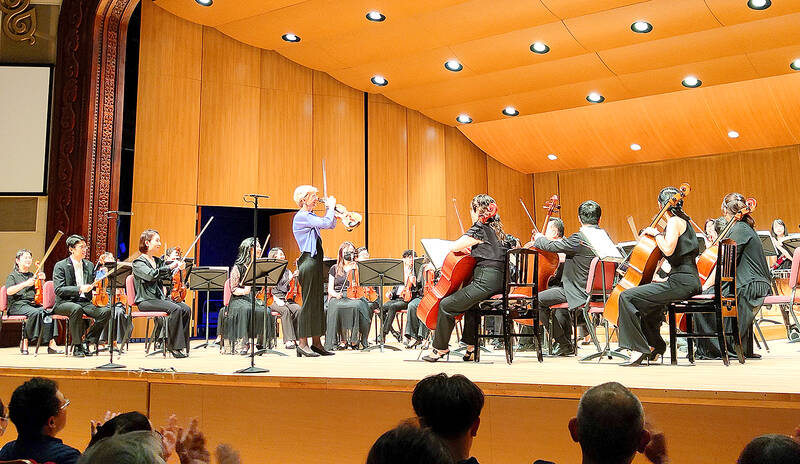
Photo: Shir Bashi
And what an energy this brought to the music. Sometimes conducting the TSO with movements of her bow, shoulders and spray-fixed hairdo, sometimes leading simply through the well-cast glance of an eye from the concertmaster’s seat, Weithaas set up the orchestra to act like the second instrument in a highly dynamic duet.
During what could have easily been a sleepy performance, the ensemble and solo violinist kept the audience glued to their seats as they played in the style of a large quartet — a true chamber music approach to Beethoven’s music.
The dynamics were exceptional as Weithaas guided the musicians through the thinnest of pianissimos and deliberate, steady crescendos, while still achieving the buttery smooth amalgamation of sounds that defines these pieces. All of this despite the treacherously dry acoustics of Zhongshan Hall’s main auditorium.
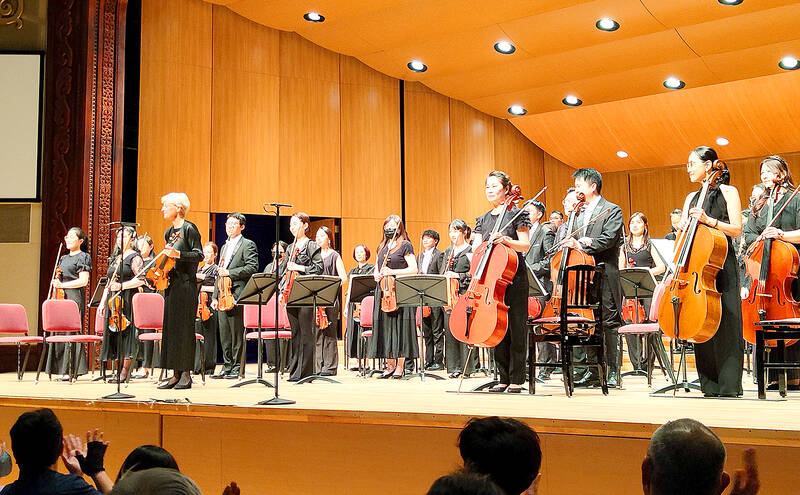
Photo: Shir Bashi
As the soloist in the violin concerto, Weithaas was dynamic and powerful while leading the orchestra. However, while she showed herself a real virtuoso and seemed to play with great ease, in this role her choice of phrasing sounded less deliberate.
Lacking the tension inserted by some of the other great interpreters of the piece, Weithaas substituted energy and joy for suspense and solemnity, making the arpeggios and weaving melodies of the first movement exercises in technique rather than lyricism.
Choosing to play Beethoven’s original candenzas — which were originally written for piano — in the first and second movements of the concerto also delivered novelty value while emphasizing why transcriptions by the great modern violinists are generally preferred: The composer never intended for his piano improvisations to be interpreted on the violin and when played on the instrument, they somewhat lack emotional depth.
Ultimately, Saturday’s season starter proved the concept of the player-leader for pieces that the audience are used to seeing conducted in the traditional way. It also showed how well the TSO has come together over the past few years as perhaps Taiwan’s most exciting symphony orchestra.
NEW CONCERT HALL
With Taipei City investing over NT$11 billion (US$363 million) in a new concert hall and library building to give the orchestra a long-awaited new home by 2030, it is easy to see the ensemble continue its interesting programming and high-quality performances.
The TSO has six more performances planned through December, with returning maestro Eliahu Inbal leading the orchestra through major symphonies by Mahler, Bruckner and Shostakovich. Meanwhile new chief conductor Alexander Liebreich, who is joining the orchestra next year, is to conduct his first concert in November.
Guest conductor Nicholas Carter will tomorrow night take the orchestra through Benjamin Britten’s Sinfonia da Requiem, Sergei Rachmaninoff’s Isle of the Dead, Claude Debussy’s La Mer and the premier of Taiwanese composer Shiuan Chang’s (張玹) violin concerto 23.5°N, 121°E, played by South Korean violinist Inmo Yang.
Britten’s symphonic piece bears an interesting connection to Taipei’s Zhongshan Hall: Both were originally created to honor Japan’s imperial house after the ascension of Emperor Showa. National Concert Hall at 7:30pm, tickets are NT$300 to NT$1,600 through Opentix.life.
On Nov. 27, Liebreich is set to make his entrance in a warm-up concert conducting Dmitri Shostakovich’s Cello Concerto No. 1, with cellist Alban Gerhardt. National Concert Hall at 7:30pm, tickets are NT$300 to NT$2,000 through Opentix.life.
And famous French film composer Alexandre Desplat has confirmed for two concerts conducting his own works on Dec. 5 and Dec. 6. Taipei Performing Arts Center at 7:30pm, tickets are NT$300 to NT$2,500 through Opentix.life.
Taiwan residents and ARC holders can take advantage of the orchestra’s free membership scheme to receive a 20 percent discount on tickets for all performances.
Visit english.tso.gov.taipei and scroll down to “TSO Friends” to sign up.
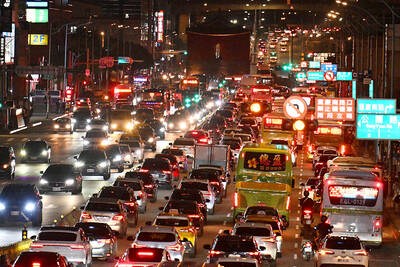
By global standards, the traffic congestion that afflicts Taiwan’s urban areas isn’t horrific. But nor is it something the country can be proud of. According to TomTom, a Dutch developer of location and navigation technologies, last year Taiwan was the sixth most congested country in Asia. Of the 492 towns and cities included in its rankings last year, Taipei was the 74th most congested. Taoyuan ranked 105th, while Hsinchu County (121st), Taichung (142nd), Tainan (173rd), New Taipei City (227th), Kaohsiung (241st) and Keelung (302nd) also featured on the list. Four Japanese cities have slower traffic than Taipei. (Seoul, which has some

Michael slides a sequin glove over the pop star’s tarnished legacy, shrouding Michael Jackson’s complications with a conventional biopic that, if you cover your ears, sounds great. Antoine Fuqua’s movie is sanctioned by Jackson’s estate and its producers include the estate’s executors. So it is, by its nature, a narrow, authorized perspective on Jackson. The film ends before the flood of allegations of sexual abuse of children, or Jackson’s own acknowledgment of sleeping alongside kids. Jackson and his estate have long maintained his innocence. In his only criminal trial, in 2005, Jackson was acquitted. Michael doesn’t even subtly nod to these facts.
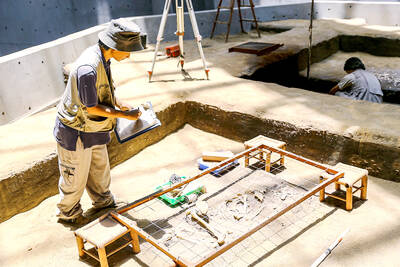
Writing of the finds at the ancient iron-working site of Shihsanhang (十 三行) in New Taipei City’s Bali District (八里), archaeologist Tsang Cheng-hwa (臧振華) of the Academia Sinica’s Institute of History and Philology observes: “One bronze bowl gilded with gold, together with copper coins and fragments of Tang and Song ceramics, were also found. These provide evidence for early contact between Taiwan aborigines and Chinese.” The Shihsanhang Web site from the Ministry of Culture says of the finds: “They were evidence that the residents of the area had a close trading relation with Chinese civilians, as the coins can be
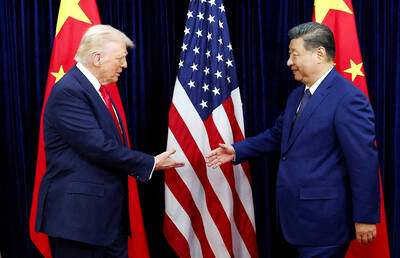
The March/April volume of Foreign Affairs, long a purveyor of pro-China pablum, offered up another irksome Beijing-speak on the issues and solutions for the problems vexing the People’s Republic of China (PRC) and the US: “America and China at the Edge of Ruin: A Last Chance to Step Back From the Brink” rang the provocative title, by David M. Lampton and Wang Jisi (王緝思). If one ever wants to describe what went wrong with US-PRC relations, the career of Wang Jisi is a good place to start. Wang has extensive experience in the US and the West. He was a visiting


 RSS
RSS