


Will she, or won’t she?
The media has been abuzz in the past few days with reports citing people in Taichung Mayor Lu Shiow-yen’s (盧秀燕) camp that she is “considering” not running for Chinese Nationalist Party (KMT) chair. If these reports are accurate, she is concerned about being distracted from her job as Taichung mayor for the rest of her term, and is considering backing a proxy she can work closely with to run instead.
Reports just days before suggested that current Chairman Eric Chu (朱立倫) was planning on a smooth transfer of power to the next chair, reviving quotes from a May 26 United Daily News interview, which this column pointed out was more of a warning to Lu that she would be making a big mistake to run than the surface comments suggested (“Eric Chu’s stark between-the-lines warning ahead of the KMT chair race,” June 7, page 12).
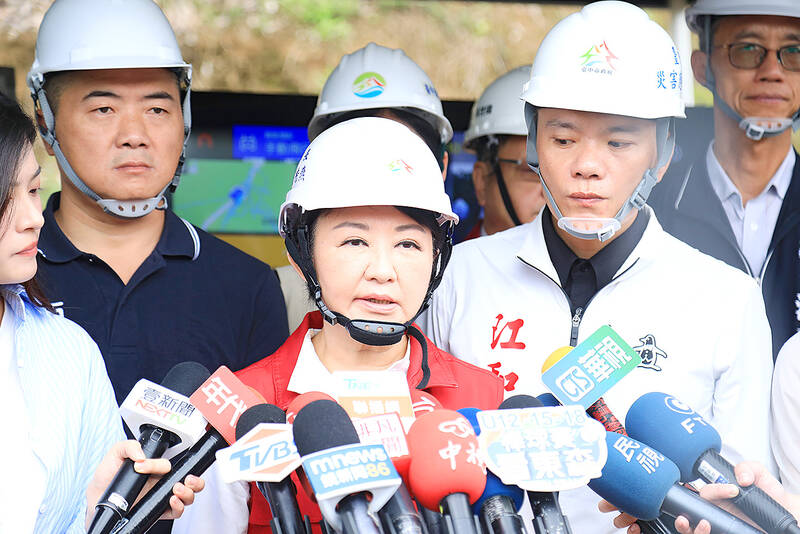
Photo: Chen Chien-chih, Taipei Times
Lu is widely tipped to be the KMT’s presidential candidate in 2028. Previous reports — also allegedly from “insiders” in her camp — suggested she wanted to consolidate and streamline the party leadership and presidential campaign under her leadership during her presidential run. The traditional model in Taiwan is for the party chair to also be the party’s presumptive presidential candidate.
The next party chair election is on Oct. 18, with the winner officially taking office on Nov. 1.
The new chair will lead the party into next year’s local elections. If that election goes badly, whoever is leading the party will be under pressure to resign to take responsibility, but if it goes well the chair will be in a strong position to lead the party into 2027, when most of the campaigning takes place for the January 2028 national elections.
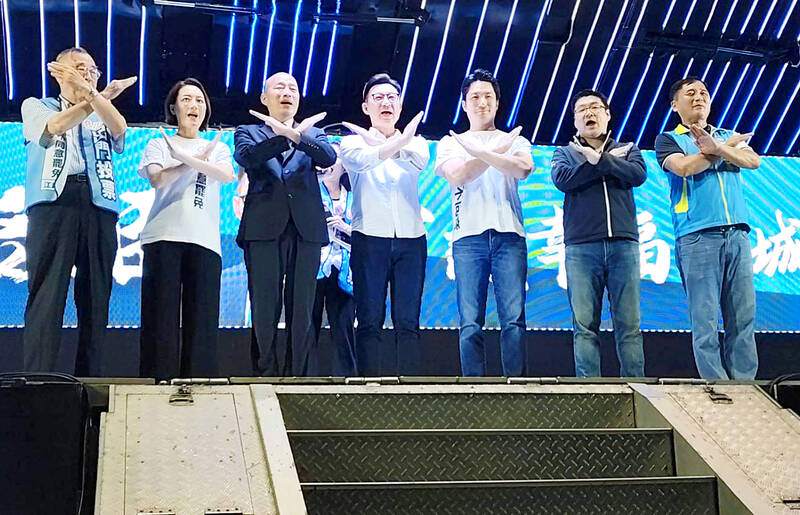
Photo: Chang Hsuan-che, Taipei Times
Chu has had a fairly successful run as party chair. He led the party to triumphant victory in the 2022 elections, a mixed but improved result last year and all the recall campaigns against KMT lawmakers on July 26 were defeated.
He has tackled the biggest problems facing the party with some success. Though the party’s finances are still a mess, Chu likely saved it from bankruptcy by streamlining it.
However, his reforms have made him many enemies and he has struggled to maintain control in the face of seemingly endless revolts from inside the party. To his credit, he succeeded every time in keeping the party on track, but more than once it appeared touch-and-go.
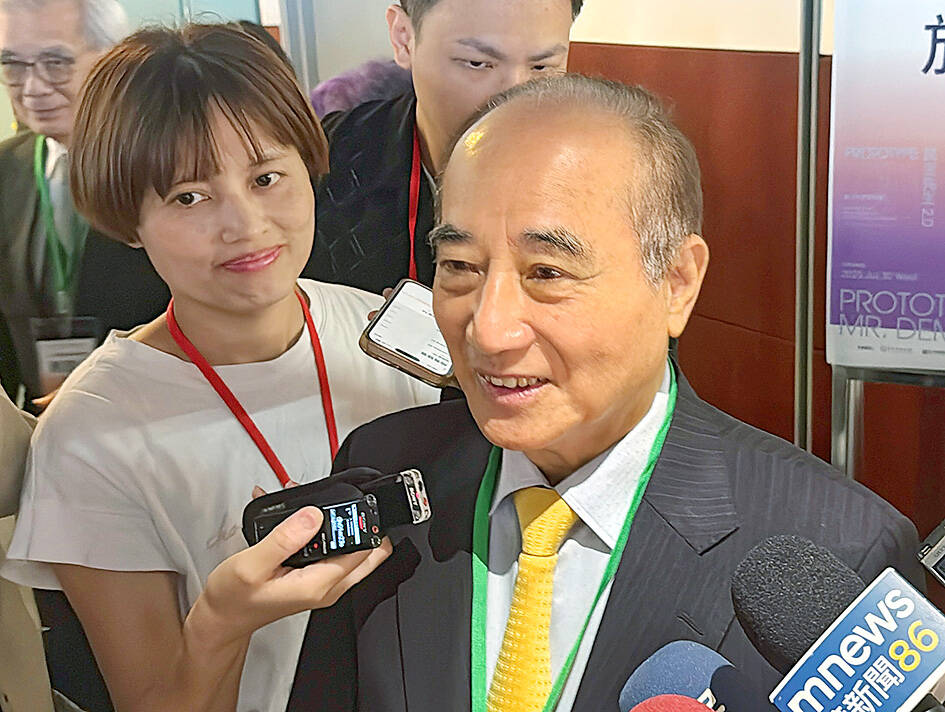
Photo: Liu Hsin-de, Taipei Times
Lu is widely popular and has the backing of a vocal “draft Lu” movement that includes the influential association of city and county council speakers and deputy speakers. Even the normally sphinx-like former legislative speaker Wang Jin-pyng (王金平) has been unusually blunt in backing her.
CONSEQUENTIAL
This election has the potential to be enormously consequential for the future of Taiwan.
In 2028, the Democratic Progressive Party (DPP) will have served an unprecedented three consecutive terms in the presidency. If the KMT can overcome widespread distrust, they will be well-positioned to win back the presidency — but that is a tall challenge.
Whoever wins the chair race will be faced with a series of severe challenges.
Tough reforms will continue to be necessary to keep the party financially viable. The chair will also need to spend considerable time raising money in both donations and loans, while fending off existing creditors — a hard, time-consuming and thankless job.
Additionally, there are over 100 investigations into KMT local chapter leaders, staff and volunteers over allegations of voter fraud during the KMT’s failed attempt to launch recall campaigns against DPP lawmakers. Enough have already confessed that it is clear that many local KMT chapters will be losing key personnel, risking damaging the party’s highly effective get-out-the-vote capabilities.
With their predecessors in jail, will the party chair be able to find enough willing replacements with the knowledge and capabilities necessary? Repairing the damage done to local chapters will also be a hard, time-consuming and thankless job.
To succeed electorally next year and 2028, not only will those challenges need to be dealt with professionally and effectively, the party chair will also have to jolt the party back away from the hyperbolic hyperpartisan tone of recent months towards something more moderate and acceptable to voters outside of their core base.
The deep blue camp has gone through periodic hyperpartisan fits before. The term “green terror” goes back to the year 2000, and Hitler comparisons are nothing new — though they got creative this time with “green commies,” which, to my recollection, is new.
Traditionally, party leaders let underlings run with the over-the-top rhetoric to feed the base, while keeping some distance to appear more moderate. This time, it was the party leader Chu himself leading the charge in the final months.
Lu played the traditional role of being the more moderate, rational face of the party this time. This worked because she was the presumptive next party chair and presidential nominee.
But what if she does not run?
GRAVITAS NEEDED
That would introduce new challenges. To moderate the party, they will not only need to rein in the deep-blues, they will need to exercise control over the KMT legislative caucus.
Flush off of surviving the recalls, the KMT caucus might feel emboldened to return to their agenda of paralyzing the government, accruing power to the legislature and meeting Chinese Communist Party (CCP) leaders in charge of making Taiwan’s annexation a reality.
That would make selling the KMT as the responsible party looking out for Taiwan’s security a hard sell.
KMT caucus convener Fu Kun-chi (傅?萁) is a party heavyweight, strong-willed and stubborn. His agenda in the legislature appeals to the deep base, but is a liability to the party’s electability.
Lu is a heavyweight powerful and strong-willed enough to be able to rein in the party and stare down Fu.
Now that Chu has let the hyperpartisan genie out of the bottle, he is in a weak position to bottle it back up. He also has many enemies looking to undermine him. However, he has proven time and again he can bounce back.
Other names have been suggested. Taipei Mayor Chiang Wan-an (蔣萬安), legislative speaker Han Kuo-yu (韓國瑜), former vice presidential candidate Jaw Shaw-kong (趙少康), Taoyuan Mayor Simon Chang (張善政) or even former president Ma Ying-jeou (馬英九). Reportedly, Lu is considering putting former foreign minister and Taichung mayor Jason Hu (胡志強) forward as a candidate, though he has been supporting her.
Han’s position as speaker is legally constrained as a neutral arbiter between party caucuses, making it difficult to also serve as party chair. He is also not known for his executive experience, and could struggle in the role.
Simon Chang might be an acceptable candidate, but is he enough of a heavyweight? He also only recently joined the KMT, so he likely lacks the experience to run the party.
Jaw is smart and entertaining, but is unlikely to steer the party towards a more electable middle. He is also very blunt and arrogant, which works in Taipei, but would offend people in the rest of the country.
Jason Hu is one of the smartest, savviest politicians the KMT has ever produced, but has been off stage for over a decade and has a multitude of health issues.
Ma is too old and frail.
Chiang does not have the gravitas and authority to rein in the party. Fu would eat Chiang for breakfast.
If Lu does not run, Chu is probably the only candidate with the skills and authority to effectively lead the party, but he would be constantly challenged.
Lu faces a dilemma.
She would face many distractions and take many risks by being chair. If she does not run, there is the risk the party could fall apart under her.
Donovan’s Deep Dives is a regular column by Courtney Donovan Smith (石東文) who writes in-depth analysis on everything about Taiwan’s political scene and geopolitics. Donovan is also the central Taiwan correspondent at ICRT FM100 Radio News, co-publisher of Compass Magazine, co-founder Taiwan Report (report.tw) and former chair of the Taichung American Chamber of Commerce. Follow him on X: @donovan_smith.

Taiwan’s English education system is being pulled apart by three opposing forces. Bilingual Nation 2030 pulls students toward English and global communication. Artificial Intelligence (AI) readiness pulls them toward digital judgment, verification and AI-mediated work. But Taiwan’s old exam culture pulls them back toward memorization, grammar drills, timed reading and correct answers. If the education system keeps using old exams to define success, it risks producing graduates who are neither genuinely bilingual nor genuinely AI-ready, but trained for tasks machines can already perform. The first force is Bilingual Nation 2030. Launched in 2018, the policy aimed to “help Taiwan’s workforce connect
It seems every few days one bumps into one of those “real man” comments in which Taiwan is urged to “face reality” or similar, and “make a deal,” with the speaker implying that soon it will be too late. “Deal” advocates always present themselves as having a superior grip on reality, and the manly ability to make the “hard choice.” Their testosterone-laden language often echoes that of Taiwan sellout advocates. Note that such commentary always specifies a process (“make a deal, work with, make progress”), never the end state of what occupation by a violent authoritarian colonialist state will entail. In

“Taiwan’s Opposition Leader Comes to US With a Message Straight Out of Beijing” read a May 31 headline in the Wall Street Journal. Top US administration officials and members of Congress almost certainly read the WSJ, and if there was a bullet point takeaway that people in Washington should absorb ahead of Chinese Nationalist Party (KMT) Chair Cheng Li-wun’s (鄭麗文) arrival in DC on June 9, that headline is it. The last few columns have discussed this very topic, and the timing is not coincidental. While those top officials likely do not read the Taipei Times, judging by the number
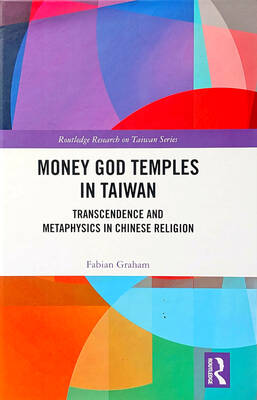
As someone who normally steers clear of books with “transcendence” or “metaphysics” in their subtitles, this reviewer — a casual observer of local belief systems since the 1990s — found Fabian Graham’s Money God Temples in Taiwan a challenging read. Those who’ve only dipped their toes into temple culture will likely need to parse several sections with special care if they’re to keep up with the author, a British ethnographic researcher whose previous books have investigated religious practices among ethnic Chinese in Southeast Asia. This scholarly volume examines a facet of Taiwan’s religious landscape that didn’t exist a century ago, and


 RSS
RSS