


The most popular Taiwanese political commentators in my opinion are not that good. Mostly, they just state what seems obvious. This is not to say that excellent Taiwanese political analysts do not exist, but they usually can only be found in more obscure outlets.
I could name perhaps one or two dozen native English speakers whose analysis is easily as good as, if not better than, the most popular commentators operating in Chinese in Taiwan. That there is a group of analysts of Taiwan politics of such high-quality writing in English did not happen in a vacuum, and it took decades to develop.
PRO TAIWAN
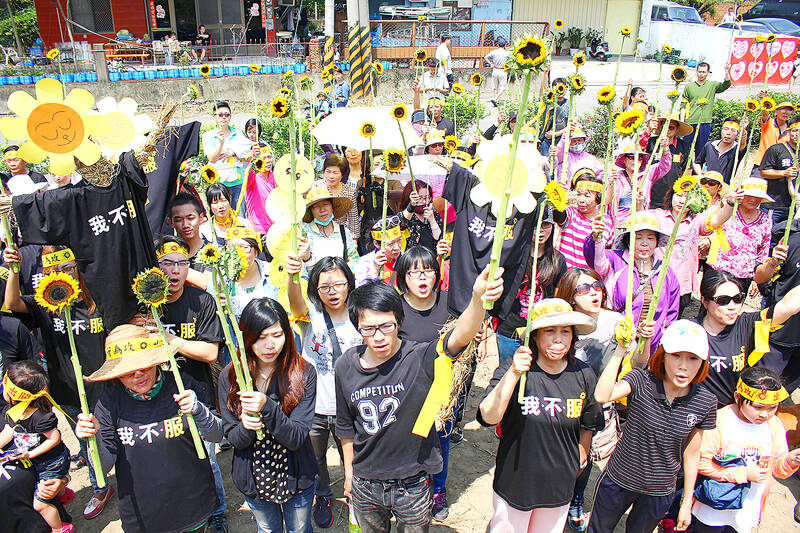
Photo: Lin Yi-chang, Taipei Times
Prior to the democratic era, “Free China’s” politics was viewed through different lenses, typically academically, diplomatically or through political activism, and it was mostly people from those fields who wrote about the topic. Diplomat George Kerr wrote Formosa Betrayed, political activists like Lynn Miles wrote for Amnesty International and alongside Linda Arrigo served as conduits smuggling information out (which was extremely difficult in the days when phones were tapped and they were limited exclusively to physical paper) and later Gerrit van der Wees’s Taiwan Communique smuggled information into Taiwan.
With the two English-language newspapers, the China Post and the China News, both propaganda outlets for the authoritarian Chinese Nationalist Party (KMT) state, about the only way to get regular up-to-date political news was to be physically in Taiwan and witness it first hand or talk to locals.
As Taiwan transitioned to democracy, we were fortunate to have academics such as Shelley Rigger and Dafydd Fell come and study this process, and for the most part became some of the earliest to study Taiwan as an independent subject and not as a subset of China.
Photo: CNA
Democratization also brought forth a wave of translations of historical works as interest in Taiwan’s past and developing identity started to rise. This allowed for insights into the politics of the Japanese, Qing Dynasty, Kingdom of Tungning and Dutch colonial periods, though I do not recall seeing very much on the Spanish colonial period.
The late 1990s brought two important developments in English-language news. The first was I-Mei Foods (義美食品) buying the China News in 1997 and renaming it Taiwan News, and taking a pro-Democratic Progressive Party (DPP) stance to balance out the China Post’s pro-KMT editorial line.
Then, in 1999, the Chinese-language pro-DPP news outlet Liberty Times launched this publication and staffed it with a strong team and featuring the very best analysts on Taiwan. It dramatically raised the bar.
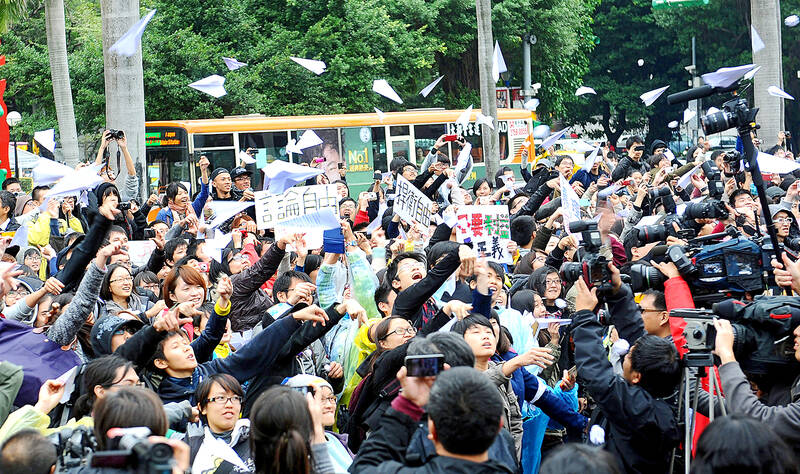
Photo: Chang Chia-ming, Taipei Times
The Taipei Times was a hit, featuring a fresh, stylish design, useful touches including names in Chinese in parentheses and interesting and insightful columns and editorials. To this day the humorous — yet insightful — political column bylined “Johnny Neihu” still comes up in conversation.
PAST THE MILLENNIUM
The turn of the millennium brought the newly minted terms “pan-blue” and “pan-green” and the widespread adoption and adaptation to the Internet. Previously, one had to physically buy or subscribe to newspapers and magazines, which could be very costly if done internationally.
It became significantly easier to do wider analysis on content from across the political spectrum as well as to create new content. The oldest blog I am aware of that lasted for years was Dateline Taipei, which specialized in translating deep blue editorials from Chinese-language outlets like the China Times and United Daily News. This was very useful for analysis, and even while reading the Chinese-language media daily I would still read those because my reading speed is still faster in English.
It would be the founding of the pan-green blog The View from Taiwan by current Taipei Times “Notes from Central Taiwan” columnist Michael Turton who set things on fire. People forget how controversial it was.
For those of us on the pan-green side of the spectrum it was hugely influential, including on this column. We appreciated his deft weaving of history, culture, business, society and politics into well-crafted work that would not only make profound or insightful points, he would do so in a way that brought context and understanding in a way that had not been done so well before.
It was also often funny, and his takedowns of bad takes were — and still are — masterful. Quite often his work was — and continues to be — prophetic.
His detractors essentially called him a partisan stooge and there were long, drawn-out battles in online forums filled with all kinds of unpleasantry. He was a lightning rod, people seemed to either love his work or hate it. Around the time of the Sunflower movement the center of political gravity shifted to what was previously light-green territory, and in a fairly short time a fair number of us no longer came across as radical any longer.
Similarly, Jenna Lynn Cody’s Lao Ren Cha blog was also highly controversial for a time, especially in the Facebook era, for some of the same reasons as Turton, but also for her irreverent writing style. Cody continues to bring interesting perspectives and insights from Taipei that might not occur to us Taichung-based men.
FROZEN GARLIC
Of the English-language analysts that I can think of who are as good or better than the popular local ones, there are only four things aside from being native English speakers that all have in common. As a group we come from different countries, ethnicities and backgrounds. The group skews, but is not exclusively, pan-green, Taiwanese-American or white and male, but it will skew more female and far more ethnically diverse in the coming years judging by the younger up-and-coming talents that have reached out to me.
All of these analysts have a passion for Taiwan and must have read quite a few books to understand the background. We all also read Chinese-language media, and professionally prepare that in English for readers in various forms such as writing, radio, television, podcast and YouTube content.
The final thing we almost certainly have in common, regardless of political leaning, is we are all students at what I call the “Frozen Garlic academy of Taiwan political science.” The Frozen Garlic blog (frozengarlic.wordpress.com) by Associate Research Fellow at the Institute of Political Science, Academia Sinica and Jointly Appointed Associate Research Fellow at the Election Study Center, National Chengchi University Nathan Batto is the gold standard and benchmark for all of us in the analysis of electoral politics, and anyone claiming to not have been influenced by it is deluding themselves.
Without a doubt Batto is better than most — and possibly all — popular local analysts and he raised the bar much, much higher. Crucially, like any great teacher he not only taught us an immense amount, he also taught us how to approach the topic as a political scientist observing politics in real time and with a style much closer to that used in local media. I would argue his work was — and continues to be — the capstone to everything that came before that allowed English language analysts to compete with the Chinese language ones.
Regular readers of my work know I frequently do deep dives into all sorts of aspects of local politics, strategy, the legal framework, party finances, polling data and so forth, digging deep into government records, the constitution and election laws, driven by curiosity and questions on how it shapes politics and strategies. As far as I know, my predictions in recent elections have easily beat the local pundits.
Frozen Garlic sped up my learning curve dramatically. He also inspired me by making the best election prediction I have ever seen. In the topsy-turvy 2016 election where everyone was predicting the KMT would win over 40, 50 or even 60 legislative seats I privately predicted 28-32 but publicly and cheekily to provoke discussion predicted under 30, which was wildly off everyone else’s prediction, which still was as far as I know the second-best prediction.
The information available on all the legislative races was sparse as there is only sporadic polling. In discussion with Nathan, we bet a bottle of wine on my prediction. I lost, his prediction was “mid-thirties,” which is 35 plus or minus a couple. To this day I continue to be amazed how he perfectly nailed it in such a wild swing of an election. They won 35 on the dot.
ENGLISH-LANGUAGE ANALYSIS TODAY
Following the Sunflower movement a range of new sources, blogs and writers took to the stage making it possible to become knowledgeable enough to basically understand local politics through available English-language sources, though being able to read Chinese helps to capture the granularity of detail in Taiwan’s politics and to get access to certain research materials.
Another problem is that while pan-blue writers and content do exist, there is no longer very much available deep-blue content being produced in English, without which it is harder to do good analysis on the KMT. Though I am pan-green, I do think the end of Dateline Taipei, the China Post and the English-language section of the KMT’s Web site is a loss for people trying to truly understand Taiwan’s full political spectrum, though one can still access archived content on Dateline Taipei and the KMT Web site to get a sense of their worldview.
One book worth recommending to beginners and experts alike is Dafydd Fell’s Government and Politics in Taiwan second edition published by Routledge Research. For beginners it lays out the context and background and for specialists it serves as an excellent review, reminding us of events we may have forgotten about and in context. Fortunately, unlike most academics, Fell writes with actual reader enjoyment and understanding in mind.
Donovan’s Deep Dives is a regular column by Courtney Donovan Smith (石東文) who writes in-depth analysis on everything about Taiwan’s political scene and geopolitics. Donovan is also the central Taiwan correspondent at ICRT FM100 Radio News, co-publisher of Compass Magazine, co-founder Taiwan Report (report.tw) and former chair of the Taichung American Chamber of Commerce. Follow him on X: @donovan_smith.


Taiwan’s English education system is being pulled apart by three opposing forces. Bilingual Nation 2030 pulls students toward English and global communication. Artificial Intelligence (AI) readiness pulls them toward digital judgment, verification and AI-mediated work. But Taiwan’s old exam culture pulls them back toward memorization, grammar drills, timed reading and correct answers. If the education system keeps using old exams to define success, it risks producing graduates who are neither genuinely bilingual nor genuinely AI-ready, but trained for tasks machines can already perform. The first force is Bilingual Nation 2030. Launched in 2018, the policy aimed to “help Taiwan’s workforce connect

“Taiwan’s Opposition Leader Comes to US With a Message Straight Out of Beijing” read a May 31 headline in the Wall Street Journal. Top US administration officials and members of Congress almost certainly read the WSJ, and if there was a bullet point takeaway that people in Washington should absorb ahead of Chinese Nationalist Party (KMT) Chair Cheng Li-wun’s (鄭麗文) arrival in DC on June 9, that headline is it. The last few columns have discussed this very topic, and the timing is not coincidental. While those top officials likely do not read the Taipei Times, judging by the number

With weighty, anxiety-inducing geopolitical topics dominating the headlines, checking in on the wild and weird state of local politics can take some of the edge off. This November’s elections will determine who will be in charge of fixing potholes in your neighborhood, not the potholes in Taiwan’s complicated geopolitical space. Recently, after an online interview with a Taipei-based journalist, I commented that Taipei journalists never go further than the MRT can take them. He laughed and agreed. Naturally, the Taipei mayoral race is eating up much of the press attention. TAIPEI CITY Democratic Progressive Party (DPP) candidate Puma Shen (沈伯洋) has
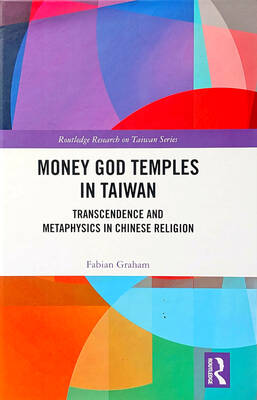
As someone who normally steers clear of books with “transcendence” or “metaphysics” in their subtitles, this reviewer — a casual observer of local belief systems since the 1990s — found Fabian Graham’s Money God Temples in Taiwan a challenging read. Those who’ve only dipped their toes into temple culture will likely need to parse several sections with special care if they’re to keep up with the author, a British ethnographic researcher whose previous books have investigated religious practices among ethnic Chinese in Southeast Asia. This scholarly volume examines a facet of Taiwan’s religious landscape that didn’t exist a century ago, and


 RSS
RSS