


When the writer Fredick King Poole visited Taiwan in the late 1960s, he was struck by “the sad little sun flag over the airport proclaiming this to be China itself, the announcement over the plane’s PA system that picture-taking was not allowed because this island was in fact a great nation at war, the portraits everywhere of poor old discredited Chiang.”
By Chiang, he of course meant Chiang Kai-shek (蔣介石), then leader of Taiwan’s authoritarian party-state, and the “sad little sun flag” was that of Chiang’s Chinese Nationalist Party (KMT).
Poole, who included these satirical digs in his 1971 novel Where Dragons Dwell –– a story of American expatriates grifting off the US military in Bangkok with a backstory set in Taipei –– was one of very few Western authors to offer first-hand accounts of Taiwan during its Martial Law era, which lasted from 1949 to 1987. He was also almost certainly one of the first to write about Taiwan with such streetwise cynicism.
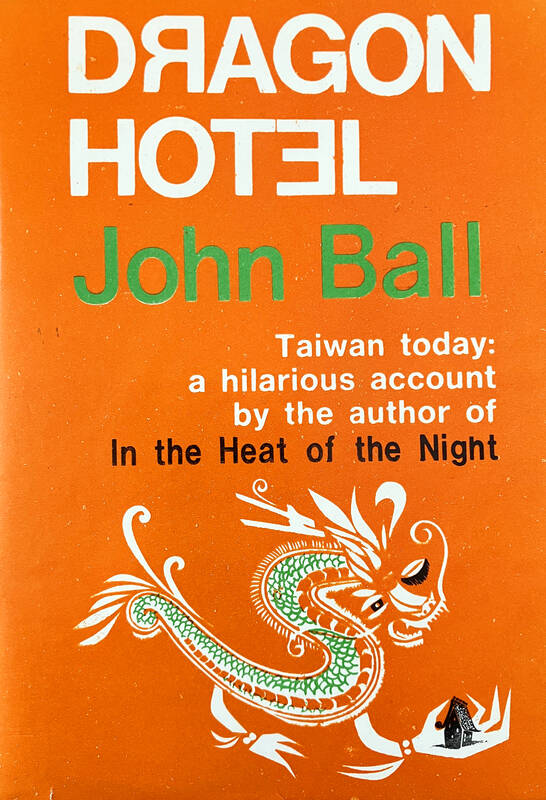
Photo: David Frazier
Poole’s novel came as part of a small cluster of three Taiwan books published by two American authors at the height of the Vietnam War era –– a time that saw a large influx of Americans into Taiwan including military and civilians. Two of these books were by Poole, Where Dragons Dwell and a dimestore sex guide called Taipei After Dark. The third was a travelog, Dragon Hotel, by the detective writer John Dudley Ball.
Poole and Ball could not have been more different writers.
Ball was a former US military man who flew the “Hump” during World War II in support of Chiang’s army, and by the time of his Taiwan visit was already famous for his 1965 detective novel In the Heat of the Night, which had been made into a Hollywood film starring Sydney Poitier.

Photos: David Frazier
Poole, the black-sheep scion of an upper crust New England family, was of the 1960s generation, and, though hardly a hippy, was a free-thinking, chain smoking hedonist who professed, “I could not make myself believe in objective journalism.”
‘BLATANT SEX CAPITAL OF ASIA’
Poole first drifted into Taipei as a sort of gonzo typewriter-for-hire on an assignment to write the semi-factual, soft-core sex guide Taipei After Dark –– a 176-page pocket book sold in American drug stores, which on its cover proclaimed Taipei to be “blatant sex capital of Asia, where vice is legal and the price is right.” It was recently republished in a 50th anniversary edition available on Amazon.com.

Photo: David Frazier
Poole wrote the book under the pseudonym Andrew Harris, with chapters covering massage parlors, girlie bars, hotel sex, gay and lesbian scenes, fantastic orgy scenarios, and a discreet madame said to procure girls for international dignitaries and possess connections in Taipei’s elite corridors of government.
But beyond the sensual fluff, the guide presented an unexpectedly canny summary of Taiwan’s political situation, including several uncomfortable truths. For example, Poole wrote, “It is part of the tragedy of Nationalist China that it attracts the interest of so many small-timers from America,” including “discredited racist Southern senators,” “new-McCarthyite ex-FBI agents,” and smalltown newspapermen who “are treated as press lords if their views are sufficiently to the right.”
In both politics and sex, Poole’s book would likely have scandalized Ball, who arrived in Taiwan on a military cargo plane as a “distinguished guest” of the US Navy.
Permission to visit Taiwan, Ball noted in Dragon Hotel, required a high ranking officer to vouch for him, as “in the embarrassingly recent past another correspondent … had erupted into print with some ‘off the record’ information.”
“Such a violation of journalistic ethics is unheard of,” he continued. “As a result, everyone in the military-information business in Southeast Asia was particularly on edge.”
‘FREE CHINA’
Throughout Dragon Hotel, Ball consistently took the official line of referring to Taiwan as “Free China” or “the real China.” He described his first view of Taiwan from his airplane window, writing, “There, spread out like something created from an armchair traveler’s rich imaginings, was the landscape of China. Steep mountains shot up from the surrounding foundations of brilliantly green fields. Climbing their sides like fantastic water staircases were terraced rice paddies.”
Ball’s purpose for this trip was a Taiwan report, based on visits to Taichung’s CCK Air Base, military installations on the outlying island of Kinmen, the US Military Assistance Advisory Group (MAAG) headquarters in Taipei and a British military attache.
The Dragon Hotel travelog was probably spun off as a side project. This “real” account centers on Ball’s comedic adventures while staying in a seedy Taipei hotel, where the staff is repeatedly amazed that Ball will not let them supply him with a girl for the night. Or the evening. Or the afternoon.
As Ball wanders Taipei, he captures vivid descriptions of the city, including now demolished landmarks like the Zhonghua Market (中華商場) –– “eight rectangular buildings…built along modern packing-crate lines” indistinguishable save for “big neon advertisements…erected on their roofs”–– and the Jiancheng Roundabout (建成圓環) on Nanjing West Road.
Ball also mentions a Taipei Foreign Correspondents Club –– also long since disappeared –– which featured hotel rooms and a 24-hour bar, where revelers drank till dawn.
Poole, meanwhile, moved in very different, civilian circles. In Where Dragons Dwell, characters frequent one of Taipei’s earliest expat hangouts, a Ximending “basement coffee house called the Barbarian, started two years earlier by a German and an American, now run by an absentee Chinese owner, still the only meeting place for foreigners in town.”
MENAGERIE OF FOREIGNERS
As for its denizens, “the visiting academic experts on Oriental studies all stopped there, as did the young scholars on foundation grants to learn Mandarin, plus the occasional true expatriate scrounging a living teaching, and a scattering of liberal Dutch and Belgian missionary priests.”
But, Poole continued, “Not that their meetings ever led to anything. They always seemed to be on the fringe.”
I recently confirmed the Barbarian was a real place with American journalist Don Shapiro, who first arrived in Taipei in 1969. By email, he noted, “the government shut it down not too long after I arrived as a hotbed of potential opposition.”
The plot of Where Dragons Dwell centers on a trio of expat naifs –– living mostly in Bangkok, but also in Tokyo, Taipei and Laos –– who become unhinged in various ways, until they are finally caught up in a tragic and senseless carbombing precipitated by CIA incompetence.
Poole gave the novel’s main character the name Andrew Harris, which was the very pen name he hid behind in authoring Taipei After Dark just two years previously. The character is almost certainly an alter ego for Poole himself, a 30-something failed US politician who drifts to Bangkok, ostensibly to write a smutty guidebook, but who loses himself in a destructive spiral of whores and alcohol.
The scene that sends Harris to Asia –– a New York job interview –– could well be a novelization of Poole’s own life:
“He remembered the paperback editor, sitting across from him in the anonymity of an East Side businessmen’s restaurant, explaining the work: ‘Don’t worry too much about being accurate. Just sexy…What you’re doing, remember, is basically a girlie book. But don’t forget to get into homosexuality. And for God’s sake don’t forget about lesbians and gigolos. Women buy these books too.’”
“‘If the truth be known,” the editor continues, “the writers don’t count for much in these operations.”
Harris of course takes the job but privately laments that he is writing a “sad hack book…to which he was ashamed to put his name.” The guide, he continues, is “geared presumably to old men who masturbate in Midwestern railway stations.”
Poole’s novel was praised by reviewers as “authentic” and offering “the best physical descriptions of Bangkok we’ve ever seen,” but derided for its “run-of-the-mill” story and characters who “never acquire substance.”
Though Where Dragons Dwell was published by literary-minded Harper’s Magazine Press, following poor reviews, paperback rights were quickly handed to sci-fi publisher Berkley Medallion, whose catalog included Frank Herbert’s Dune and titles by Robert Heinlein. There it was miscast as a dimestore thriller, with a caption added to the cover: “American adventurers find sensuality and deadly danger in mysterious Bangkok.”
It was too bad they tried to peg Poole as another James Clavell. They’d have done better to call him Asia’s Henry Miller.
PERSONAL FREEDOM
For me, the most enduring quality of Where Dragons Dwell is how it predicts the waves of Western expats who would follow the US military presence in Asia. Several remarkable passages describe the expat’s sense of awakening to personal freedom, including the realization of one female character, a flighty Bennington college dropout who drifts to Bangkok by way of Tokyo and Taipei.
In Asia, “She had not needed the years she thought were required to make contacts in New York, the linguistic and cultural jump that would have had to precede triumph in Paris, the studied calm necessary to movement in London. She leapfrogged the cities of the past.”
And once quickly established, “She was a singer who had found her voice, a starving child who had come upon food….The best that her own past had had to offer did not approach what was now in her grasp. Nobody’s dictates now governed her life.”
Following the failure of Where Dragons Dwell, Poole carried on in journeyman fashion, writing After Dark sex guides to Bangkok and Manila while at the same time authoring Asian-themed hardcover nonfiction for American high school libraries. In 1984, he finally co-authored a critically acclaimed book of investigative journalism, Revolution in the Philippines: The United States in a Hall of Cracked Mirrors, before eventually returning to the US to run “authentic writing” workshops in New Hampshire.
Ball was the more commercially viable of the two. He enjoyed consistent success with his Virgil Tibbs detective novels, many of them relying heavily on Asian story elements. His 1972 novel, Five Pieces of Jade, might even be construed as anticipating the current fentanyl crisis, as it involved a Chinese plot to flood the US with a synthetic opioid stronger than heroin. As the book however centered around the murder of a Chinese American man in California, it was reprinted in 1985, a year after the real-life Daly, California murder of Taiwanese dissident writer Henry Liu (劉宜良). But Liu of course was killed by KMT agents sent from Taiwan, while Ball could only ever imagine his fictional bad guys as being communist Chinese.

Taiwan’s English education system is being pulled apart by three opposing forces. Bilingual Nation 2030 pulls students toward English and global communication. Artificial Intelligence (AI) readiness pulls them toward digital judgment, verification and AI-mediated work. But Taiwan’s old exam culture pulls them back toward memorization, grammar drills, timed reading and correct answers. If the education system keeps using old exams to define success, it risks producing graduates who are neither genuinely bilingual nor genuinely AI-ready, but trained for tasks machines can already perform. The first force is Bilingual Nation 2030. Launched in 2018, the policy aimed to “help Taiwan’s workforce connect

It seems every few days one bumps into one of those “real man” comments in which Taiwan is urged to “face reality” or similar, and “make a deal,” with the speaker implying that soon it will be too late. “Deal” advocates always present themselves as having a superior grip on reality, and the manly ability to make the “hard choice.” Their testosterone-laden language often echoes that of Taiwan sellout advocates. Note that such commentary always specifies a process (“make a deal, work with, make progress”), never the end state of what occupation by a violent authoritarian colonialist state will entail. In
June 1 to June 7 "If all Taiwanese were as afraid of dying as you, then what would happen?” Physician Shih Chiang-nan (施江南) reportedly said this to his wife Chen Chiao-tung (陳焦桐) after she urged him to stop intervening on behalf of Taiwanese soldiers stranded overseas after serving in the Japanese Army during World War II. Shih had clashed with high-ranking officials over the issue, engaged in several heated arguments with Taiwan governor-general Chen Yi (陳儀) and allegedly shouted at general Ko Yuan-fen (柯遠芬), chief of staff of the Taiwan Garrison Command, over

“Taiwan’s Opposition Leader Comes to US With a Message Straight Out of Beijing” read a May 31 headline in the Wall Street Journal. Top US administration officials and members of Congress almost certainly read the WSJ, and if there was a bullet point takeaway that people in Washington should absorb ahead of Chinese Nationalist Party (KMT) Chair Cheng Li-wun’s (鄭麗文) arrival in DC on June 9, that headline is it. The last few columns have discussed this very topic, and the timing is not coincidental. While those top officials likely do not read the Taipei Times, judging by the number


 RSS
RSS