


At lunchtime on the second day of the Year of the Dragon (Feb. 11), Taiwan posted a clean-energy record.
This milestone became public knowledge a few hours later, when Taiwan Power Co (Taipower) announced that, at 12:21pm, photovoltaic solar arrays and wind turbines had supplied 52.37 percent of the electricity going into the country’s grid.
In its press release, the state-run utility touted the fact that a combination of solar and wind could briefly meet more than half of Taiwan’s electricity needs as proof that it’s made rapid progress. It was the first time that wind and solar together exceeded all other forms of power generation. What’s more, never before had Taiwan’s two main sources of clean electricity produced a combined 10GW.
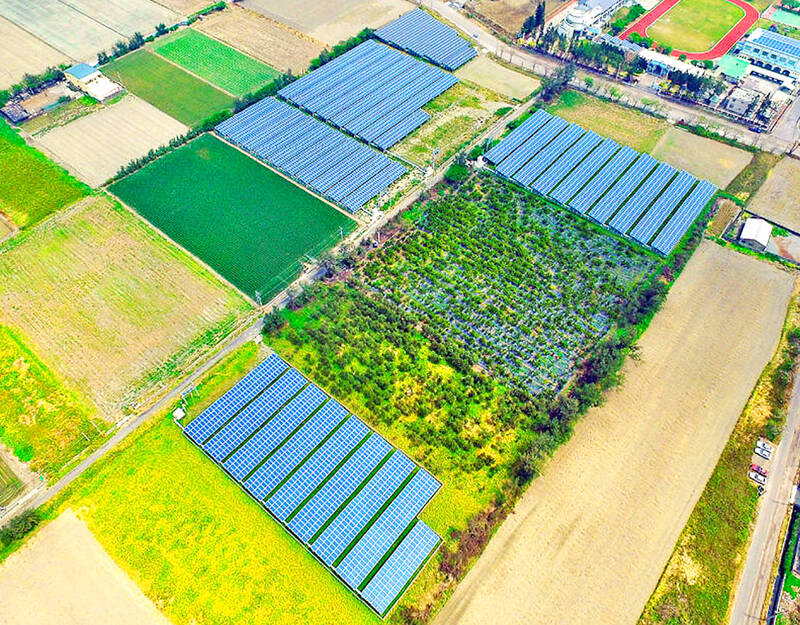
Photo: Taipei Times file photo
As observers were quick to point out, and Taipower’s press release acknowledged, Feb. 11 wasn’t a working day for the vast majority of Taiwan’s people. During the Lunar New Year vacation, many factories that otherwise run 24/7 take a break. This makes a huge difference: In 2021, the industrial sector accounted for 57 percent of total electricity consumption in Taiwan.
Thanks to just the right kind of weather on Feb. 11, solar contributed a little over 8GW for part of the day, yet few households turned on their air-conditioning.
Comparison with the 2023 Lunar New Year holiday season throws some flattering light on Taiwan’s efforts to decarbonize its grid. A year ago, Taipower patted itself on the back when the solar-wind combination crept over the 30 percent mark. The completion in recent months of large-scale solar and offshore wind projects has clearly made a difference to the energy mix.
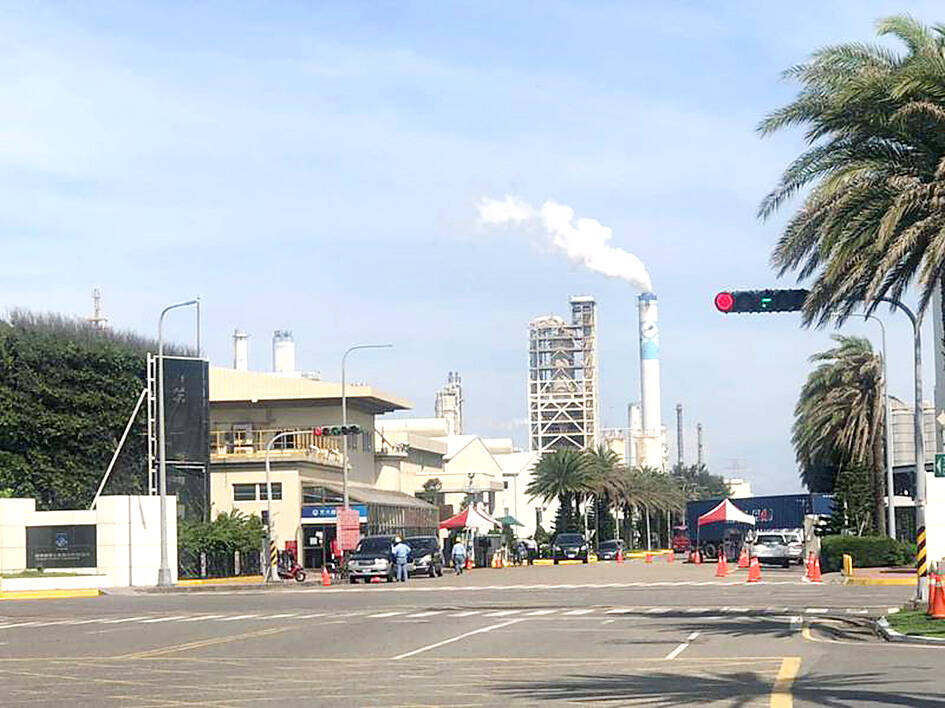
Photo courtesy of Formosa Plastics
WORK TO DO
However, the total for last year as a whole wasn’t nearly so impressive. Including hydropower and waste-to-energy plants, as well as tiny amounts contributed by geothermal and biomass facilities, renewables produced just under 11 percent of the electricity consumed in Taiwan. That’s an improvement compared to 2022 (9.8 percent), which itself was better than the 2018 figure (6.3 percent).
Taiwan’s energy predicament is often compared to that of Japan. Both countries depend on imported fossil fuels, and in neither is there much enthusiasm for nuclear power. Yet in 2022, renewables accounted for 22.7 percent of Japan’s total electricity generation, up from 22.4 percent the previous year. Less than half of that comes from solar and wind, however. Japan has a significant hydropower advantage over Taiwan, and makes much more use of biomass. Geothermal energy has yet to become a significant source of electricity in Japan or Taiwan.
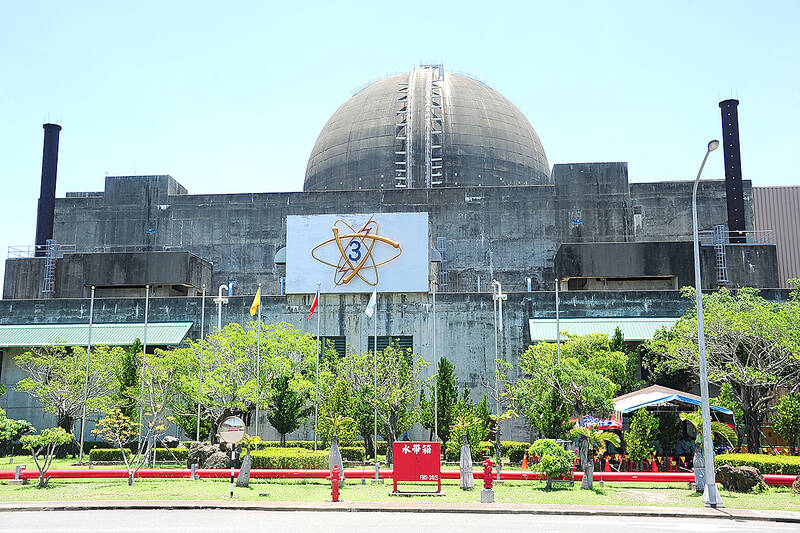
Photo: Taipei Times file photo
There’s no realistic prospect of Taiwan significantly expanding its hydroelectric capacity. In those few places where the topography lends itself to the building of new hydropower plants, such as Meinong (美濃) in Kaohsiung, there’s strong local opposition.
Since 2018, Japan has doubled the capacity of its biomass power stations. These plants, which burn biogas, wood chips, and certain waste materials, produced 4.6 percent of the country’s electricity in 2022. In Taiwan last year, less than 0.1 percent of the electricity fed into the grid came from biomass-to-power facilities.
According to a paper published in the academic journal Energies in 2022, among the steps Taiwan could take to expand this source of energy are: easing regulations on the establishment of biomass plants in industrial parks; promoting the use of biomass-based fuels in industrial boilers and heaters; and increasing feed-in tariff (FIT) rates to better reflect recent increases in capital and operating costs. But regulatory change is seldom quick. Only in the past few months has the government announced plans to make photovoltaic arrays a mandatory feature on every new building with a footprint of at least 300 ping (坪, equal to 992m2) — something that should have been done years ago.
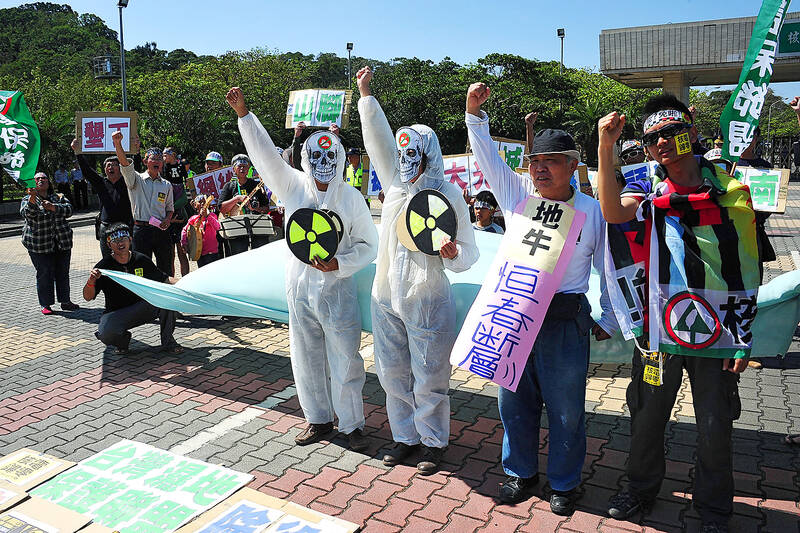
Photo: Tsai Tsung-hsien, Taipei Times
PROLONGING COAL
In certain respects, Japan may be ahead of Taiwan, yet not everyone is satisfied with Tokyo’s progress toward net zero. Christopher Doleman, in a Jan. 26 op-ed published by Nikkei Asia, criticized JERA, Japan’s no. 1 power producer, for “showing no signs of abandoning its fossil fuel-dominated business model. Rather, it is seeking to prolong the life of its coal-fired power plants through adopting unproven decarbonization technologies.”
In addition to putting vast amounts of carbon dioxide in the atmosphere, coal-fired power stations emit nitrogen oxide, sulfur dioxide, particulate matter, and other gaseous pollutants. Although burning liquified natural gas (LNG) produces significantly less carbon dioxide, recent research suggests that, if extraction, liquefaction, transportation, and methane emissions during combustion are counted, the climate impact of gas might be even greater than that of coal.
Since 2018, coal-fired power plants have generated between 26.5 percent and 28.2 percent of Japan’s electricity. Taiwan’s dependence on coal peaked two decades ago at around 45 percent, and in the past two years it has fallen below 35 percent. Given that the government has scaled back its 2025 target for renewables, from 20 percent of the nation’s electricity to 15 percent, and the country’s last nuclear power station is due to go offline next year, it isn’t clear if the next few years will see any meaningful decline in the amount of coal Taipower burns.
South Korea, where annual per capita electricity consumption is very slightly lower than in Taiwan, is a bit behind Taiwan when it comes to solar and wind power. In 2022, renewables accounted for a mere 8.9 percent of total electricity supplies. That year, the country got most of its grid power from coal (32.5 percent), nuclear (29.6 percent) and LNG (27.5 percent).
Between now and 2036, Seoul expects nuclear power output to increase, coal’s share of the mix to fall to 14.4 percent, LNG to shrink to 9.3 percent, and renewables to expand to 30.6 percent. If these targets are achieved, South Korea is likely to overtake Taiwan in the race to decarbonize.
According to “Taiwan’s Pathway to Net-Zero Emissions in 2050,” published on Mar. 30, 2022 by the National Development Council, renewables should meet between 60 percent and 70 percent of Taiwan’s electricity needs by 2050. This allows for a growth in demand of between 1.5 percent and 2.5 percent per year, which is likely if gasoline-burning cars are replaced by electric vehicles.
Hydrogen energy is expected to account for 9 percent to 12 percent, with the remainder coming from thermal power plants equipped with carbon-capture technologies. It isn’t clear if these plants will burn LNG or coal. The document includes the words, “phasing out of coal,” but no target date is given.
Europe is doing much better than East Asia. Last year, 27 percent of the EU’s electricity was provided by wind and solar, up from 23 percent the previous year. Also last year, coal generation declined by a quarter to make up just 12 percent of the electricity mix in 2023. For a fourth consecutive year, the burning of LNG also fell.
In some countries, progress has been even more rapid. For a 131-hour period in late 2019, the electricity needs of Portugal were entirely met by renewables. The Iberian country hasn’t used any coal since 2022. Last year, starting from the early hours of Oct. 31, it managed to go without burning any fossil fuels for 149 consecutive hours.
Portugal has three major advantages over Taiwan. Annual per capita electricity consumption is just four tenths of that in Taiwan. It’s blessed with an abundance of hydropower resources, accounting for 23 percent of total power generation in 2021. And because Portugal’s population density is less than a fifth of Taiwan’s, finding locations for solar arrays and onshore wind farms is surely easier.
Will anyone reading this today still be alive the day Taiwan finally manages to power itself entirely by renewables?
Steven Crook, the author or co-author of four books about Taiwan, has been following environmental issues since he arrived in the country in 1991. He drives a hybrid and carries his own chopsticks. The views expressed here are his own.

The problem with Marx’s famous remark that history repeats itself, first as tragedy, the second time as farce, is that the first time is usually farce as well. This week Chinese Nationalist Party (KMT) Chair Cheng Li-wun (鄭麗文) made a pilgrimage to the People’s Republic of China (PRC) “to confer, converse and otherwise hob-nob” with Chinese Communist Party (CCP) officials. The visit was an instant international media hit, with major media reporting almost entirely shorn of context. “Taiwan’s main opposition leader landed in China Tuesday for a rare visit aimed at cross-strait ‘peace’”, crowed Agence-France Presse (AFP) from Shanghai. Rare!

What is the importance within the Chinese Nationalist Party (KMT) of the meeting between Xi Jinping (習近平), the leader Chinese Communist Party (CCP), and Cheng Li-wun (鄭麗文), the leader of the KMT? Local media is an excellent guide to determine how important — or unimportant — a news event is to the public. Taiwan has a vast online media ecosystem, and if a news item is gaining traction among readers, editors shift resources in near real time to boost coverage to meet the demand and drive up traffic. Cheng’s China trip is among the top headlines, but by no means

Sunflower movement superstar Lin Fei-fan (林飛帆) once quipped that the Democratic Progressive Party (DPP) could nominate a watermelon to run for Tainan mayor and win. Conversely, the DPP could run a living saint for mayor in Taipei and still lose. In 2022, the DPP ran with the closest thing to a living saint they could find: former Minister of Health and Welfare Chen Shih-chung (陳時中). During the pandemic, his polling was astronomically high, with the approval of his performance reaching as high as 91 percent in one TVBS poll. He was such a phenomenon that people printed out pop-up cartoon
A recent report from the Environmental Management Administration of the Ministry of Environment highlights a perennial problem: illegal dumping of construction waste. In Taoyuan’s Yangmei District (楊梅) and Hsinchu’s Longtan District (龍潭) criminals leased 10,000 square meters of farmland, saying they were going to engage in horticulture. They then accepted between 40,000 and 50,000 cubic meters of construction waste from sites in northern Taiwan, charging less than the going rate for disposal, and dumped the waste concrete, tile, metal and glass onto the leased land. Taoyuan District prosecutors charged 33 individuals from seven companies with numerous violations of the law. This


 RSS
RSS