


Preceded by shouts and yelps, the handmade rattan ball flew upward until it was several meters above the narrow village street. As soon as gravity began pulling it back to Earth, more than a dozen young men tilted the spike-tipped bamboo poles they were holding upright, jostling while trying to snag the ball.
More often than not, the ball hit the tarmac. A few times, it landed on a rooftop and had to be given up as lost. But whenever a rattan ball was caught, onlookers clapped and cheered. The master-of-ceremonies tucked a red envelope into the pocket of the lucky lad, who then chugged a plastic beaker of millet wine. And unlike the far more formal ceremony we’d watched that morning — where the only reward for success was prestige — the “winner” didn’t have to immediately withdraw and give his spot to another Paiwan participant.
TOURS IN ENGLISH
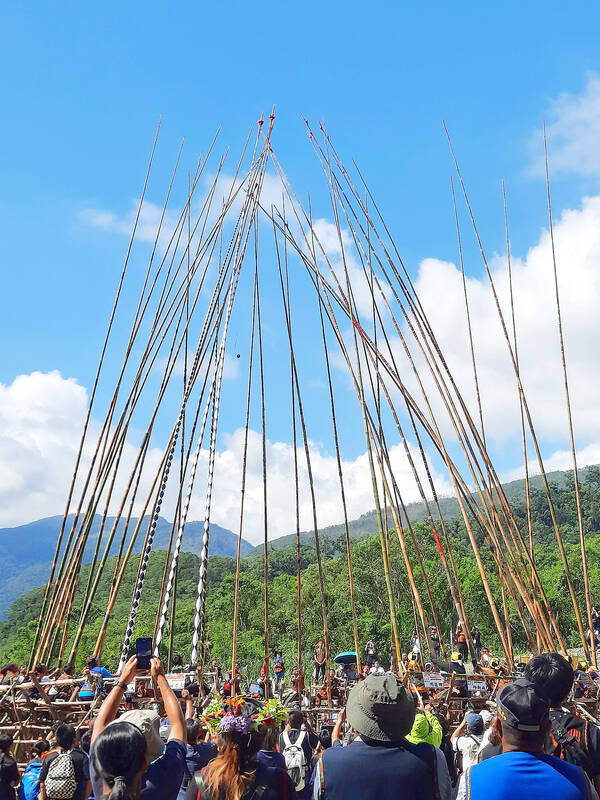
Photo: Steven Crook
We’d been invited to this corner of Taitung by the organizers of the Cross-Generational Bilingual Training Program, a multiyear government-sponsored project that has tried to make the county more accessible to travelers who don’t speak Mandarin. Rather than spend money on bilingual signs or English-language Web sites, this program focuses on giving local people the ability to introduce in English what the itinerary booklet described as “culturally profound attractions waiting to be discovered.”
And we’d learned a great deal. Our guides — who included a university freshman and a woman who’s made a name for herself as a wild-vegetables expert — introduced indigenous toponyms, songs and cuisine, told us about the impact of Japanese colonialism and foreign missionaries, and explained certain differences between Paiwan culture and the traditions of Taiwan’s other indigenous communities. Among the Paiwan people, for instance, hereditary chieftainships pass to the firstborn child, whether they’re male or female. But in the neighboring Rukai community, the position is awarded to the oldest male child.
The previous day had included a visit to a driftwood workshop at Duoliang (多良) in Taimali Township (太麻里), and a session learning about the culture and staple food of the indigenous Paiwan people at the Millet School (小米學堂) in Jinfeng Township (金峰).
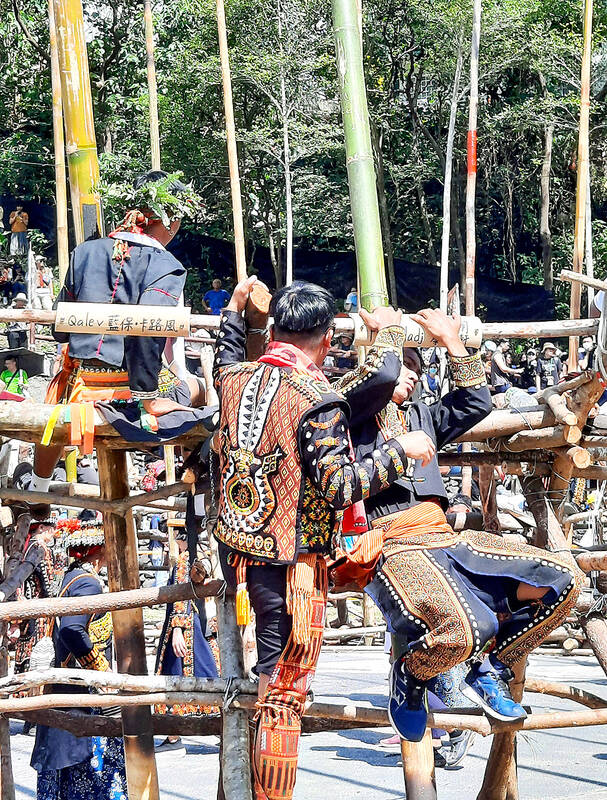
Photo: Steven Crook
Now we were in the village that, for a few days every five years at least, is the center of the Paiwan universe: Tuban (土?) in Daren Township (達仁鄉).
FIVE-YEAR CEREMONY
Tuban, or Tjuabal as it’s known to speakers of the Paiwan Austronesian language, hosts the tribe’s quinquennial Maljeveq Festival, sometimes called the Five-Year Ceremony (五年祭). It’s the only Paiwan community where this ancestor-honoring rite has been celebrated regularly since well before the 1895-1945 era of Japanese colonial rule. The Maljeveq Festival at Gulou (古樓; Paiwan: Kuljaljau) in Pingtung County’s Laiyi Township (來義鄉) was in abeyance for a period after World War II.
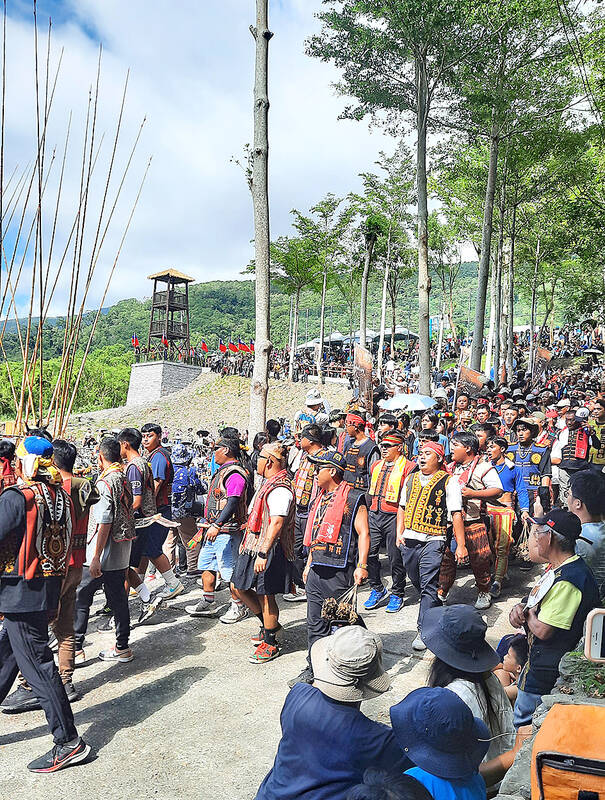
Photo: Steven Crook
Preceded by speeches and announcements in Paiwan and Mandarin, Tjuabal’s 2023 Maljeveq in Tuban culminated on the morning of Oct. 25. On a sunbaked clearing, chiefs, aristocrats and warriors formed a circle around a shaman. I was told that 40 to 42 men usually take part; I counted 37.
Each man had a designated place, and each gripped a personalized bamboo pole several meters long. There was some variation in length. Most were unpainted, but a few bore the black-and-white diamond pattern that symbolizes the hundred-pacer snake, a tribal totem. Some poles were crowned with three spikes instead of the usual one. In the past, this signified a warrior who’d notched up an impressive number of kills. Nowadays, it’s possible to earn this honor through peaceful endeavors such as higher education.
The tempo of the ceremony reminded me of a baseball match, and not just because nobody knew what exactly time it’d finish. The atmosphere was neither solemn nor raucous. And there was music: Paiwan voices, unaccompanied by any instruments.
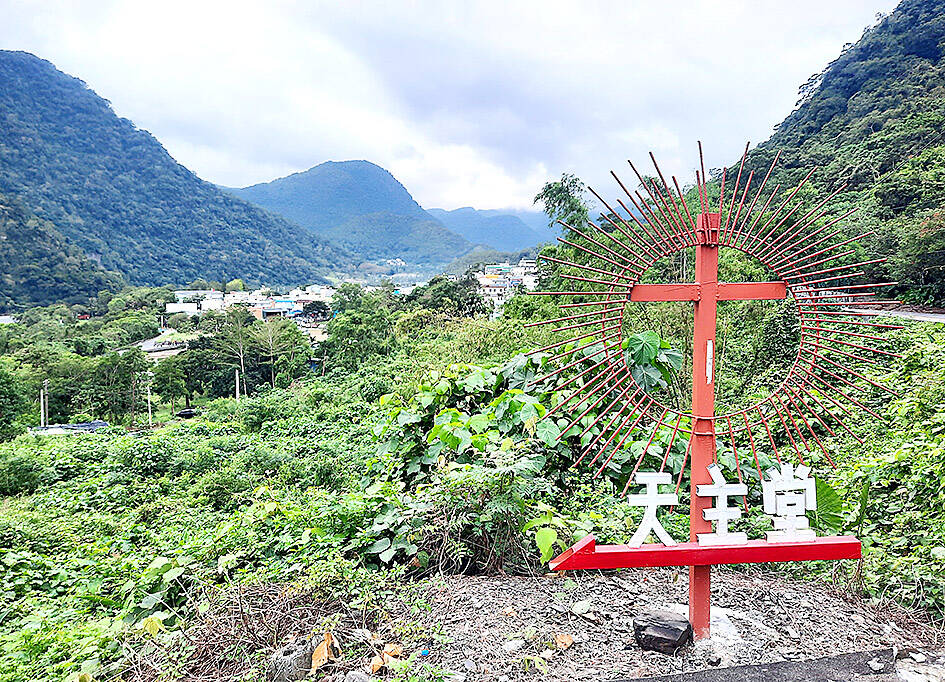
Photo: Steven Crook
The officiating shaman uttered a spell — there are 10 in total — then pitched the ball skyward. If it wasn’t caught, he threw it again. And again and again, until it was caught.
A few “innings” ended on the third or fourth throw, but other times it took a dozen or more attempts to ensnare the rattan sphere. As at a baseball game, most of those watching kept one eye on their phones. Some grumbled about the quality of the pitching, yet every success was greeted by applause. As soon as a pole holder claimed a ball, he left the circle and his place was taken by another person.
Most of the spells are believed to bring good things to whoever catches the ball. A few, however, represent hazards. If you spike one of the latter, I was told, you win respect, because you’ve taken one for the team. This year, the final ball was caught well before lunchtime.
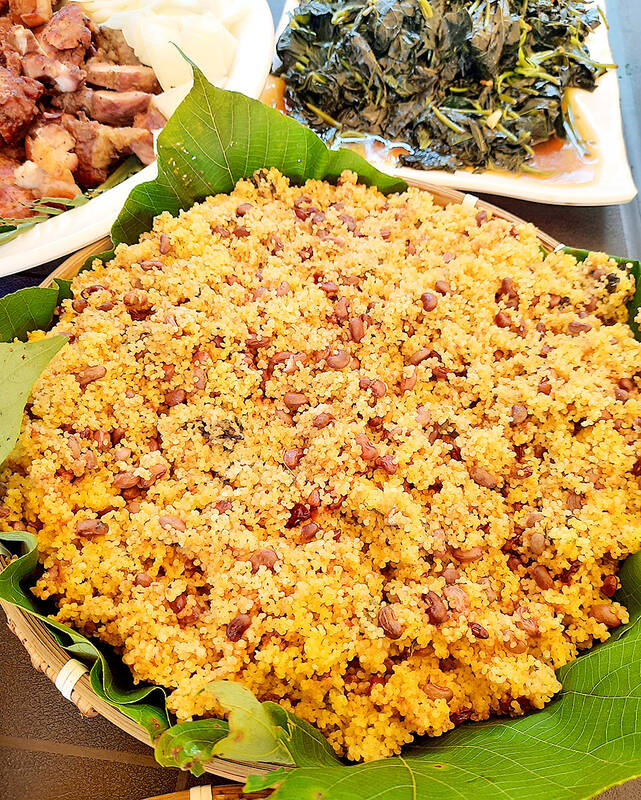
Photo: Steven Crook
According to Cheryl Robbins, the American who led our tour, far more people were at this year’s Maljeveq Festival compared to the event she attended 10 years ago. The majority were indigenous, but I spotted several sightseers of Han descent and a few Western faces.
True to its name, the Cross-Generational Bilingual Training Program involves people of all ages. This has enabled culture, language and knowledge to be passed on, explains Robbins, a Taiwan-licensed tour guide who specializes in local indigenous communities.
“This program is unique and valuable in that it’s a four-year project, whereas most training projects in Taiwan last for only one year. That means we, the consultants, can do more in terms of providing guidance to participants on developing tourism products for the international market and introducing their destinations or communities in English,” says Robbins, who’s served as a consultant to the project since its inception. “I consider it a success.”

It seems every few days one bumps into one of those “real man” comments in which Taiwan is urged to “face reality” or similar, and “make a deal,” with the speaker implying that soon it will be too late. “Deal” advocates always present themselves as having a superior grip on reality, and the manly ability to make the “hard choice.” Their testosterone-laden language often echoes that of Taiwan sellout advocates. Note that such commentary always specifies a process (“make a deal, work with, make progress”), never the end state of what occupation by a violent authoritarian colonialist state will entail. In

There are shadowy cabals plotting to sell out Taiwan to be annexed by China, by invasion if necessary. Fortunately, they are buffoons. In 2019, former Bamboo Union gangster and founder of the China Unification Promotion Party (CUPP), Chang An-le (張安樂, colorfully known as “White Wolf”), led a protest at the Legislative Yuan against comments made by then-premier Su Tseng-chang (蘇貞昌) that in the event of an attack by China, he would never surrender, but would protect the nation by fighting to the end, even if he only had a broom. Chang had party members bring a wooden casket that they
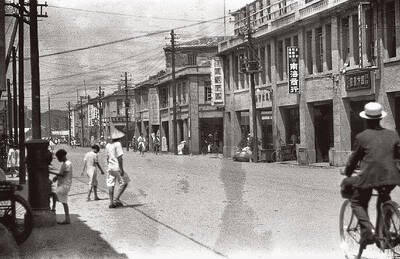
June 1 to June 7 "If all Taiwanese were as afraid of dying as you, then what would happen?” Physician Shih Chiang-nan (施江南) reportedly said this to his wife Chen Chiao-tung (陳焦桐) after she urged him to stop intervening on behalf of Taiwanese soldiers stranded overseas after serving in the Japanese Army during World War II. Shih had clashed with high-ranking officials over the issue, engaged in several heated arguments with Taiwan governor-general Chen Yi (陳儀) and allegedly shouted at general Ko Yuan-fen (柯遠芬), chief of staff of the Taiwan Garrison Command, over

Food prices have often played a major role in Taiwan’s history. The first major wave of migration from China occurred in 1628. A moderate drought, the Ming Dynasty maritime ban that prohibited fishing and trading (intended to reduce piracy) and a temporary tax, conspired to exhaust local resources, leading to famine in Fujian Province. The famed pirate and trader Zheng Zhilong (鄭芝龍), scooped up starving people from Fujian and transported them across the Taiwan Strait, where they settled under the Dutch. Two factors enabled Zheng. First, by 1624 he had settlements around today’s Beigang (北港) in Yunlin County with a small


 RSS
RSS