


A heightened fear for their safety, increased worry for their families, and a desperate search for international support — this is what dominates everyday life for two activists in Britain who are among Hong Kong’s most wanted.
Last month, Hong Kong police announced bounties of HK$1 million (US$128,000) on eight democratic activists living abroad, encouraging the public to pass on information that could lead to their arrest.
Former legislator Nathan Law(羅冠聰) and veteran unionist Christopher Mung (蒙兆達) are among the eight, accused under a sweeping national security law that Beijing imposed on the city to quell dissent following massive 2019 protests. Singled out overnight with the announcement, they woke up in England on July 3 to messages on social media about their fugitive status.
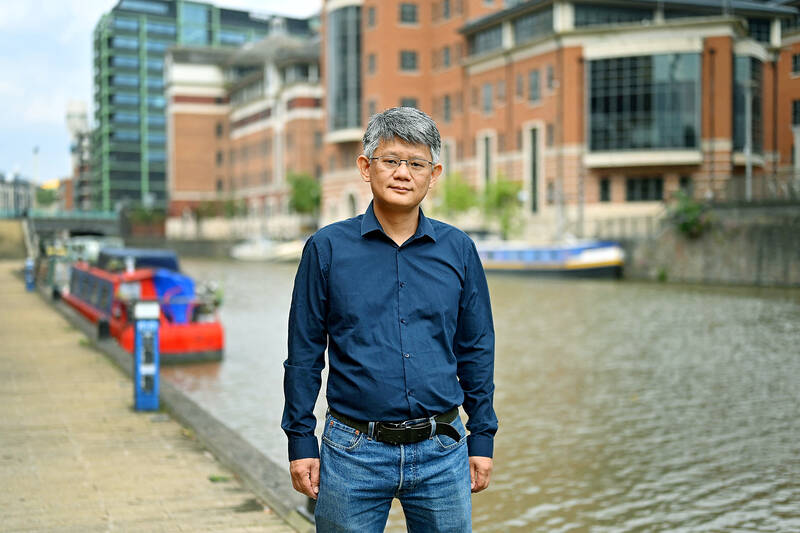
Photo: AFP
“I was shocked,” Mung, 51, said in a recent interview in Britain, saying that he looked into the charge of secession to figure out why he was in the group. He realized “once you (are) targeted by the regime, then you will be charged with whatever excuse.”
“If I were ever found guilty, the only crime should be speaking out the truth for Hong Kong people,” the veteran unionist said.
Law, 30, a familiar face for his role as prominent legislator in Hong Kong’s pro-democracy bloc, said being wanted by the law was not new for him.
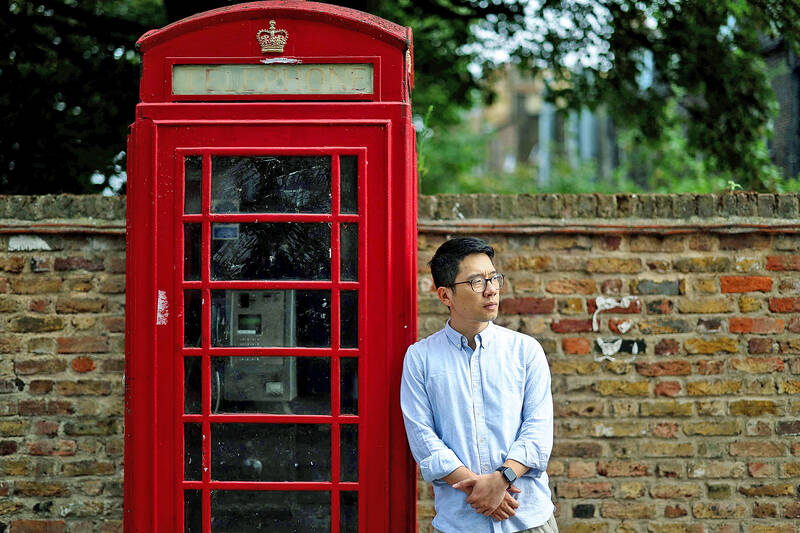
Photo: AFP
“But being on a bounty list is definitely something new,” Law said in London, where he was granted asylum in 2021 for his political advocacy. “I had to look into it, what does it entail, and whether it will give a lot of incentive for the people around me... to provide any information of sensitive privacy data about me,” he said.
Suddenly being pushed to think about how to protect his personal information and his daily movements caused “a little bit of anxiety.”
“It also shows the stepping up of Hong Kong government’s intimidation tactics, (in which) they’re not only arresting you — they’re harassing people around you, then they are trying to offer incentive for people to give up your information,” Law said.
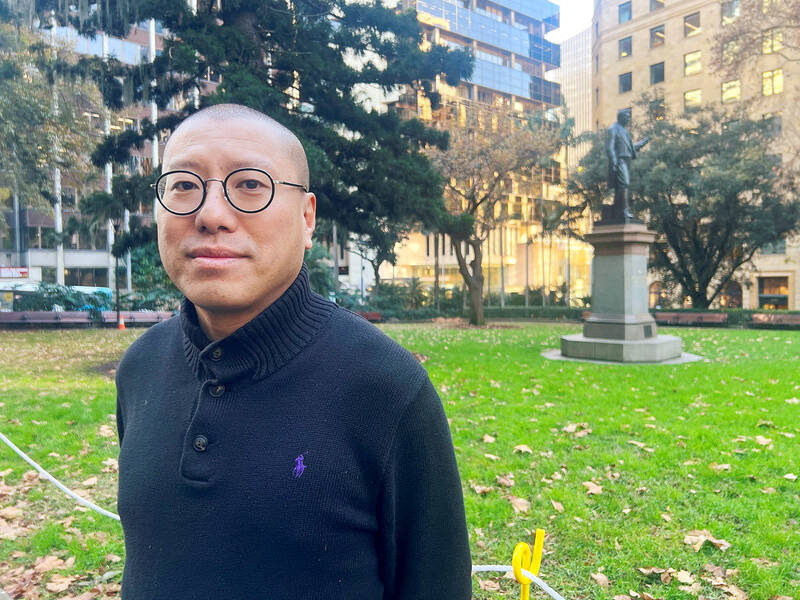
Photo: Reuters
Hong Kong’s leader John Lee (李家超) has said the group of eight will be “pursued for life” and “spend their days in fear.”
The US, Britain and Australia — all countries where the activists are currently residing — have condemned Hong Kong for issuing bounties.
‘HARASSING’ FAMILIES, COLLEAGUES
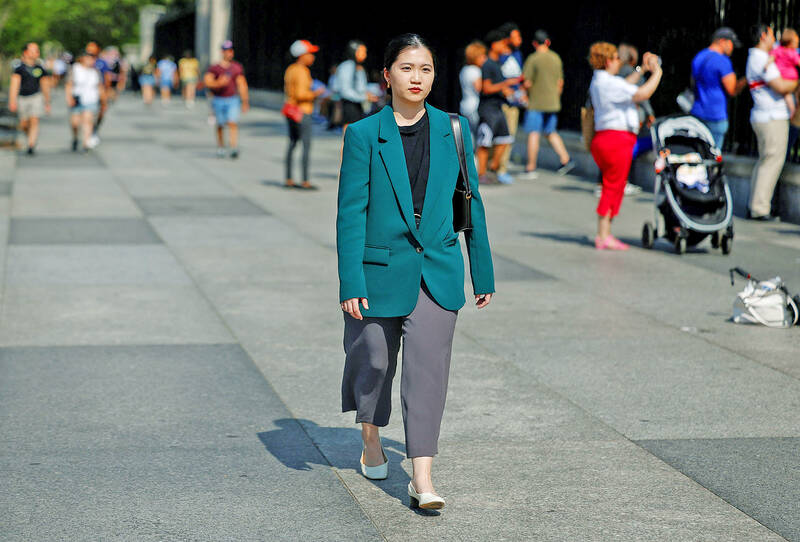
Photo: Reuters
Police have so far taken in at least 30 people in Hong Kong, two-thirds of them family relatives, for questioning over their alleged ties to the eight activists. Most were released within hours and not formally arrested.
During the same period, seven former members of a now-disbanded political party, once led by Law, were arrested for supporting “people who have fled overseas” accused of national security crimes. “That has become the common pattern for the regime — to blackmail the social activists by harassing their colleagues or their family members on the ground,” said Mung, who said he has not set foot in Hong Kong since he left in September 2021.
But he is “worried” about his family in Hong Kong — in the past month, his brother, sister-in-law and nephew were taken in for questioning. “Although they don’t have any relation (to) what I’m doing, I still have low confidence to say they are safe,” Mung said.
The new strategy shows “the long-arm policy of China and of Hong Kong”, said Law, whose family members were questioned by the police even though he has repeatedly said he has severed ties with them.
He also rejected the accusation that he is a “foreign agent”.
“The government doesn’t want to recognise... that Hong Kong people have the agency to resist,” Law said.
Mung agreed, adding that “even those in prison... still hold their belief in their hearts”.
More than 260 people have been arrested under the national security law since its enactment in 2020, with most of the city’s best-known activists jailed or fled overseas.
‘SPEAK THE TRUTH’
Now settled in Britain, Mung remains cautious about disclosing personal information. He wears a cap when going out to avoid being recognized and carries an alarm device with him.
But he is determined to continue his advocacy.
“I will remind myself... the burden on us is still much less than what the people in Hong Kong are bearing,” he said. “If I stopped because of the fear, that will only encourage the Chinese government to do more intimidation.”
Echoing Mung, Law called for “more sanctions” on Hong Kong for its crackdown on civil rights.
“We are here to speak out the truth and what is really happening in Hong Kong, and (urge) the global community to implement a more assertive policy towards China and towards Hong Kong,” Law said. “That wouldn’t change.”
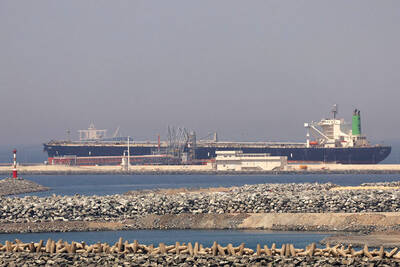
The breakwater stretches out to sea from the sprawling Kaohsiung port in southern Taiwan. Normally, it’s crowded with massive tankers ferrying liquefied natural gas from Qatar to be stored in the bulbous white tanks that dot the shoreline. These are not normal times, though, and not a single shipment from Qatar has docked at the Yongan terminal since early March after the Strait of Hormuz was shuttered. The suspension has provided a realistic preview of a potential Chinese blockade, a move that would throttle an economy anchored by the world’s most advanced and power-hungry semiconductor industry. It is a stark reminder of
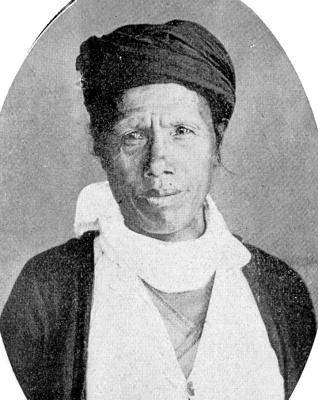
May 11 to May 17 Traversing the southern slopes of the Yushan Range in 1931, Japanese naturalist Tadao Kano knew he was approaching the last swath of Taiwan still beyond colonial control. The “vast, unknown territory,” protected by the “fierce” Bunun headman Dahu Ali, was “filled with an utterly endless jungle that choked the mountains and valleys,” Kano wrote. He noted how the group had “refused to submit to the measures of our authorities and entrenched themselves deep in these mountains … living a free existence spent chasing deer in the morning and seeking serow in the evening,” even describing them as
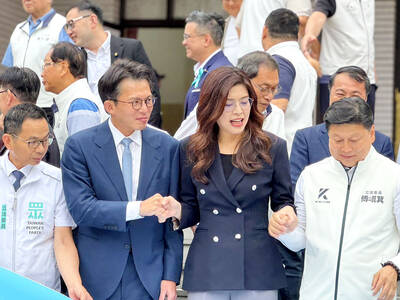
As a different column was being written, the big news dropped that Chinese Nationalist Party (KMT) caucus whip Fu Kun-chi (傅?萁) announced that negotiations within his caucus, with legislative speaker Han Kuo-yu (韓國瑜) of the KMT, party Chair Cheng Li-wun (鄭麗文), Taichung Mayor Lu Shiow-yen (盧秀燕) and Taiwan People’s Party (TPP) Chair Huang Kuo-chang (黃國昌) had produced a compromise special military budget proposal. On Thursday morning, prior to meeting with Cheng over a lunch of beef noodles, Lu reiterated her support for a budget of NT$800 or NT$900 billion — but refused to comment after the meeting. Right after Fu’s
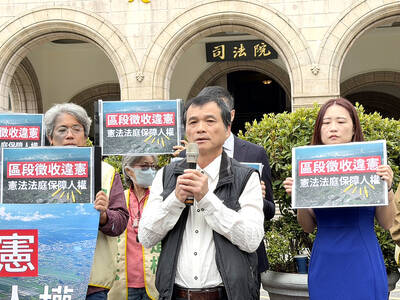
What government project has expropriated the most land in Taiwan? According to local media reports, it is the Taoyuan Aerotropolis, eating 2,500 hectares of land in its first phase, with more to come. Forty thousand people are expected to be displaced by the project. Naturally that enormous land grab is generating powerful pushback. Last week Chen Chien-ho (陳健和), a local resident of Jhuwei Borough (竹圍) in Taoyuan City’s Dayuan District (大園) filed a petition for constitutional review of the project after losing his case at the Taipei Administrative Court. The Administrative Court found in favor of nine other local landowners, but


 RSS
RSS