


Flamin’ Hot Cheetos get an origin story worthy of any Marvel superhero with Hulu’s totally engrossing Flamin’ Hot. It’s the tale of how a struggling Mexican American janitor came up with the idea of adding spice to the cornmeal, forever saving after-school snacking.
Is it true? Probably not. Don’t let that stop you.
You’ll wish Flamin’ Hot was accurate because it’s a winning tale of perseverance, family love, proud heritage and blue-collar success, told with a wink, some Cheetos dust and a ton of love by Eva Longoria, in her directorial debut.
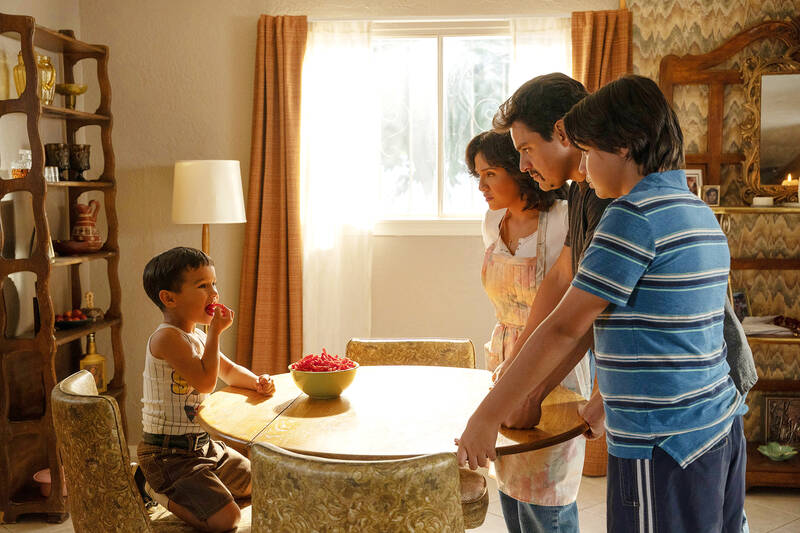
Photo: AP
Jesse Garcia stars as Richard Montanez, a one-time Frito-Lay floor-sweeper in southern California who convinced his bosses to make a snack that celebrates the flavors of Mexico despite a seven-layer dip of skeptics.
“New products take years to develop, cost millions to launch and they do not get created by blue-collar hoodlums, who probably can’t spell hoodlum,” our hero is told.
Nevertheless, Montanez persists, cracking the Latino market and repairing his relationship with his abusive father along the way.
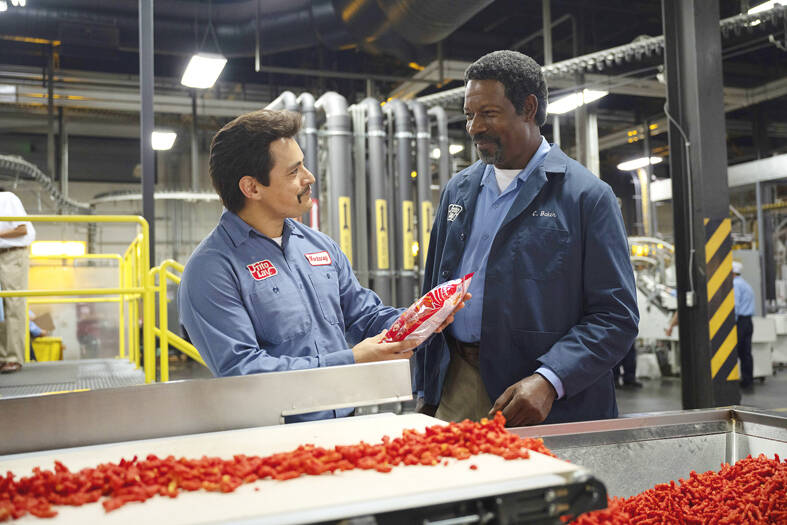
Photo: AP
“I’m the guy who helped bring the world the most popular snack it’s ever seen,” he says in a voice-over.
It’s an unlikely story, for sure. No, really. It’s unlikely. The Los Angeles Times has published allegations that Montanez fabricated his role in the snack’s creation and Frito-Lay says he “was not involved.”
But Longoria and the screenplay by Lewis Colick and Linda Yvette Chavez — based on Montanez memoir — will have you cheering when the gnarled red snacks finally zip along on an assembly line and you’ll be ready to gleefully fist-bump Montanez, played understatedly but with deep soul by Garcia.
This is more than just a snack-version Rocky story, with the filmmakers exploring the insecurity of factory shift workers, the stress of integrating into white culture, how hard it is for corporations to innovate and the ability to silence the voices in your head that urge you to quit.
In one heartbreaking early scene, Montanez — so poor he waters down the milk for his kids and uses chewing gum to seal holes in their shoes — is wide-eyed at the Frito-Lay factory until he notices all the overcooked chips are tossed.
“People are always trying to throw away the brown ones,” he says.
The filmmakers enliven their story with wonderful flights of fancy, like when we see Montanez lose it and beat up a manager with a mop after being called Paco.
“Nah, just kidding,” he says in the voice over. “What you think? It was my first week on the job.”
To show the passage of time during the Reagan administration, they’ve also cleverly got a man on the factory floor holding a box reading “1985,” the extruder pumps out “1986” and forklifts carrying boxes that read “1987” and “1988.”
There are a few references to Frito-Lay scientists in the Midwest also working on a spicy flavor, but this is strictly a fist-in-the-air portrayal of Montanez alone, set to a soundtrack of Latin artists like Santana, Los Lobos and Ozomatli.
His heroic arc is more than a little unbelievable, especially when he taps his former drug-dealing pals to start handing out free bags of chips like pushers, and for the many times he jumps up on a piece of factory equipment to deliver a Dead Poets Society-like speech.
Dennis Haysbert as a gruff engineer, Annie Gonzalez as Montanez’s loving wife and Tony Shalhoub as the CEO of Frito-Lay all add welcome flavor notes.
It’s the montages that really shine, like the moment in a park when Montanez, eating elote and watching everyone put hot sauce on their food, gets a vision of a spicy snack.
“I had been searching for an answer. Or a door to open. And there it was all around me. It had been there the entire time,” he says.
There’s also the sequence when he and his family try every chile combo — poblano, pasilla, serrano, guajillo and habanero included — until they find the right formula, often hovering around their youngest kid as he samples a chip and gives them the green light.
The final product is credited with opening the door to cool new convenience store flavors and for US corporations to finally respect the Latino market. That’s a lot of stuff to put in a bag of chips, even if it’s all made up. But it’s so fun to watch. It burns so good.

Growing up in a rural, religious community in western Canada, Kyle McCarthy loved hockey, but once he came out at 19, he quit, convinced being openly gay and an active player was untenable. So the 32-year-old says he is “very surprised” by the runaway success of Heated Rivalry, a Canadian-made series about the romance between two closeted gay players in a sport that has historically made gay men feel unwelcome. Ben Baby, the 43-year-old commissioner of the Toronto Gay Hockey Association (TGHA), calls the success of the show — which has catapulted its young lead actors to stardom -- “shocking,” and says

The 2018 nine-in-one local elections were a wild ride that no one saw coming. Entering that year, the Chinese Nationalist Party (KMT) was demoralized and in disarray — and fearing an existential crisis. By the end of the year, the party was riding high and swept most of the country in a landslide, including toppling the Democratic Progressive Party (DPP) in their Kaohsiung stronghold. Could something like that happen again on the DPP side in this year’s nine-in-one elections? The short answer is not exactly; the conditions were very specific. However, it does illustrate how swiftly every assumption early in an

Inside an ordinary-looking townhouse on a narrow road in central Kaohsiung, Tsai A-li (蔡阿李) raised her three children alone for 15 years. As far as the children knew, their father was away working in the US. They were kept in the dark for as long as possible by their mother, for the truth was perhaps too sad and unjust for their young minds to bear. The family home of White Terror victim Ko Chi-hua (柯旗化) is now open to the public. Admission is free and it is just a short walk from the Kaohsiung train station. Walk two blocks south along Jhongshan

Francis William White, an Englishman who late in the 1860s served as Commissioner of the Imperial Customs Service in Tainan, published the tale of a jaunt he took one winter in 1868: A visit to the interior of south Formosa (1870). White’s journey took him into the mountains, where he mused on the difficult terrain and the ease with which his little group could be ambushed in the crags and dense vegetation. At one point he stays at the house of a local near a stream on the border of indigenous territory: “Their matchlocks, which were kept in excellent order,


 RSS
RSS