


June 5 to June 11
After trying all day, reporters finally reached then-Peking University president Ding Shisun (丁石孫) by phone. It was around 6pm on June 10, 1989, the first day that Taiwanese could directly call people in China, and a week after the People’s Liberation Army began violently suppressing the pro-democracy student protests in Tiananmen Square.
The reporters, who worked at the Liberty Times (Taipei Times’ sister newspaper), asked Ding about the situation at the school, whose students were the center of the demonstrations. Ding replied, “The students have all left!” When they asked whether any students or professors had been arrested, Ding paused for a moment and asked the reporters where they were calling from.
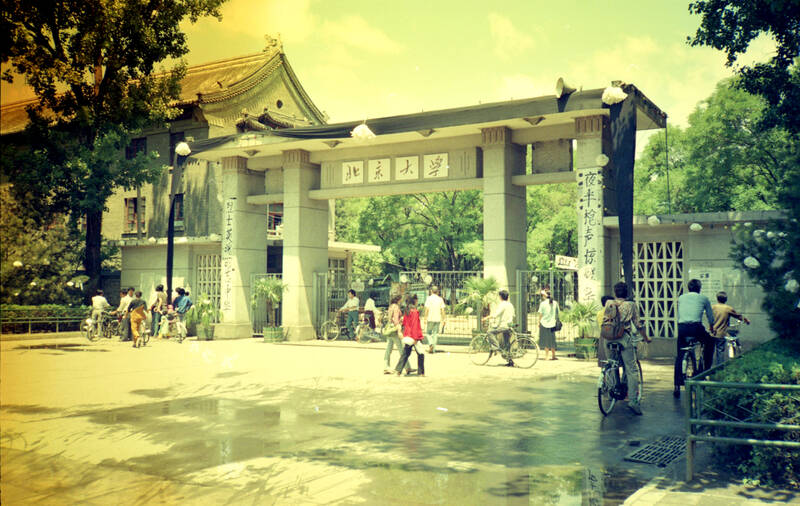
Photo courtesy of Wikimedia Commons
When they replied “Taipei,” Ding immediately said, “Let’s end the conversation here,” and hung up. He resigned from his post two months later.
The long-awaited phone connection between the two sides of the strait came at an inopportune time for the Chinese Communist Party (CCP), as they were trying to suppress news of the events. A YouTube video shows a reporter from Taiwan’s Chinese Television System (華視) calling a station in Beijing that day to inquire about the alleged killings of protesters, to which the voice on the other end responded, “That never happened!”
But most people just wanted to speak to their loved ones, which many haven’t heard from in over 40 years. The volume of calls was so high that the phones jammed for days, and the June 11, 1989 front page of the Liberty Times showed a woman tearfully speaking to her daughter in Shanghai.
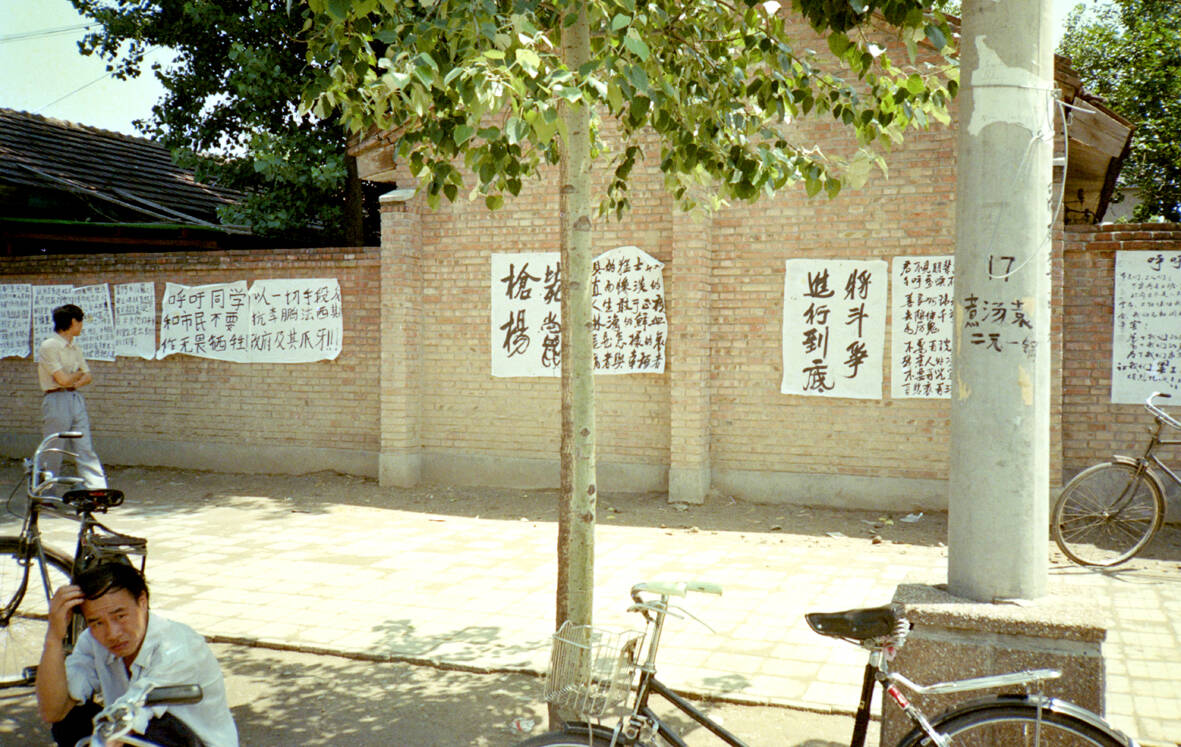
Photo courtesy of Wikimedia Commons
A total of 730,351 calls were made to China that year, with 767,606 received calls. This number grew to over 8 million outbound calls in 1992 and 41.5 million in 1995, which was 22 percent higher than international calls to other countries combined.
JAMMED CONNECTIONS
Contact between the two sides of the Taiwan Strait increased rapidly after the lifting of martial law in July 1987. Taiwanese were allowed to visit their relatives in China starting in November that year, and it was just a matter of time before telecommunications would open up. China had been calling for the opening of the “direct three links” (communications, trade and flights) with Taiwan since 1979, but the Chinese Nationalist Party (KMT) continued to adhere to a no official contact policy.
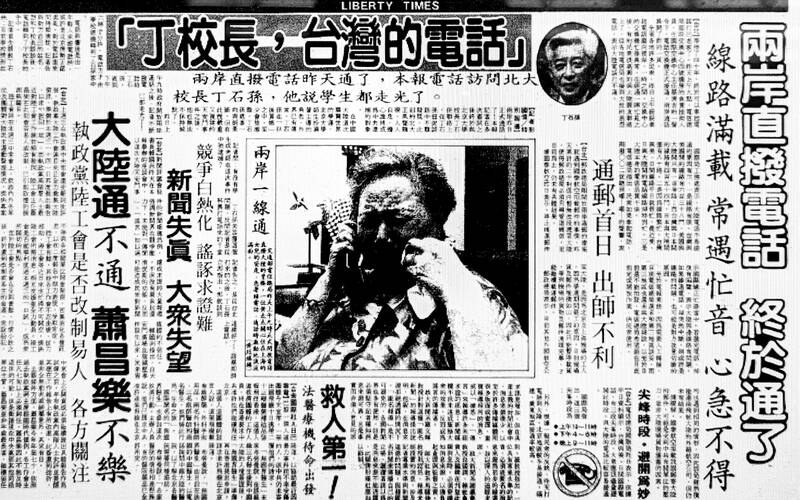
Photo: Taipei Times File
Direct mail began in June 1988, but it was still passed through Hong Kong airlines en route to China to avoid actual direct contact. It was the same with phone calls, which were routed via the US, Japan and Singapore. This led to unstable connections and exorbitant transfer fees — Taiwan forked over NT$650 million in 1994 — but this system remained in place until a fiber optic cable connection was established in 1997.
Calls officially began at 9am on June 10. The telecommunications offices around the nation couldn’t handle the sudden rush, and they received complaints all day from people who were unable to get through. A caller surnamed Chang (張) reported that he finally reached relatives in Beijing after nearly 30 attempts, while another surnamed Lee (李) gave up after more than 200 tries.
One problem was the disparity in connection numbers each side had with the routing country: Taiwan had 638 lines to the US, but the US only had around 100 to China, for example. The inferior quality of the Chinese telecommunication system was also an issue, and callers reported that it was easier to get through to Fujian and Guangdong provinces compared to Beijing and Shanghai.
“Only after China opened its telecommunications market to the world in the late 1970s did the outside world realize how primitive and crude its system was,” the Liberty Times reported.
Direct mail also hit a snag, as Hong Kong’s Cathay Pacific Airways declined to carry the more than 2,000 letters scheduled to go to China that day. The airlines explained that there was already a severe backlog in mail due to strikes at the Beijing and Shanghai airports in conjunction with the Tiananmen demonstrations, and they could not accept any more.
The Liberty Times supported the “three links,” noting in an editorial that the government’s no contact policy was severely out of tune with current events, which has led to inconveniences and illegal activity such as smuggling, and they might as well establish rules to regulate contact.
“We believe that instead of pretending to be blind and deaf, we might as well face reality,” it stated.
CALLING ABOUT TIANANMEN
Much of the news regarding the phone calls revolved around Tiananmen. Taiwan’s Central Daily News (中央日報) instructed readers how to call hotlines in China meant for its citizens to report “anti-revolutionary rioters.” The callers should report the real culprits, namely (then-CCP chairman) Deng Xiaoping (鄧小平), (then-premier) Li Peng (李鵬) and (then-president) Yang Shangkun (楊尚昆), the paper urged.
“We received inquiries from readers who were willing to, on their own dime, call these agencies responsible for arresting people and explain to them the People’s Liberation Army’s bloody acts of violence at Tiananmen Square, and persuade them to stop using cruel means to suppress Chinese,” the article stated. “But these are all public agencies, so if the person on the other end is unwilling to listen to reason, our readers should not waste their words either.”
The paper noted that it was unlikely that the Chinese authorities had the capability to intercept individual calls and cut them off. Therefore, callers from Taiwan could overwhelm these hotlines and reduce the number of people getting reported.
“It appears that China regrets its prior eagerness to open up direct links with Taiwan … These calls from Taiwan to China are now exposing the truth and creating a huge headache for the CCP,” the United Daily News stated.
Most people on the other end were reluctant to say too much.
“I started calling around 11am and got through to a relative serving in a government agency on my fifth attempt,” one reader told the China Times. “They said that things are very calm and told us not to worry, and I was afraid to ask too much.”
United Daily News reporters made about 300 random calls, first reaching a restaurant owner.
“Everything is normal, please don’t believe the rumors, Chinese should help Chinese and support our own government,” he responded.
Another man said that he was refraining from going outside and spending his time reading at home, while a student talked about returning to school the following week and the surge in vegetable prices.
The United Daily News got through to 22 people, eight of whom hung up after being asked about Tiananmen Square. Most who spoke acknowledged that protests and arrests had taken place in Beijing, but were only willing to discuss how it affected businesses, schools and transportation, stressing that things were mostly back to normal.
Taiwan in Time, a column about Taiwan’s history that is published every Sunday, spotlights important or interesting events around the nation that either have anniversaries this week or are tied to current events.
Ajay Verma, a consultant gastroenterologist at Kettering general hospital in Northamptonshire, says our gut is a “complex machine.” “It is constantly providing us with the nutrition we need, initially to grow and develop, and then for us to survive, thrive and repair from injury and illness.” How can we keep it functioning well? Put simply: “Make sure what you put into it is balanced, and that you clear out its waste products adequately,” Verma says. “In a general gastroenterology clinic, the most common conditions we see are irritable bowel syndrome (IBS), gastroesophageal reflux disease, inflammatory bowel disease and constipation,” says Nisha

And so, in the wake of US President Donald Trump’s trip to the People’s Republic of China (PRC), all the experts on the Strait of Hormuz suddenly became experts on US-China-Taiwan relations. The Internet has certainly expanded human knowledge. Lots of these sudden experts made noise this week about Trump’s words after the meeting with PRC dictator Xi Jin-ping (習近平). Trump is going to sell out Taiwan! Longtime Taiwan commentator J. Michael Cole summed the situation up neatly in the Guardian: “We need to keep in mind that he has a tendency to say many things — sometimes contradicting himself within

Last week US President Donald Trump was asked by a reporter whether he would speak on the phone to the President of Taiwan. “l’ll speak to him. I speak to everybody. We have that situation very well in hand,” Trump said. This marked the second time in a couple of weeks he had said he would talk to the President of Taiwan. In 2016 he famously took a call from then-president Tsai Ing-wen (蔡英文), when he was president-elect. Despite warnings that the apocalypse was nigh because of a phone call, the world quickly forgot about the conversation between two democratically-elected presidents.
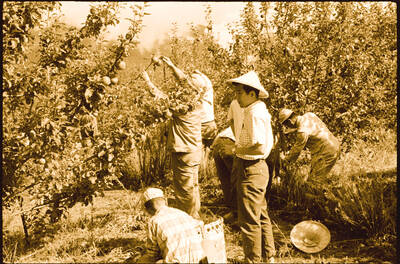
May 25 to May 31 Few believed that apples could be cultivated on a commercial scale in Taiwan’s high mountains. When horticulturalist Cheng Chao-hsiung (程兆熊) first proposed the idea in 1955, both American and Taiwanese colleagues dismissed it as implausible, arguing that temperate fruit could not be reliably grown on a subtropical island, especially on rugged terrain. However, it was this terrain in the Central Mountain Range where many Chinese Civil War veterans were resettled in the late 1950s. With limited job prospects and no family in Taiwan, they were placed on cooperative farms aimed toward self-sufficiency. Some say the conditions


 RSS
RSS