


Under the Enhanced Defense Cooperation Agreement (EDCA) between Washington and the Manila, the US is going to gain access to four bases in the Philippines, two or three most likely in Cagayan and Isabella provinces in northern Luzon.
Although officials in both countries said in a joint statement that “The addition of these new EDCA locations will allow more rapid support for humanitarian and climate-related disasters in the Philippines, and respond to other shared challenges,” these bases are obviously aimed at conflict over Taiwan, just 250km away.
The agreement also supported the completion of work at five bases the US already has access to.

Photo: AFP
Last week Senator Imee Marcos, the daughter of dictator Ferdinand Marcos and older sister of President Bongbong Marcos, questioned officials on the new agreement and the base locations, saying “I just need to understand why are you choosing all these sites in Northern Luzon when in fact if it were West Philippine Sea deterrence that were uppermost in our minds, the protection of our territorial sovereignty, surely it should be in the western sector not purely in the northern.”
CHINESE EXPANSIONISM
“West Philippine Sea” is how the South China Sea is referred to in the Philippines. The previous administration had been close to China, while the current one has shifted towards the US. At least part of that reason is Chinese expansionism in the area.
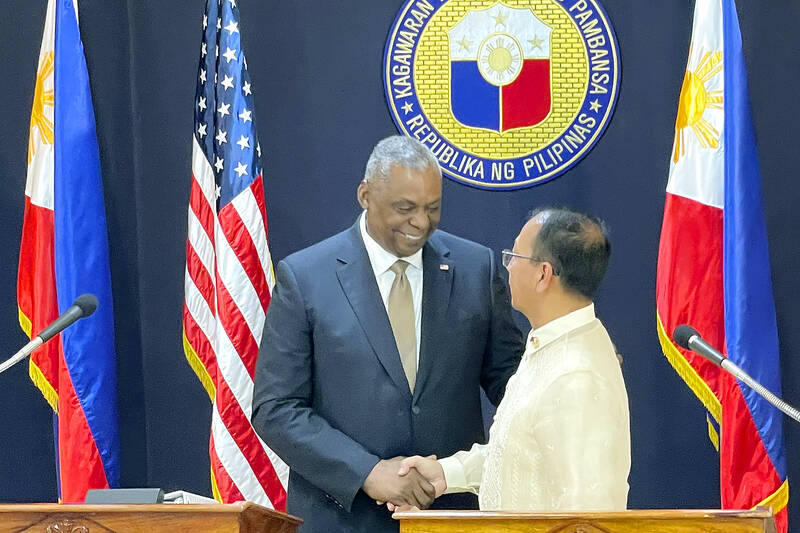
Photo: AP
The issue of Chinese expansion is not taken lightly in the Philippines, and is not the province of a particular party or intellectual school. For example, Walden Bello, longtime leftist writer, politician and intellectual (and author of Dragons in Distress, on environmental and social problems in the newly developed Asian economies in the 1980s), journeyed out to the Spratly Islands (Nansha Islands, 南沙群島) in 2011 to challenge China. Bello wrote in The Rappler in 2017: “Our mission: affirm our country’s sovereignty over nine islands and maritime formations in our possession amidst China’s increasingly aggressive behavior in the area.”
In March of 1956 Filemon Cloma led an expedition of Filipinos to the Spratlys and claimed a section of the area as a microstate called Freedomland (not to be confused with another section of the Spratlys called the Principality of Freedomland, established by a French swindler). His brother Tomas Cloma Sr declared the Free Territory of Freedomland in the area, establishing the capital and government on Flat Island (Patag Island).
ROC EXPANSIONISM

Photo: AFP
This microstate was effectively terminated in October of 1956 by two Republic of China (ROC) naval ships, which burned the structures that had been erected. Interestingly, during that expedition, as Francis-Xavier Bonnet has chronicled, the ROC naval ships left fake markers on islands in the Spratlys dating from 1946.
To this day the ROC still claims the South China Sea, confusing commentators who often falsely present this claim as if “Taiwan claims…” China’s notorious “nine-dash line” is, after all, an invention of the expansionist ROC adopted by the expansionist People’s Republic of China (PRC). ROC troops currently occupy Itu Aba Island (Taiping Island, 太平島), while China illegally occupies numerous islands and features in the area.
Similarly, certain authorities in the Philippines argue that Cloma’s claims have been inherited by the Philippines, since they compelled him to sell them for a single peso. One of Manila’s arguments is that since Japan renounced its claim to the islands in the San Francisco Peace Treaty, the islands became res nullius and anyone’s for the taking, and Cloma legally took them.

Photo: AP
In fact, in the 1930s far-sighted Filipino thinkers begged the US to claim the Spratlys on Manila’s behalf, but the US declined.
ARCHIPELAGIC NATIONS
The first article of the 1987 Philippines Constitution defines Philippine territory as an archipelagic nation and specifically includes the waters above and the seabed below its land territories. The Philippines thinks of itself as an oceanic state in a way that Taiwan should, but does not because the Han-centric thinkers who dominate Taiwan’s policy thinking come from a culture that traditionally has no connection to the sea.
Thus, another argument of the Philippines is that as an archipelagic state, it can claim a 200 mile exclusion zone, which includes the islands. China, which is not an archipelagic state, cannot claim them.
The idea of the Philippines as an oceanic state, and Imee Marco’s recent comments, are a reminder of how important the territory issue is to Filipinos of all political stripes. Bello’s 2017 piece was in response to then-president Rodrigo Duterte’s announcement that he would not be visiting Pagasa Island (Thitu Island) out of fear of offending China.
Critical of Duterte’s decision, Bello observed: “Practically the whole country supported the president’s initial decision to raise the flag at Pagasa. There was great relief that the policy of appeasing the beast was finally over.”
The PRC’s passage in 2021 of a law authorizing Chinese Coast Guard ships to use “all necessary means” against foreign vessels to enforce its territorial claims was termed a “verbal threat of war” by then-foreign secretary and current Philippine Ambassador to the UK Teodoro Locsin Jr. That’s exactly what it was.
As an aside, people who argue that we are far from war in Asia should consider the prospect of war erupting out of some peevish China aggression, such as lasering foreign ships and planes. China may not be planning a war in the near term, but that does not mean one can’t happen.
The ROC claims and island occupations in the South China Sea touch upon strongly held sensibilities, and unlike scholars or some Taipei Times commentators, Filipinos are not likely to make fine distinctions between Taiwan and the ROC.
SOUTH CHINA SEA RECONSIDERED
The recent agreements and rapprochement between Washington and Manila signal the latter’s role in any China conflict. Washington will be flying planes from bases there to interdict Chinese movements against Taiwan. Because Japan and the US Pacific territories are so distant, it is likely that such supplies as reach Taiwan will have to be brought up through the Philippines.
Taipei needs to be reconstructing and hardening its ports and transport systems on the east coast to handle wartime logistics requirements. It might also consider investments in logistics infrastructure in Luzon to complement these needs. Certainly Washington would welcome such proactive moves.
That would mean treating Southeast Asian nations as more than just suppliers of cheap labor, but as potential allies.
All this implies that Taipei should be thinking about uncomplicating the South China Sea situation with an eye toward future cooperation with Manila. Filipinos are not going to be happy about sacrificing for a state that squats on their sovereign territory.
It’s long past time Taipei thought about handing Itu Aba over to Manila and giving up its useless claims to the South China Sea, which bring nothing but headaches to the nation’s military planners and nothing but friction to its relationships with desperately needed neighboring states.
At some point, Taiwan will be a recognized independent state and the ROC will cease to exist as a ghostly avatar of China. These claims will then be a dead letter.
Kill them now, while we can still get something for them.
Notes from Central Taiwan is a column written by long-term resident Michael Turton, who provides incisive commentary informed by three decades of living in and writing about his adoptive country. The views expressed here are his own.

Taiwan’s overtaking of South Korea in GDP per capita is not a temporary anomaly, but the result of deeper structural problems in the South Korean economy says Chang Young-chul, the former CEO of Korea Asset Management Corp. Chang says that while it reflects Taiwan’s own gains, it also highlights weakening growth momentum in South Korea. As design and foundry capabilities become more important in the AI era, Seoul risks losing competitiveness if it relies too heavily on memory chips. IMF forecasts showing Taiwan widening its lead over South Korea have fueled debate in Seoul over memory chip dependence, industrial policy and

And so, in the wake of US President Donald Trump’s trip to the People’s Republic of China (PRC), all the experts on the Strait of Hormuz suddenly became experts on US-China-Taiwan relations. The Internet has certainly expanded human knowledge. Lots of these sudden experts made noise this week about Trump’s words after the meeting with PRC dictator Xi Jin-ping (習近平). Trump is going to sell out Taiwan! Longtime Taiwan commentator J. Michael Cole summed the situation up neatly in the Guardian: “We need to keep in mind that he has a tendency to say many things — sometimes contradicting himself within

It took 12 years and months of standing in the same mountain location for director Liang Chieh-te (梁皆得) to capture a few seconds of footage: Taiwan’s largest resident raptor locking talons with its mate and spinning through the air in a courtship ritual. With only about 1,000 left in the wild and very short flight windows, the mountain hawk-eagle remains among Taiwan’s most elusive birds. The species generally produces only one offspring per year. Using forest cameras, the film crew and research teams document the arduous process the monogamous pairs go through for the chick to hatch and grow up, weathering

There is considerable frustration and confusion among many, both in Taiwan and abroad — including in Washington — as to why the Chinese Nationalist Party (KMT) seems so dead set on using their legislative leverage to slash defense spending and disrupt the ability of the ruling Democratic Progressive Party (DPP) administration to function. Are they pawns of the Chinese Communist Party (CCP)? Are they traitors? In reality, there are multiple reasons. In the first column in this series on this subject, “Donovan’s Deep Dives: How and why the TPP and KMT help Beijing” (Sat May 16, page 12), we examined three


 RSS
RSS