


The rate of ground-breaking scientific discoveries and technological innovation is slowing down despite an ever-growing amount of knowledge, according to an analysis released Wednesday of millions of research papers and patents.
While previous research has shown downturns in individual disciplines, the study is the first that “emphatically, convincingly documents this decline of disruptiveness across all major fields of science and technology,” lead author Michael Park said.
Park, a doctoral student at the University of Minnesota’s Carlson School of Management, called disruptive discoveries those that “break away from existing ideas” and “push the whole scientific field into new territory.”

Photo: AP
The researchers gave a “disruptiveness score” to 45 million scientific papers dating from 1945 to 2010, and to 3.9 million US-based patents from 1976 to 2010.
From the start of those time ranges, research papers and patents have been increasingly likely to consolidate or build upon previous knowledge, according to results published in the journal Nature.
The ranking was based on how the papers were cited in other studies five years after publication, assuming that the more disruptive the research was, the less its predecessors would be cited.
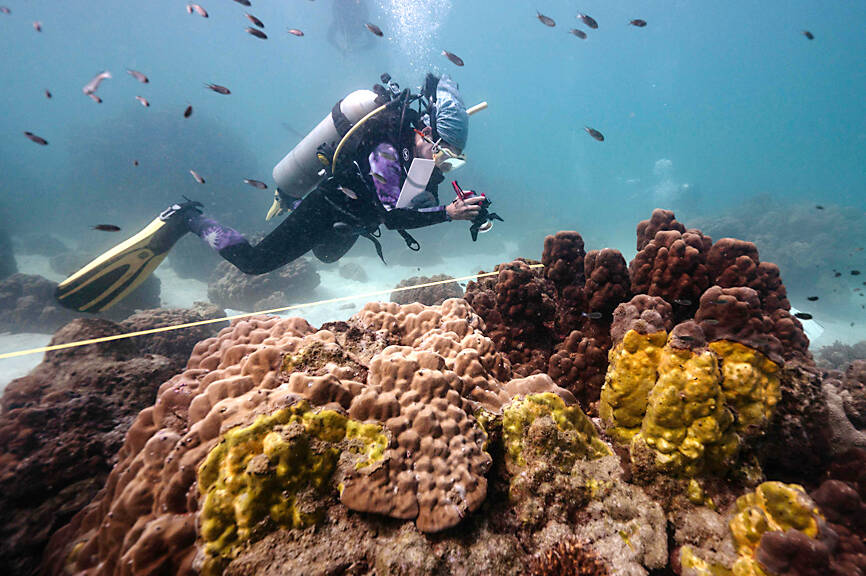
Photo: AP
The biggest decrease in disruptive research came in physical sciences such as physics and chemistry.
“The nature of research is shifting” as incremental innovations become more common, senior study author Russell Funk said.
BURDEN OF KNOWLEDGE
One theory for the decline is that all the “low-hanging fruit” of science has already been plucked.
If that were the case, disruptiveness in various scientific fields would have fallen at different speeds, Park said.
But instead “the declines are pretty consistent in their speeds and timing across all major fields,” Park said, indicating that the low-hanging fruit theory is not likely to be the culprit.
Instead, the researchers pointed to what has been dubbed “the burden of research,” which suggests there is now so much that scientists must learn to master a particular field they have little time left to push boundaries.
This causes scientists and inventors to “focus on a narrow slice of the existing knowledge, leading them to just come up with something more consolidating rather than disruptive,” Park said.
Another reason could be that “there’s increasing pressure in academia to publish, publish, publish, because that’s the metric that academics are assessed on,” he added.
The researchers called on universities and funding agencies to focus more on quality, rather than quantity, and consider full subsidies for year-long sabbaticals to allow academics to read and think more deeply.
“We’re not getting any less innovative as a species,” Park emphasized, pointing to recent breakthroughs such as the use of mRNA technology in COVID-19 vaccines, or the measurement of gravity waves in 2015.
Jerome Lamy, a historian and expert in the sociology of science at France’s CNRS research agency, who was not involved in the research, said it showed that “ultra-specialization” and the pressure to publish had increased over the years.
He blamed a global trend of academics being “forced to slice up their papers” to increase their number of publications, saying it had led to “a dulling of research.”

Taiwan’s overtaking of South Korea in GDP per capita is not a temporary anomaly, but the result of deeper structural problems in the South Korean economy says Chang Young-chul, the former CEO of Korea Asset Management Corp. Chang says that while it reflects Taiwan’s own gains, it also highlights weakening growth momentum in South Korea. As design and foundry capabilities become more important in the AI era, Seoul risks losing competitiveness if it relies too heavily on memory chips. IMF forecasts showing Taiwan widening its lead over South Korea have fueled debate in Seoul over memory chip dependence, industrial policy and
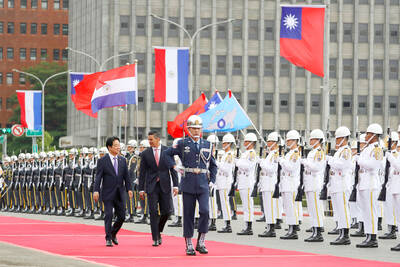
“China wants to unify with Taiwan at the lowest possible cost, and it currently believes that unification will become easier and less costly as time passes,” wrote Amanda Hsiao (蕭嫣然) and Bonnie Glaser in Foreign Affairs (“Why China Waits”) this month, describing how the People’s Republic of China (PRC) is playing the long game in its quest to seize Taiwan. This has been a favorite claim of many writers over the years, easy to argue because it is so trite. Very obviously, if the PRC isn’t attacking Taiwan, it is waiting. But for what? Hsiao and Glaser’s main point is trivial,
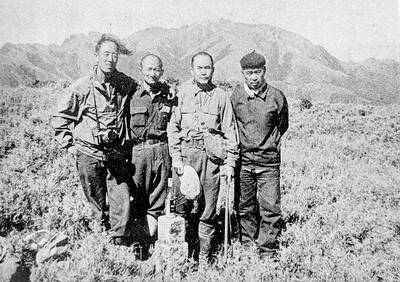
May 18 to May 24 Gathered on Yangtou Mountain (羊頭山) on Dec. 5, 1972, Taiwan’s hiking enthusiasts formally declared the formation of the “100 Peaks Club” (百岳俱樂部) and unveiled the final list of mountains. Famed mountaineer Lin Wen-an (林文安) led this effort for the Chinese Alpine Association (中華山岳協會). Working with other experienced climbers, he chose 100 peaks above 10,000 feet (3,048m) that featured triangulation points and varied in difficulty and character. The list sparked an alpine hiking craze, inspiring many to take up mountaineering and competing to “conquer” the summits. A common misconception is that the 100 Peaks represent Taiwan’s 100 tallest

And so, in the wake of US President Donald Trump’s trip to the People’s Republic of China (PRC), all the experts on the Strait of Hormuz suddenly became experts on US-China-Taiwan relations. The Internet has certainly expanded human knowledge. Lots of these sudden experts made noise this week about Trump’s words after the meeting with PRC dictator Xi Jin-ping (習近平). Trump is going to sell out Taiwan! Longtime Taiwan commentator J. Michael Cole summed the situation up neatly in the Guardian: “We need to keep in mind that he has a tendency to say many things — sometimes contradicting himself within


 RSS
RSS