


Almost 1,000 references to dehumanizing misogyny or violent action are recorded each day in the “incelosphere” as the toxicity of male supremacist content continues to intensify.
Analysis of the incel movement found that online references to inflicting violence and extremely degrading language on dedicated incel forums are running eight times higher than in 2016, when researchers first began tracking misogynist content on the internet.
Academics from the University of Exeter also noted an increasing overlap between incel followers and the far right, with online algorithms blamed for pushing young boys towards extreme rightwing ideology.
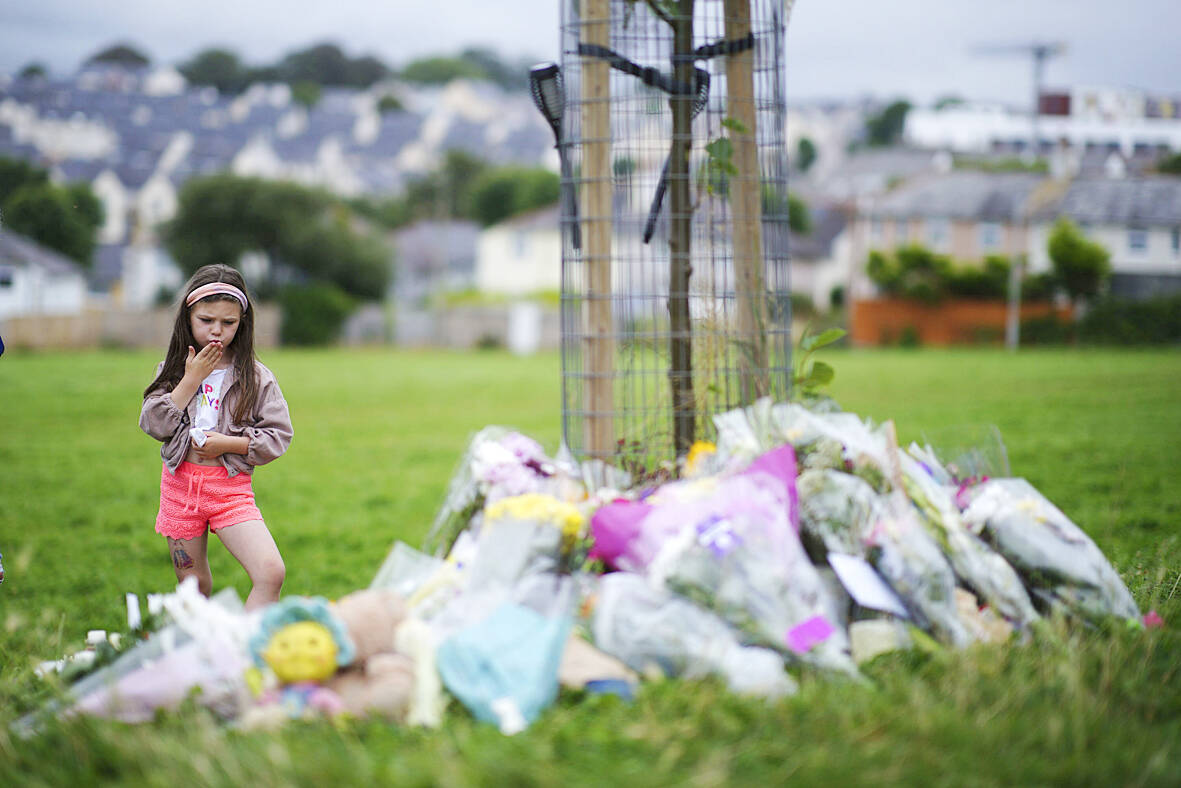
Photo: AP
Lewys Brace, who advises the government on extremism, led a long-term study that recorded, on average, 112 references a day to extreme misogynistic terms along with words “punch, stab, shoot, attack” in 2016 on dedicated incel forums.
Numbers have steadily increased since, now rising to a daily total of 849 references, prompting fears over the movement’s trajectory following a series of terrorist attacks linked to online misogynists.
The incel — or “involuntarily celibate” — movement is an online subculture in which a misogynistic worldview is promoted by individuals who blame women for their lack of sexual activity.
Incels have been linked to violent extremism and are classified by the government’s anti-radicalization strategy, Prevent, as having a “mixed, unstable or unclear” ideology.
The most recent data reveals that such ideologies account for more than half of all referrals to Prevent.
Brace, a lecturer in data analysis at Exeter, said: “The incelosphere is definitely growing and diversifying and has increased in the toxicity of its discussions since 2016.
“The cross pollination of ideologies is helping to drive this.”
He singled out YouTube whose content recommendation algorithms, he claimed, had in the past pushed users “towards increasingly extreme content; particularly in the case of anti-woman/feminist content.”
YouTube says its recommendation system is designed to limit the spread of harmful misinformation and point people to authoritative sources.
This week, research funded by the UK’s Home Office and security and intelligence agencies will reveal the extent of “incel contagion” online and the growing threat posed by male supremacist ideology at a Dublin conference showcasing new studies documenting the internet.
Brace said the volume of references to committing violence should be taken seriously, with more than 50 cases of incel-related violence documented since 2014.
Cases include the murder of five people in August 2021 in Plymouth by Jake Davison, who expressed misogynistic views on online incel forums.
Another involves Gabrielle Friel, who in 2019 amassed weapons in preparation for a terrorist attack in Scotland and who “idolized” incel Elliot Rodger, who killed six people in California in 2014. One concerning dynamic, said Brace, was how boys as young as 12 were being drawn into misogynistic ideology.
Recent police figures reveal that more under-18s were arrested in the 12 months to March 2022 than any other year, with senior counter-terrorism officers describing the trend as of “real concern”.
This month, the Department for Education published new safeguarding guidance regarding the radicalization of young people, warning that some may target gender or other protected characteristics, but “do not otherwise identify with one particular terrorist ideology or cause — for example, involuntary celibates (incels) who direct their anger mainly at women.”
However, the government’s independent reviewer of terrorism legislation cautioned that, despite the rising number of arrests of young people, only one child had been imprisoned for terrorism in the last two years.
Jonathan Hall KC, told the Observer that the old-school approach to tackling terrorist offending needed to be recalibrated in the case of children.
“This discrepancy between numbers of arrests and sentences of imprisonment shows that the traditional method of prosecution, conviction and incarceration as a way of managing terrorist risk is no longer in play.”
Hall also stressed that, increasingly, a distinction needed to be made between terrorism and something falling short of terrorism, which could be described as extremism.
“Although we have to be careful about trying to codify extremism because, as has been found time and time again, extremism is a concept without natural boundaries.”
Brace said: “At the heart of the debate lies the question of how concerning discussions on online incel spaces are; a question further exacerbated by the manner in which the incel subculture is amorphous and evolving.”
He said the movement had evolved from a series of subreddits to dedicated forums — the “incelosphere” — but which were now spreading across other online spaces, such as Instagram, TikTok, Discord and Twitch.

It starts out as a heartwarming clip. A young girl, clearly delighted to be in Tokyo, beams as she makes a peace sign to the camera. Seconds later, she is shoved to the ground from behind by a woman wearing a surgical mask. The assailant doesn’t skip a beat, striding out of shot of the clip filmed by the girl’s mother. This was no accidental clash of shoulders in a crowded place, but one of the most visible examples of a spate of butsukari otoko — “bumping man” — shoving incidents in Japan that experts attribute to a combination of gender

The race for New Taipei City mayor is being keenly watched, and now with the nomination of former deputy mayor of Taipei Hammer Lee (李四川) as the Chinese Nationalist Party’s (KMT) candidate, the battle lines are drawn. All polling data on the tight race mentioned in this column is from the March 12 Formosa poll. On Christmas Day 2010, Taipei County merged into one mega-metropolis of four million people, making it the nation’s largest city. The same day, the winner of the mayoral race, Eric Chu (朱立倫) of the Chinese Nationalist Party (KMT), took office and insisted on the current

When my friend invited me to take a tour of a wooden house hand-built by a Pingtung County resident, my curiosity was instantly piqued and I readily agreed to join him. If it was built by a single person, it would surely be quite small. If it was made of wood, it would surely be cramped, dingy and mildewy. If it was designed by an amateur, it would surely be irregular in shape, perhaps cobbled together from whatever material was easily available. I was wrong on all counts. As we drove up to the house in Fangliao Township (枋寮鄉), I was surprised

March 16 to March 22 Hidden for decades behind junk-filled metal shacks, trees and overgrowth, a small domed structure bearing a Buddhist swastika resurfaced last June in a Taichung alley. It was soon identified as a remnant of the 122-year-old Gokokuzan Taichuu-ji (Taichung Temple, 護國山台中寺), which was thought to have been demolished in the 1980s. In addition, a stone stele dedicated to monk Hoshu Ono, who served as abbot from 1914 to 1930, was discovered in the detritus. The temple was established in 1903 as the local center for the Soto school


 RSS
RSS