


The Chinese-language United Daily News reported last week that China had set a target of 676 cross-strait flights weekly for the coming year. The first iteration of tourism from China during the administration of Ma Ying-jeou (馬英九) was all about building a fantasy Taiwan for Chinese tourists to experience, while constructing links to local networks that could act on China’s behalf, redirecting Taiwan’s domestic investment to tourism activities and reducing its electronics exports (purchases of New Taiwan dollars by millions of tourists annually drive up its value).
The tourists were withdrawn with the election of President Tsai Ing-wen (蔡英文), which rendered that strategy fruitless and further application pointless, not as “punishment” to Taiwan for electing Tsai, as so many in the media reported. They were part of a “peace offensive” aimed at presenting China as interested in peaceful engagement with Taiwan.
More of that is inbound.
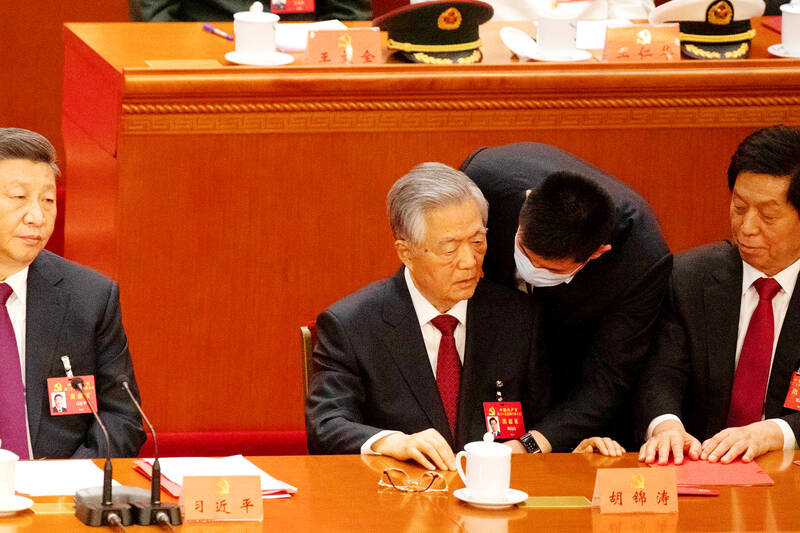
Photo: Bloomberg
Chinese leader Xi Jinping’s (習近平) “unprecedented” — except for Mao Zedong (毛澤東) and Deng Xiaoping (鄧小平); it was Hu Jintao (胡錦濤) and Jiang Zemin (江澤民) who were exceptions — continuance of dictatorial powers has been widely viewed as bad for Taiwan. Commentators have noted that those appointed to the Central Politburo Standing Committee are largely loyalists unlikely to second-guess Xi’s decisions. His military chieftainships are filled with Taiwan-oriented officers. A war cabinet, it is said.
KNOWING AGENTS, USEFUL IDIOTS
Ground must be laid for war, and that includes a “peace offensive” carried out by both knowing agents and useful idiots, aimed at both foreign and domestic audiences, the former to slow the response to China’s military build-up, the latter to legitimate the war in local eyes.
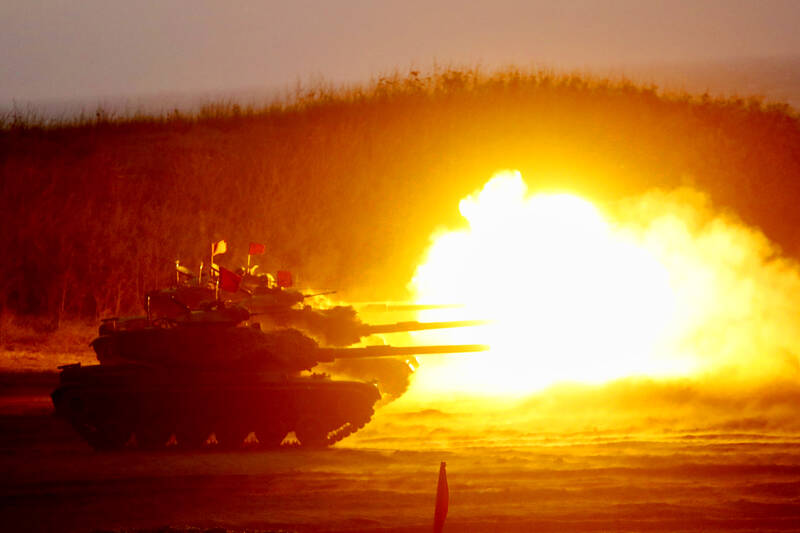
Photo: EPA-EFE
Several of us who track the media have noticed what appears to be a coordinated push across many publications for “peace.” The latest example of this is a publication from the Quincy Institute, the Koch-funded think tank that typically adopts pro-China and pro-Russia positions, which it repurposes as “peace” moves.
Quincy’s latest, “Ending the Destructive Sino-US Interaction Over Taiwan: A Call for Mutual Reassurance,” was written by Michael D Swaine, a senior fellow at the Carnegie Endowment for International Peace, which has institutional branches in China.
Swaine’s calls for changes in the Taiwan-US-China relationship echo the prescription offered in the recent Foreign Affairs piece by Thomas Christianson, Jessica Chen Weiss (白潔曦) and others, which I commented on last week. Similar works have been appearing elsewhere.
These pieces follow a specific pattern. First, America is accused of backing away from its “One China” policy, but the specifics of that policy are never named. With comments like “A few current and former US officials and military officers have hinted that Taiwan policy should be predicated on preventing China from unifying with Taiwan, but the current US administration has not made this an official position, which would destroy the One China policy,” Swaine appears to imply that the US as a matter of policy makes Taiwan part of China, when the opposite is true.
As I noted last week, when the US policy that Taiwan is not part of China is correctly identified, arguments like Swaine’s become instantly understandable as pro-Beijing propaganda. Swaine has been told many times what the US position is.
Both Swaine’s essay and the Foreign Affairs essay I wrote about last week contend that the US has moved away from its old position on Taiwan. The reason that happened is obvious: despite 40 years of assurances, Beijing built up its military. The US is responding to this change. This causation generally falls out of pieces in this genre.
REMOVING TAIWAN’S AGENCY
A second pattern is the removal of Taiwan’s agency. Swaine does this by repositioning Taiwan as a fantasy object of Beijing’s fears and desires, thus removing its own independent existence. The word “people” does not even occur in the text, while “independence” generally occurs in the context of “Beijing’s fears,” part of the tiresome “Beijing sees…” formulation so dear to the hearts of Beijing’s defenders.
Writing as if the stated motivations of actors are their real motives is a classic propaganda move. It is also an orientalist move that positions Beijing as motivated by sincere “feelings” while Washington is driven by malign “interests.”
This same pattern of Orientalization occurs in another Quincy specialty, calling for “peace” in Ukraine, positioning Russia as invading Ukraine out of fear of encirclement by NATO while describing the US as being driven by malign interests. And, of course, ignoring Ukrainian agency.
Swaine calls for the US to reduce mil-mil contacts, halt its intelligence activities and “maritime” activities off China’s coast, “or at least in the vicinity of Taiwan.” Rarely for the pro-China side, Swaine says that China should reduce “offensive ballistic missiles, amphibious platforms and minelayers” while the US reduces weapons sales to Taiwan. He concedes that this is impossible, at present. He is not wrong.
The essay, like the Foreign Affairs piece, assumes that at some point Taiwan will become part of China and that the pro-democracy side in Taiwan should simply shut up about it.
“For Taipei, this would mean finding some language that does not preclude the possibility of an eventual One China outcome,” he says.
Swaine thus appears to be perfectly comfortable packing Taiwanese off to camps, and with the follow-on wars that will occur once China has Taiwan. If history teaches anything, it is that the outcome of imperialism is always more imperialism. It stops only when the imperialist is physically checked.
In addition to its flow of pro-China and pro-Putin pieces, Quincy had a hand in the recent, dangerously stupid letter calling for “peace” in Ukraine from a group of progressives in the US congress. Vox (“The drama over progressives’ Ukraine letter,” Jonathon Guyer, Oct. 26), explained: “An early draft of the congressional letter was reviewed by the Quincy Institute, which helped build support for it and has advocated for more avenues of diplomacy outside this letter.”
Josh Marshell of Talking Points Memo fame argued in a long Twitter thread that the letter itself appeared to be a Quincy project.
“I’ll note that the Quincy folks were pretty pumped when the letter came out and seemed to have their own write up pretty much right when the Post broke the story,” he pointed out.
The effort by “serious” writers to pimp China talking points is taking place as China conducts a major influence effort ahead of the US mid-terms. NBC reported (“Pro-China social media campaign sought to influence US voters, researchers say,” Kevin Collier, Oct. 26) that two firms that analyze social media had identified the campaign.
These are all one. The pro-China campaign we will face in the coming years is a hydra-headed thing, running the gamut from nice upper-class commentators from fancy organizations like Quincy to academics forwarding Beijing’s fantasy history to QAnon promoters from the darkest corners of the Web.
As China moves toward war, the cacophony will increase, and the alternate epistemic world it constructs will only grow richer and more influential.
Shout louder, folks.
Notes from Central Taiwan is a column written by long-term resident Michael Turton, who provides incisive commentary informed by three decades of living in and writing about his adoptive country. The views expressed here are his own.
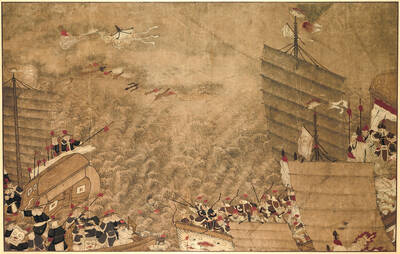
For many centuries from the medieval to the early modern era, the island port of Hirado on the northwestern tip of Kyushu in Japan was the epicenter of piracy in East Asia. From bases in Hirado the notorious wokou (倭寇) terrorized Korea and China. They raided coastal towns, carrying off people into slavery and looting everything from grain to porcelain to bells in Buddhist temples. Kyushu itself operated a thriving trade with China in sulfur, a necessary ingredient of the gunpowder that powered militaries from Europe to Japan. Over time Hirado developed into a full service stop for pirates. Booty could

Politically charged thriller One Battle After Another won six prizes, including best picture, at the British Academy Film Awards on Sunday, building momentum ahead of Hollywood’s Academy Awards next month. Blues-steeped vampire epic Sinners and gothic horror story Frankenstein won three awards each, while Shakespearean family tragedy Hamnet won two including best British film. One Battle After Another, Paul Thomas Anderson’s explosive film about a group of revolutionaries in chaotic conflict with the state, won awards for directing, adapted screenplay, cinematography and editing, as well as for Sean Penn’s supporting performance as an obsessed military officer. “This is very overwhelming and wonderful,” Anderson

Another moment of the US making permanent concessions for transient gains, which appears to be longstanding US policy with the People’s Republic of China (PRC), occurred last week when President Donald Trump announced that weapons sales to Taiwan would be delayed in order to arrange a meeting with the PRC dictator Xi Jinping (習近平). There were “concerns among some in the Trump administration that greenlighting the weapons deal would derail Trump’s coming visit to Beijing, according to US officials,” the Wall Street Journal reported. It attributed the suspension of the weapons sale to pressure from Xi. While some might shrug

Social media addiction has been compared to casinos, opioids and cigarettes. While there’s some debate among experts about the line between overuse and addiction, and whether social media can cause the latter, there is no doubt that many people feel like they can’t escape the pull of Instagram, TikTok, Snapchat and other platforms. The companies that designed your favorite apps have an incentive to keep you glued to them so they can serve up ads that make them billions of dollars in revenue. Resisting the pull of the endless scroll, the dopamine hits from short-form videos and the ego boost and validation


 RSS
RSS