


The world is getting softer around the edges. It’s blurry and confusing — are you squinting at the screen or are your arms getting too short to read a magazine? Research published at the start of this year indicates rates of myopia are increasing so rapidly that it cannot be solely our genes that are changing, but the environment.
“In our lives, we tend to do a lot more ‘near viewing,’ particularly in education and our social lives,” said Jugnoo Rahi, the study lead. “At the same time, we do less distance viewing [outside].”
That’s without taking the pandemic into consideration, with all that extra Zooming and squinting at our phones.
Photo: EPA-EFE
Add in the direct effects on eye health of COVID infection — one in 10 sufferers reports problems, such as blurred vision and sensitivity, and researchers have found Sars-CoV-2 directly affects retinal cells — and it’s hard to escape the conclusion that our eyes are struggling.
That’s scary to contemplate. Our vision is how the majority of us comprehend and navigate the world most immediately; it’s at the heart of our figurative language: “You see,” “Is that clear?” “Do you need to reflect?”
But it’s also not that alien. One in three people in the UK is short sighted — me, certainly; perhaps you. Then most of us become long sighted with age: few are spared the middle-aged reading-glasses scramble (lost on the top of the head, left on trains or swapped with similarly afflicted friends). Already being short sighted may mean the wallet-ravaging delight of varifocals.
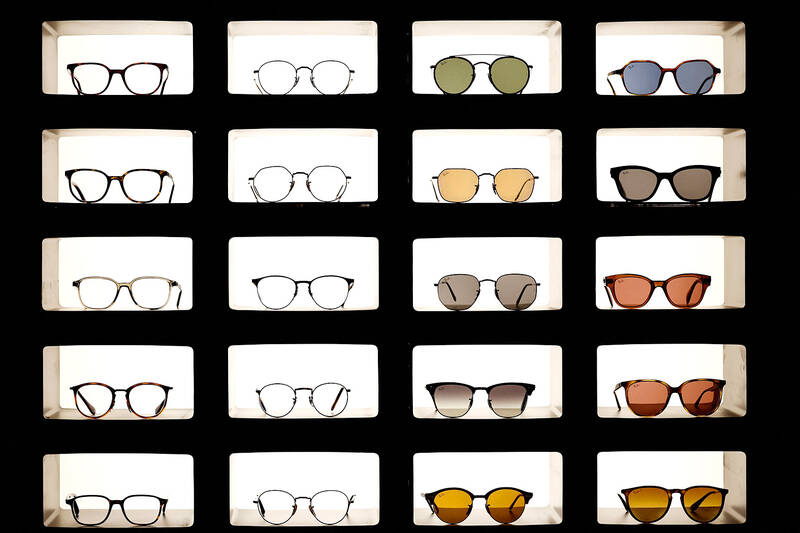
Photo: Reuters
‘IN PLAIN SIGHT’
Our complex relationship with vision is the focus — see, there we go again — for the Wellcome Collection’s new exhibition, In Plain Sight. It’s an eyeful, taking in the spiritual and cultural associations around eyes and blindness, the subjectivity of what we see, the interconnectedness of the senses and how intimately eyewear is tied up in personal identity and biography.
To complement the wonders and curiosities in the Wellcome’s optics collection, the show’s curators, Laurie Britton Newell and Ligaya Salazar, commissioned and sourced pieces from contemporary artists, many with a particular personal experience of vision that informs their work.
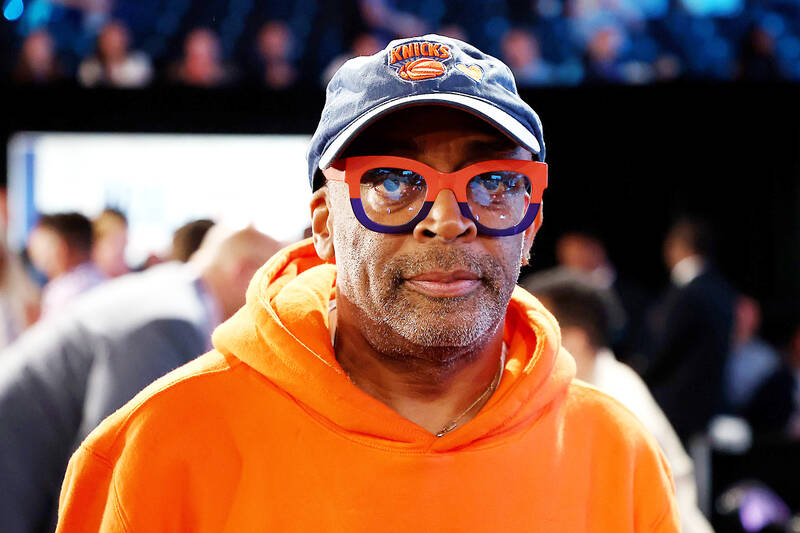
Photo: AFP
Blind artist Emilie Gossiaux has created a dreamily evocative personal color chart based on memories — the color of a grazed knee or of her mother’s lipstick. Carmen Papalia, who is also blind, joyfully replaced his white cane with a high school marching band which guided him through a busy city center using sound — trills for obstacles and changing pitch for steps.
The aim throughout is to interrogate our relationship with vision and how we feel about our own sight, or lack of it.
So many of us see the world imperfectly, though even the criteria we use to assess it is debatable.
“Less than half the UK population has 20/20 vision,” Salazar explains. “It’s what you see from 20 feet (6.1m) away, so it’s quite arbitrary.”
It may be arbitrary, but for those of us whose vision issues are picked up in childhood, a “failed” sight test is often the first point at which we understand that our bodies are fallible and imperfect. I remember feeling a sense of betrayal, shame even, when the optician confirmed what a school sight test had picked up: I needed glasses. I’m a minus 5: the kind of short sight where the uncorrected world is an impressionistic blur. I cried, I remember, not just for an hour, but on and off for weeks.
Pictures of me from that era shift suddenly from a bouncy kid turning cartwheels or propped in a casual headstand to someone inertly vertical and withdrawn, expression hidden by the bounce of flash on lens. I hated my early glasses, from classic NHS pink to outsized silver square frames I self-sabotagingly selected — I looked like a Silicon Valley pioneer in the “before” picture in his parents’ garage.
SIGHT CORRECTION HISTORY
The history of sight correction is long — as long as we have been experimenting with lenses. There’s a theory that the emperor Nero used a concave green stone to enhance his vision. “Reading stones” to magnify text become relatively common in the 11th century.
The first glasses date from 13th-century Italy and were, unsurprisingly, developed and used by those pioneers of long, repetitive hours of desk-based work — monks. They spread fast: a 15th-century stained glass window in a church near me features a man in glasses that could have been designed by Marc Jacobs yesterday.
Despite this, our understanding of how vision works was hazy, at best, for centuries. One school of thought — the “extramissionists,” who believed light shone out of our eyes like tractor beams — held sway up to and including Leonardo da Vinci.
“The eye and the visual sensory system has thrown everyone for a loop for so long,” says Britton Newell. “It’s still one of the hardest areas of biology and medicine to explain.”
There have, too, always been those skeptical about the merits of correcting vision with lenses. Well into the 19th century, doctors would prescribe emigrating to sunnier climes to improve eyesight. They had a point, it transpires: 2017 research found teenagers exposed to the most sun between the age of 14 and 19 were about 25 percent less likely to have developed myopia by middle age, vindicating every nagging parent ever.
JUST FOR DORKS?
The idea of wearing glasses as weakness or capitulation is pervasive. Aldous Huxley was one of many proponents of the cranky Bates method of eye exercises, asserting that we should strive to cure short sight rather than merely accepting it.
Certainly my glasses felt like weakness. In them I felt ugly and vulnerable, and nothing I saw in popular culture made me feel otherwise. The spectacles of 1980s England are probably a cult Depop subgenre now, but I didn’t want to look like Timmy Mallett or Deirdre Barlow.
The glasses wearer on must-watch Beverly Hills, 90210 was swotty Andrea Zuckerman, whose whole character was “being uncool,” and I’m fairly certain no one wore them on Baywatch (excluding sunglasses — a whole other, innately cooler beast).
Elvis Costello might have been fighting the good fight for NHS frames — in his memoir Good Pop, Bad Pop, Jarvis Cocker, himself no specs slouch, says Costello “transformed them from a symbol of handicap/poverty into Pop Star Glasses” — but he was no role model for a teenage girl with no aspiration to look edgy.
Much of my generation shared my shame. We internalized the prevailing narrative that glasses were for dorks — a message dating back in some form to the monks. There’s a positive spin of sorts to this: glasses are also seen as scholarly, the preserve of the intelligent. There’s good evidence that is factual: research in 2018 indicated that wearing glasses is correlated with higher levels of intelligence and again, this year, evidence showed a link between higher levels of education and short sight.
That was cold comfort for us self-hating myopics and “hate” is the word that comes back again and again when I asked friends and Internet acquaintances about their experiences of getting, and wearing, glasses.
“I hated them, they were so ugly,” says Sabele, a lifelong spec-wearer who responded to my call out; she once tricked her mother into throwing her glasses into the fire.
“Got them at seven, hated them, still hate them,” says another, and “Hated them as a teenager,” say my Twitter friends Anna and Ellen. “I used to tell my friends they were broken and wander round school discos blind as a bat,” adds Ellen.
In a 1956 essay, Isaac Asimov demolished the pervasive “girl takes off glasses and becomes beautiful” cinematic trope: glasses, he writes, “are merely a symbol… of intelligence.”
By casting them — education, intellectual development — off, the suggestion is you can attain happiness.
But we bought into it wholeheartedly. I petitioned and pleaded for contact lenses until, at 14, I was allowed them. Expensive and unforgiving, they adhered painfully to your eyeball if incorrectly inserted and were absurdly easy to lose.
My teens and 20s were mainly spent crawling around dusty public loo and pub floors or pleading with people to unscrew sink U-bends. Then — trigger warning for the squeamish, but I was not alone in this — I would pop the lens in my mouth and straight back into my eye. It’s a wonder I can still see at all. Later, autoimmune disease made me lose my lashes and dry, scratchy eyes forced me back into glasses. Cue another period of deep gloom about my appearance.
These strong emotions around glasses-wearing made life difficult for Nina Manandhar, who curates the British youth style archive, What We Wore. She contributed a piece to the show exploring individuals’ relationships with their glasses over a lifetime.
Manandhar’s deft eye and the inherent cool of some of her subjects make it a manifesto for eyewear, but “it was actually the most challenging image collection I have ever done. People were reluctant to submit images of themselves in glasses and a lot of people didn’t wear glasses in what they considered to be their youthful years; they wore contact lenses.”
Those who wore glasses, she adds, often took them off for pictures.
‘GEEK CHIC’
But the trajectory of Manandhar’s Life Stories in Glasses and the experience of those around me hints at a second, more positive act to sight stories. You can frame that in two ways: the first is that glasses have become chicer, younger and bolder.
“They might be cooler now?” ventures Manandhar. There’s certainly a long history of the media declaring glasses cool – Britton Newell and Salazar unearthed a Daily Mail fashion feature from 1925; a casual Google reveals recent pronouncements from 2005, 2008, 2011, 2012 and 2015; “geek chic” entered the dictionary in 2013.
But somewhere along the way, as “glasses” became “eyewear,” it seems to have actually stuck. For me, Tom Ford exquisitely styling Colin Firth in heavy frames in A Single Man in 2009 started to unlock a sense that perhaps glasses could be a conscious aesthetic choice. In an age of feather-light, disposable contacts and laser eye surgery, it’s a choice regularly made by the likes of Kendall Jenner, Emily Ratajkowski or the Hadid sisters.
Now “dark academia” is a TikTok style trend (surely cooked up by people who haven’t met many real academics), and the likes of Schitt’s Creek’s Dan Levy and Hailey Bieber have eyewear lines.
The second is that we grow into self-acceptance, becoming more comfortable showing the bits of us that are broken.
“You’ve got to own it and embrace it, and the people who have done that have become icons,” says Manandhar, highlighting Spike Lee and Rihanna as influential, unapologetic glasses wearers.
Friends who got glasses later in life seem to find it an uncomplicated delight.
“I love them so much I find myself wearing them at times when they don’t even help,” says writer Sophie Heawood. “I noticed all these chic middle-aged women with thick-rimmed specs looking amazing, so I got the same ones,” says Marie Philips, another writer friend. “It’s instant cool.”
Longtime specs wearers’ frames tend to get bolder, too. My current pair is my biggest yet. People I know have full wardrobes of outlandish glasses: cat’s eyes and rimless; curlicued or rainbow colored. This is what you could call the Iris Apfel trajectory. At 100, Apfel (who also has her own eyewear line) is more spectacles than face. Her glasses have become inseparable from who she is, much as they have for David Hockney or Jarvis Cocker.
I think mine have too, now: they are part of me. I squashed them in my sleep last month. When I put them on in the morning, everything looked wrong — nauseating, and fairground distorted. I unearthed my ancient spares and dashed off to throw myself on the optician’s mercy. Suddenly nothing in the world was more important than my glasses.

Just after 6am, I walked up to the ticket gate at Taipei Main Station and entered the Taiwan Railway platform without scanning any ticket; instead, I flashed the Sanrio Fun Rail pass on my phone to the gate worker and was admitted. I found my train and prepared to board. My destination? This very same station. I was embarking on a 13-hour journey on one of two round-the-island trains operated by ezTravel. They run each day, one counterclockwise around the island and one clockwise. They differ in a number of ways from an ordinary Taiwan Railway train and can make for

Jason Han says that the e-arrival card spat between South Korea and Taiwan shows that Seoul is signaling adherence to its “one-China” policy, while Taiwan’s response reflects a reciprocal approach. “Attempts to alter the diplomatic status quo often lead to tit-for-tat responses,” the analyst on international affairs tells the Taipei Times, adding that Taiwan may become more cautious in its dealings with South Korea going forward. Taipei has called on Seoul to correct its electronic entry system, which currently lists Taiwan as “China (Taiwan),” warning that reciprocal measures may follow if the wording is not changed before March 31. As of yesterday,

The Portuguese never established a presence on Taiwan, but they must have traded with the indigenous people because later traders reported that the locals referred to parts of deer using Portuguese words. What goods might the Portuguese have offered their indigenous trade partners? Among them must have been slaves, for the Portuguese dealt slaves across Asia. Though we often speak of “Portuguese” ships, imagining them as picturesque vessels manned by pointy-bearded Iberians, in Asia Portuguese shipping between local destinations was crewed by Asian seamen, with a handful of white or Eurasian officers. “Even the great carracks of 1,000-2,000 tons which plied

On Thursday, former Taipei mayor and founder of the Taiwan People’s Party (TPP) Ko Wen-je (柯文哲) was sentenced to 17 years in prison and had his civil rights suspended for six years over corruption, embezzlement and other charges. Seven others related to the case were also handed prison sentences, while two were found not guilty. It has been a bad week for the TPP. On Tuesday, prosecutors charged Chinese immigrant Xu Chunying (徐春鶯) with suspicion of taking part in Beijing-directed election interference. Xu has strong links to the TPP, which once offered her a party list legislator nomination. Tuesday also


 RSS
RSS