


Steven Spielberg premiered his much-anticipated The Fabelmans to thunderous applause at the Toronto International Film Festival, debuting his most autobiographical film and one the 75-year-old filmmaker said he’s been building toward his whole life.
The Fabelmans, which Spielberg wrote with Tony Kushner, draws extensively from the director’s own childhood — from his parents, played by Michelle Williams and Paul Dano in the film, and from his early formation as a filmmaker. The film opens with a timid young boy outside a cinema going to see his first movie (The Greatest Show on Earth). His mother encourages him: “Movies are dreams, doll.”
“It’s something obviously I’ve been thinking about for a long time,” Spielberg said on stage after the screening late Saturday. “I didn’t really know when I was going to get around to this. It is not because I decided to retire and this is my swan song. Don’t believe any of that.”
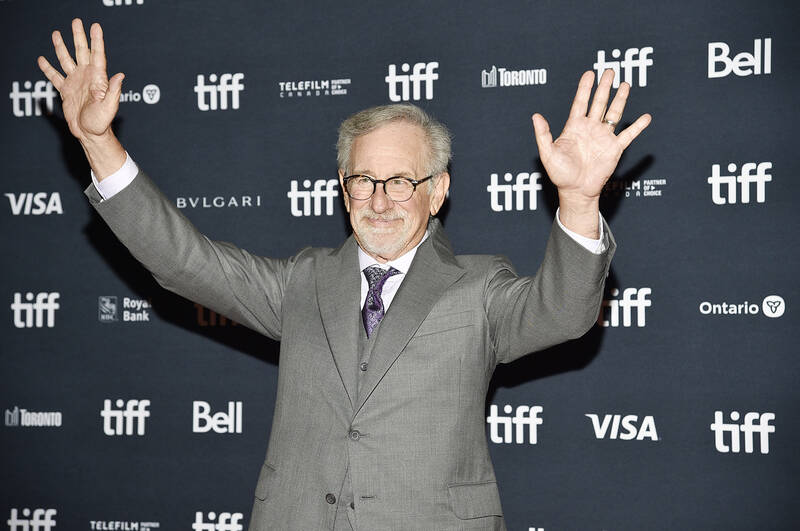
Photo: AP
Spielberg said he first talked about what would become The Fabelmans with Kushner during the making of Lincoln. The playwright, Spielberg said, played the role of therapist as Spielberg unloaded his memories. But it wasn’t until the pandemic that the director resolved to tell, for the first time, his own story.
“As things got worse and worse, I felt if I was going to leave anything behind, what was the thing that I really need to resolve and unpack?” said Spielberg.
Spielberg, whose three sisters were in the audience, later added: “This film is for me a way of bringing my mom and dad back. And it also brought my sisters — Annie and Sue and Nancy — closer to me than I ever thought possible. And that was worth making the film for.”

Photo: AFP
Universal Pictures will release The Fabelmans on Nov. 11 in New York and Los Angeles before expanding it nationwide Nov. 23. Its world premiere at Toronto — which happened to immediately follow Rian Johnson’s Glass Onion: A Knives Out Mystery at the Princess of Wales Theater — was a major event, and an unusual one. It was Spielberg’s first film at TIFF, and he said while introducing the film that it was his first time ever in a film festival’s official lineup.
The two-and-a-half hour film was immediately received as a grand and personal opus for Spielberg, all but certain to play a staring role at the Academy Awards. Aside from Williams, who is pregnant with her third child, and Dano, the cast includes Seth Rogen as a close family friend, a brief standout performance from Judd Hirsch, Jeannie Berlin and newcomer Gabriel LaBelle who plays Sammy Fabelman, the fictionalized young Spielberg.
“Steven was generous about letting us into his life,” said Dano, who said he had access to Spielberg’s old photographs, home movies and lengthy conversations over Zoom with the director. “The goal was to capture a life lived.”
While there are vividly drawn moments of movies transporting Sammy, Fabelmans may surprise some for how complexly it weaves filmmaking and family life. Cinema in Spielberg’s film is both a transformative power and something dangerous; a way to express genuine emotion and to hide from it. Kushner, a frequently collaborator with Spielberg, said the film demonstrates how “film is an unreliable friend.”
“It will take you to into a place of safety and right through safety is something unexpected and scary,” said Kushner. “It happens over and over again in the movie.”
The Fabelmans is populated by early experiments with 8-millimeter cameras, little movies made with family members and increasingly ambitious short films. All mirror Spielberg’s own first forays into filmmaking, though there are some differences.
“I made all the behind-the-scenes stuff in this movie much better than the actual films I made when I was Sammy’s age,” Spielberg said with a smile. “It was a great do-over.”

Ajay Verma, a consultant gastroenterologist at Kettering general hospital in Northamptonshire, says our gut is a “complex machine.” “It is constantly providing us with the nutrition we need, initially to grow and develop, and then for us to survive, thrive and repair from injury and illness.” How can we keep it functioning well? Put simply: “Make sure what you put into it is balanced, and that you clear out its waste products adequately,” Verma says. “In a general gastroenterology clinic, the most common conditions we see are irritable bowel syndrome (IBS), gastroesophageal reflux disease, inflammatory bowel disease and constipation,” says Nisha
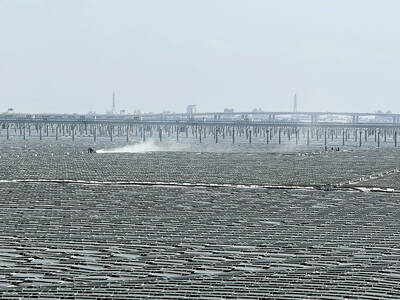
The arithmetic is straightforward and uncomfortable. By the end of 2025, Taiwan had committed itself to a 50-30-20 electricity mix — half natural gas, 30 per cent coal, 20 per cent renewables. The Ministry of Economic Affairs’s (MOEA) own monthly energy reports tell a different story. Natural gas reached 47.8 per cent of generation last year. Coal stood at 35.4 per cent, comfortably above its target ceiling. Renewables came in at 13.1 per cent, well short of the 20 per cent Taipei had pledged a decade earlier. Installed renewable capacity reached roughly half of the 12 gigawatts (GW) the government

Last week US President Donald Trump was asked by a reporter whether he would speak on the phone to the President of Taiwan. “l’ll speak to him. I speak to everybody. We have that situation very well in hand,” Trump said. This marked the second time in a couple of weeks he had said he would talk to the President of Taiwan. In 2016 he famously took a call from then-president Tsai Ing-wen (蔡英文), when he was president-elect. Despite warnings that the apocalypse was nigh because of a phone call, the world quickly forgot about the conversation between two democratically-elected presidents.
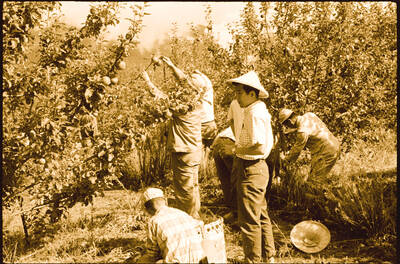
May 25 to May 31 Few believed that apples could be cultivated on a commercial scale in Taiwan’s high mountains. When horticulturalist Cheng Chao-hsiung (程兆熊) first proposed the idea in 1955, both American and Taiwanese colleagues dismissed it as implausible, arguing that temperate fruit could not be reliably grown on a subtropical island, especially on rugged terrain. However, it was this terrain in the Central Mountain Range where many Chinese Civil War veterans were resettled in the late 1950s. With limited job prospects and no family in Taiwan, they were placed on cooperative farms aimed toward self-sufficiency. Some say the conditions


 RSS
RSS