


Anyone walking around BK Arena in the Rwandan capital of Kigali who is familar with Taiwanese cuisine might be surprised to smell the fragrance of familiar dishes in the air.
Visitors can even detect the aroma of Taiwan’s famous beef noodles, chive buns and dumplings if they visit the neighborhood on the right day.
These delectable flavors can be traced to Sizzling Plates Restaurant, a small diner located just across from BK Arena.
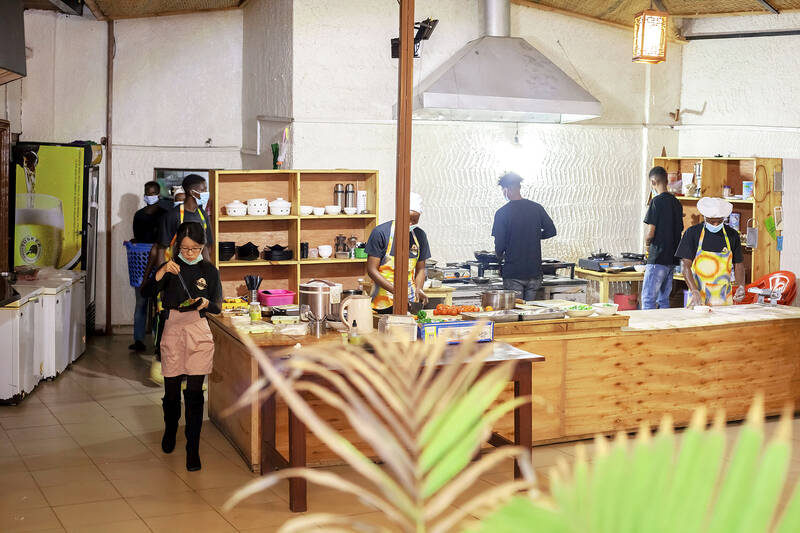
Photo: CNA
Patrons of the eatery have a plethora of traditional Taiwanese food from which to choose, whether it is vegetarian appetizers such as braised tofu or spicy entrees like mapo tofu, or the nation’s staple braised pork rice and potstickers.
The restaurant also offers special deals on dumpling dishes on Thursdays and Sundays, while a phone call to the eatery a few days ahead of a visit gives owner Teresa Fang (方薏婷) enough time to prepare her signature soup dumplings, which are only available by request.
Besides juggling her duties as the restaurant’s owner and head chef, Fang, 36, is also a busy mother whose Japanese husband works for the UN in Africa.
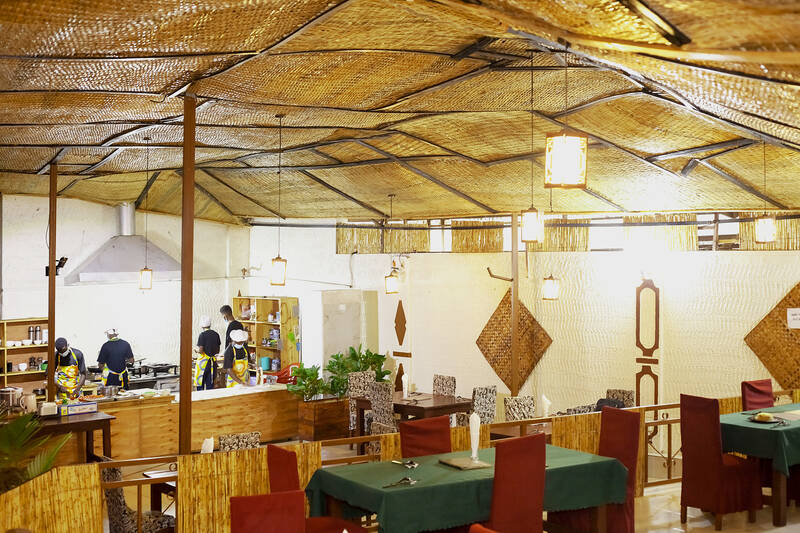
Photo: CNA
STABLER AND SAFER
The family has traveled across Africa due to her husband’s job, but the couple eventually decided to settle down in Rwanda, where both parents can work while their children grow up in an environment that is stabler and safer than neighboring nations, Fang said.
With degrees in health economics and biochemistry, plus previous work experience as a researcher and tutor at graduate school, Fang originally planned to look for a job within her field of expertise.
However, with the outbreak of the COVID-19 pandemic, Fang was forced to seek alternative job solutions when the companies she had set her heart on stopped hiring.
That was when the chance of purchasing a restaurant across the street from East Africa’s biggest indoor arena presented itself. Only then did Fang decide to make a hard turn in her career path and pursue cooking full time.
She recalled how she enjoyed recreating the flavors of her hometown cuisine while attending high school abroad, and the excitement she felt when she made dumpings for her and her husband while they lived in Australia. When they had children, she also felt happy making healthy food for them.
Fang was also motivated by her father, who passed away in February 2020.
“I reflected on the time we had together and how he truly lived in accordance with the ‘love what you do and you will never work a day in your life’ philosophy,” Fang said. “He truly enjoyed his work and always encouraged us to do what makes us happy and healthy.”
Sizzling Plates opened its doors in early 2020 amid the global pandemic, which Fang attributes to her personality of needing to get things done.
The restaurant first tailored to the expat population looking to satisfy their desire for something different from the ubiquitous Rwandan cuisine. Eventually, the dishes became popular, customers kept coming back with friends and word spread.
In the two years since the restaurant opened, Fang said she has even served six or seven fellow Taiwanese nationals.
LOCAL AND NATURAL
Instead of Taiwanese ingredients, Fang bases her recipes on local products and draws from her background as a health economics expert.
“I have always been very health conscious with my background in biochemistry, and of course after I become a mom,” Fang said. “I tend to use natural ingredients to make food for my family. After moving to Rwanda, I have to cook almost everything from scratch because it’s not easy to find Asian condiments.”
Not only does she insist on using no MSG in her food, Fang also makes sure no artificial flavoring is added to the Rwandan soybeans which she uses to make homemade tofu for her eatery.
Fang also taught her employees how to use a dough roller to turn Rwanda’s wheat flour into Taiwanese buns and dumplings.
Thanks to her insistence on using healthy ingredients and the unique flavors of Taiwanese cuisine, Sizzling Plates currently has an exclusive menu that sets her food apart from other Asian restaurants in the area.
When asked about the challenges in Rwanda, Fang points to the language and cultural differences she faces everyday, such as the pace of daily life and managing a restaurant in a country that has an unstable power grid and water supply.
That aside, Fang said she and her family are content and happy in the African country and will continue to bring the sizzle to Kigali.
“I really enjoy raising my kids here.” she said. “I cherish it’s natural environment and the simplicity which is so rare in other countries. My kids also enjoy living here. I don’t know where life is going to take us, but for now we are just enjoying ourselves here.”

As mega K-pop group BTS returns to the stage after a hiatus of more than three years, one major market is conspicuously missing from its 12-month world tour: China. The omission of one of the group’s biggest fan bases comes as no surprise. In fact, just the opposite would have been huge news. China has blocked most South Korean entertainment since 2016 under an unofficial ban that also restricts movies and the country’s popular TV dramas. For some Chinese, that means flying to Seoul to see their favorite groups perform — as many were expected to do for three shows opening

Taiwan’s semiconductor industry consumes electricity at rates that would strain most national grids. Taiwan Semiconductor Manufacturing Co (TSMC) alone accounted for more than 9 percent, or 2,590 megawatts (MW), of the nation’s power demand last year. The factories that produce chips for the world’s phones and servers run around the clock. They cannot tolerate blackouts. Yet Taiwan imports 97 percent of its energy, with liquefied natural gas reserves measured in days. Underground, Taiwan has options. Studies from National Taiwan University estimate recoverable geothermal resources at more than 33,000 MW. Current installed capacity stands below 10 MW. OBSTACLES Despite Taiwan’s significant geothermal potential, the

The entire Li Zhenxiu (李貞秀) saga has been an ugly, complicated mess. Born in China’s Hunan Province, she moved to work in Shenzhen, where she met her future Taiwanese husband. Most accounts have her arriving in Taiwan and marrying somewhere between 1993 and 1999. She built a successful career in Taiwan in the tech industry before founding her own company. She also served in high-ranking positions on various environmentally-focused tech associations. She says she was inspired by the founding of the Taiwan People’s Party (TPP) in 2019 by Ko Wen-je (柯文哲), and began volunteering for the party soon after. Ko
Chinese Nationalist Party (KMT) Chair Cheng Li-wun (鄭麗文) returned from her trip to meet People’s Republic of China (PRC) dictator Xi Jinping (習近平) bearing “a gift” for the people of Taiwan: 10 measures the PRC proposed to “facilitate the peaceful development of cross-strait relations.” “China on Sunday unveiled 10 new incentive measures for Taiwan,” wrote Reuters, wrongly. The PRC’s longstanding habit with Taiwan relations is to repackage already extant or once-existing policies and declare that they are “new.” The list forwarded by Cheng reflects that practice. NEW MEASURES? Note the first item: establishing regular communication mechanisms between the Chinese Communist Party


 RSS
RSS