


They came, they conquered and they governed. Japanese rule had a profound impact on Taiwan’s economic development and infrastructure. It’s hardly an exaggeration to say that, when it came to modernizing Taiwan, Tokyo did the heavy lifting.
Despite the demolition and repurposing of numerous temples in the late 1930s, and the building of Shinto shrines, few Taiwanese embraced Japanese religions. That doesn’t mean, however, that Japan left no imprint on local beliefs. In at least a dozen of the 15,216 religious places of worship registered with local governments, a divine being of Japanese origin is among those enshrined.
These immortals are neither Shinto gods and goddesses nor deities worshiped by Japanese Buddhists. Instead, they’re Japanese people who lived in Taiwan, died here and posthumously transitioned to godhood.
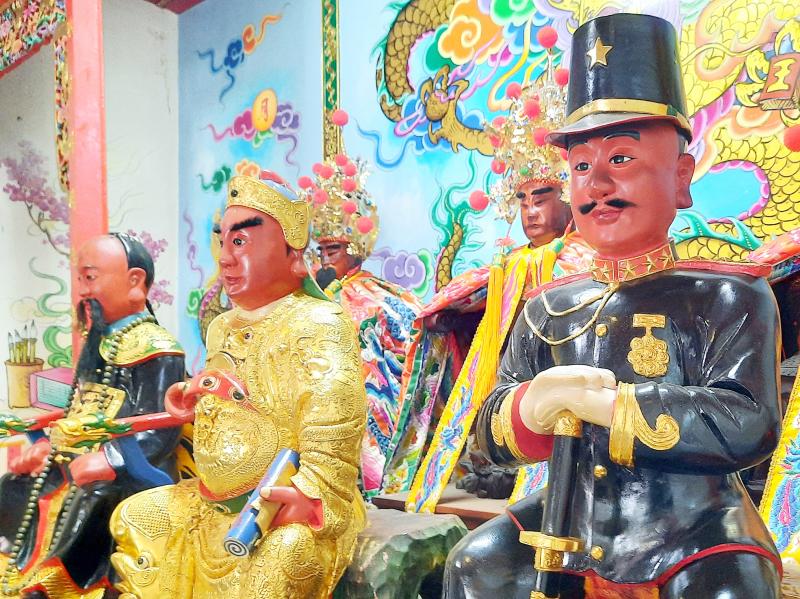
Photo: Steven Crook
As is the case with Taiwanese individuals who’ve been promoted to the local pantheon, elevation was a consequence of admirable conduct during that person’s lifetime, miraculous or inexplicable events following his or her death or a combination of the two.
THE BONEYARD AND THE JITONG
Cinglong Temple (慶隆廟) was established in 1964, in response to the discovery of 1,067 human bones and around 300 horse bones during excavations in the old heart of Tainan.
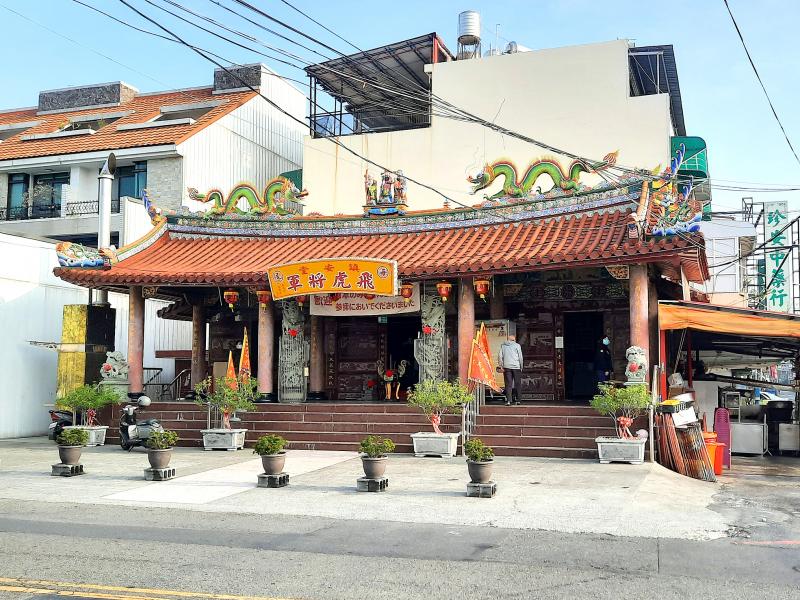
Photo: Steven Crook
The city government convened a meeting to discuss the disposal of the human remains. Among those attending were a spirit medium (jitong, 乩童) surnamed Tai (戴) and Lin Hsi-shan (林錫山), a department chief and future Tainan mayor. The former was there to communicate with the bones’ deceased “owners.” The latter’s job was to reconcile requests from the afterworld with official rules and procedures.
Tai reportedly couldn’t speak Mandarin, and only very basic Japanese. Yet, soon after falling into a trance, he was proclaiming in standard Mandarin, and then in fluent Japanese. (Xenoglossy or impressive literacy despite a lack of education are often seen as proof that jitong are truly under the control of otherworldly entities.)
That day, three spirits possessed Tai. They identified themselves as: Xie Yong-chang (謝永常), a Fujianese general who followed Cheng Cheng-kung (鄭成功, or Koxinga) and his army of Ming loyalists to Taiwan; Zhao Sheng (趙勝), a senior civil official during the Qing Dynasty; and Yoshihara Kozo, an Imperial Japanese Army colonel.
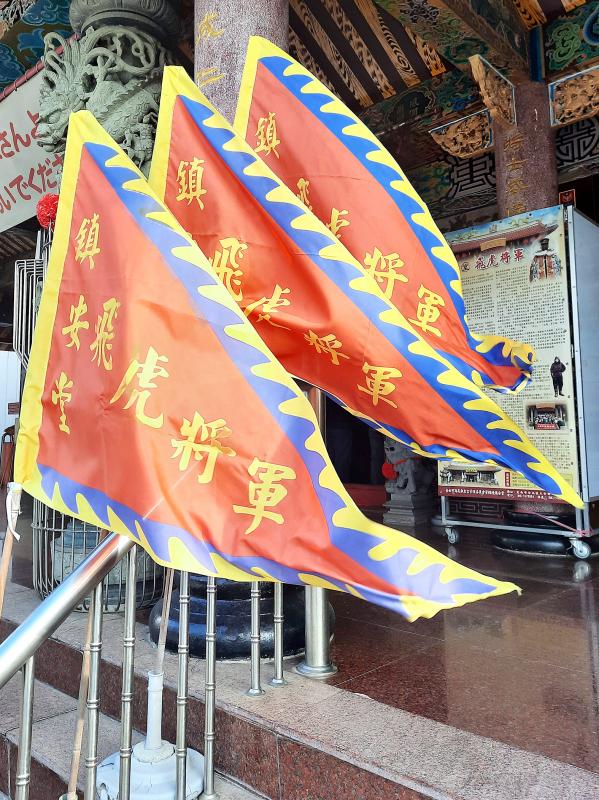
Photo: Steven Crook
Xie died in combat during Koxinga’s attack on the Dutch in Anping (安平) in 1661. According to some accounts, Yoshihara was killed during fighting in Tainan, in one of the final skirmishes of the War of 1895, when Tokyo occupied Taiwan in the wake of the First Sino-Japanese War. There’s very little information about Zhao.
Through Tai, this trinity issued specifications for an ossuary, in front of which the temple now stands. The location is about 4km east of where the bones were unearthed.
Visitors to the shrine won’t have any difficulty identifying which effigy represents Yoshihara. He’s in the front row, on the right as you face the statuettes, and wears 19th-century military uniform. Xie — in the center, being the principal deity — and Zhao, on the left, are in classical Chinese attire.
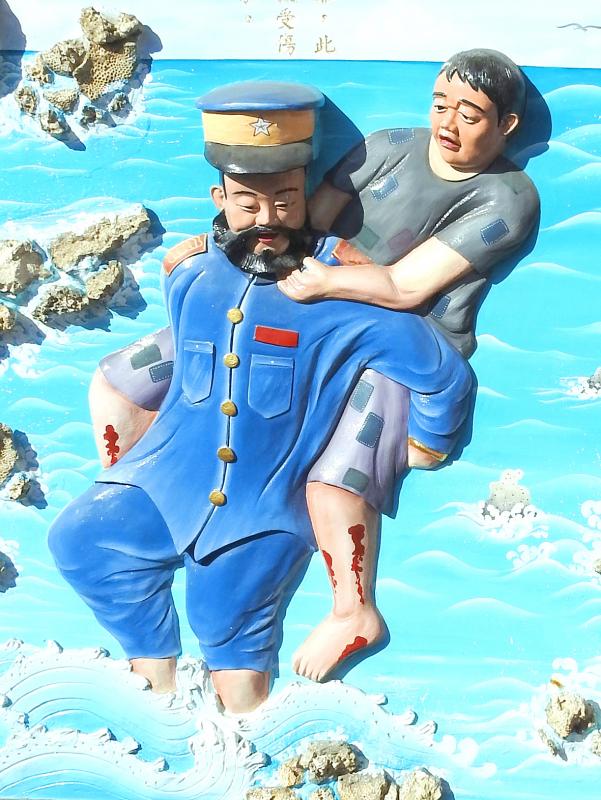
Photo: Steven Crook
Address & Directions
The temple is at 59 Yuyong Road, East District (東區裕永路), Tainan City. Parking nearby isn’t difficult. From Tainan TRA Station, take city bus #6 (services about hourly) to Salesian Technical School (慈幼工商), then walk 450m.
SHOT DOWN OVER TAINAN
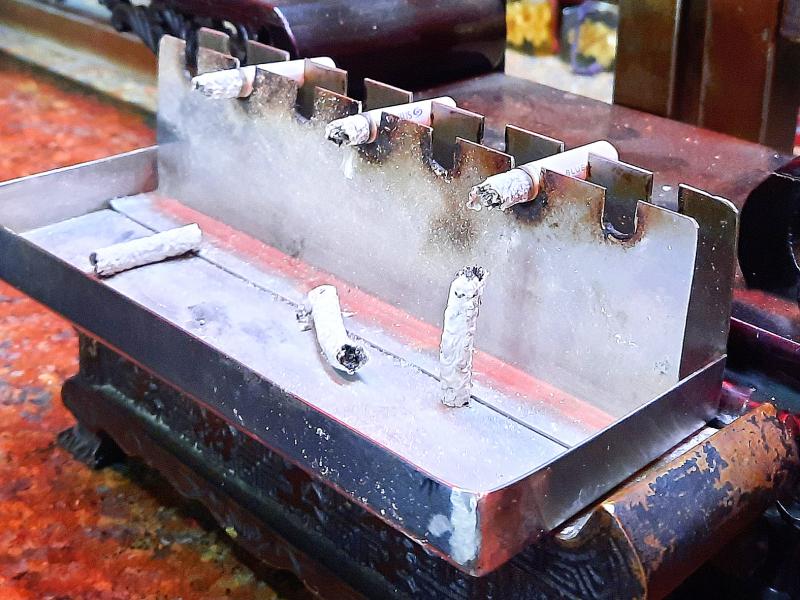
Photo: Steven Crook
Located in a nondescript Tainan suburb, Zhenan Shrine (鎮安堂) is also known as General Flying Tiger’s Temple (飛虎將軍廟) — but there’s no connection to the US airmen who flew for Nationalist China during World War II, and were dubbed “the Flying Tigers.”
The temple venerates Sugiura Shigemine, an Imperial Japanese Navy (IJN) pilot who died near here on Oct. 12, 1944. After his Zero fighter was machinegunned by a US plane, rather than bail out, Sugiura steered away from a populated area, crashing among fish farms. His badly-burnt body could only be identified by the boots.
For years after the repatriation of Japanese personnel following Japan’s defeat, there were sightings in the area of a young man in an IJN uniform. What’s more, several locals claimed that Sugiura visited them in their dreams.
With sentiment growing that the young pilot had sacrificed himself to protect others, local people in 1971 sought guidance from Baoshengdadi, a medicine god. That deity instructed them that Sugiura deserved to be honored with both a grand title and a place of worship.
Inside the current structure, which dates from 1983, Sugiura’s supporters cherish three small effigies of the pilot. Cigarettes are offered to his spirit each day. Recordings of the anthems of Japan and the IJN are played every morning and evening.
The shrine has developed strong links with Sugiura’s hometown, Mito. In 2014-15, funds were raised there so the temple could purchase a palanquin made of Japanese cypress. The effigies were then able to join processions and inspection tours. In 2016, a delegation from the shrine accompanied one Sugiura effigy to Mito, where they participated in memorial events.
Address & Directions
The temple is at 730-1 Daan Street, Annan District (安南區大安街), about 6km north of Tainan TRA Station. Parking a car within 100m of the temple should be straightforward. From Tainan TRA Station, take city bus #3 to Tongan Road Intersection (同安路口) and walk 400m northeast.
A PLAGUE GOD IN POLICE UNIFORM
Fuan Temple (富安宮) is the focal point of a village now known as Fulai (副瀨) in Chiayi County’s Dongshih Township (東石). Inside, a colonial-era policeman is revered alongside the sea goddess Matsu and a trio of Wang Ye spirits.
In 1900, Yokohama-born police officer Morikawa Seijiro was assigned to Fulai. Unlike some of those tasked with enforcing colonial rule, Morikawa was able to win the hearts and minds of local people.
In addition to maintaining law and order, he worked to increase literacy among the young, supervised the digging of irrigation ditches, and paid out of his own pocket when penniless villagers needed medicine.
In 1901, the colonial government began levying a tax on bamboo fishing rafts. When Morikawa urged his superiors to suspend the tax, telling them that the people of Fulai were too impoverished to pay it, he was reprimanded.
Morikawa was later accused of inciting non-payment. On April 7, 1902, he committed suicide, leaving behind a note in which he bemoaned colonial “tyranny.”
Two decades later, as meningitis swept the region, Morikawa appeared in the village leader’s dreams, wearing his police uniform, and urged Fulai’s inhabitants to pay attention to household and food hygiene, so as to keep the disease at bay.
After the epidemic receded, the villagers agreed that Morikawa deserved their veneration. A statuette was carved and enshrined in Fuan Temple as Lord Yi-ai (義愛公).
When I visited the temple, the volunteer on duty didn’t hesitate to bring out the effigy of Lord Yi-ai so I could take photos. She explained that she was used to doing this — until COVID-19 shut down cross-border tourism, it wasn’t unusual for Japanese tour groups to drop by and pay their respects.
That was late last year. We’re now in 2022, and there’s still a need for deities who can stave off contagious disease.
Address & Directions
Bus #7228 leaves the bus station at Puzih (朴子) seven times per day, and stops 100m east of Fuan Temple. If you’re driving, Expressway 61 is convenient. Motorcyclists and cyclists can reach Fulai by Provincial Highway 17.
Steven Crook has been writing about travel, culture and business in Taiwan since 1996. He is the author of Taiwan: The Bradt Travel Guide and co-author of A Culinary History of Taipei: Beyond Pork and Ponlai.
What was the population of Taiwan when the first Negritos arrived? In 500BC? The 1st century? The 18th? These questions are important, because they can contextualize the number of babies born last month, 6,523, to all the people on Taiwan, indigenous and colonial alike. That figure represents a year on year drop of 3,884 babies, prefiguring total births under 90,000 for the year. It also represents the 26th straight month of deaths exceeding births. Why isn’t this a bigger crisis? Because we don’t experience it. Instead, what we experience is a growing and more diverse population. POPULATION What is Taiwan’s actual population?

You would never believe Yancheng District (鹽埕) used to be a salt field. Today, it is a bustling, artsy, Kowloon-ish “old town” of Kaohsiung — full of neon lights, small shops, scooters and street food. Two hundred years ago, before Japanese occupiers developed a shipping powerhouse around it, Yancheng was a flat triangle where seawater was captured and dried to collect salt. This is what local art galleries are revealing during the first edition of the Yancheng Arts Festival. Shen Yu-rung (沈裕融), the main curator, says: “We chose the connection with salt as a theme. The ocean is still very near, just a
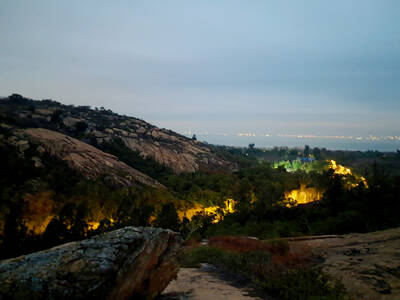
For the past five years, Sammy Jou (周祥敏) has climbed Kinmen’s highest peak, Taiwu Mountain (太武山) at 6am before heading to work. In the winter, it’s dark when he sets out but even at this hour, other climbers are already coming down the mountain. All of this is a big change from Jou’s childhood during the Martial Law period, when the military requisitioned the mountain for strategic purposes and most of it was off-limits. Back then, only two mountain trails were open, and they were open only during special occasions, such as for prayers to one’s ancestors during Lunar New Year.
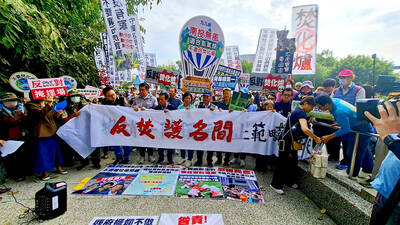
A key feature of Taiwan’s environmental impact assessments (EIA) is that they seldom stop projects, especially once the project has passed its second stage EIA review (the original Suhua Highway proposal, killed after passing the second stage review, seems to be the lone exception). Mingjian Township (名間鄉) in Nantou County has been the site of rising public anger over the proposed construction of a waste incinerator in an important agricultural area. The township is a key producer of tea (over 40 percent of the island’s production), ginger and turmeric. The incinerator project is currently in its second stage EIA. The incinerator


 RSS
RSS