


When coronavirus claimed its first victim in India’s largest slum in April, many feared the disease would turn its narrow, congested streets into a graveyard, with social distancing or contact tracing all but impossible.
But three months on, Mumbai’s Dharavi offers a rare glimmer of hope with new infections shrinking, thanks to an aggressive strategy that focused on “chasing the virus, instead of waiting for disaster,” according to city official Kiran Dighavkar.
The sprawling slum has long been a byword for the financial capital’s bitter income disparities — with Dharavi’s estimated one million people scraping a living as factory workers or maids and chauffeurs to Mumbai’s well-heeled residents.

Photo: AFP
With a dozen people typically sleeping in a single room, and hundreds using the same public toilet, authorities realized early that standard practices would be of little use.
“Social distancing was never a possibility, home isolation was never an option, and contact tracing was a huge problem with so many people using the same toilet,” Dighavkar said.
An initial plan to conduct door-to-door screenings was abandoned after Mumbai’s searing heat and humidity left medical workers feeling suffocated under layers of protective equipment as they combed the area’s cramped alleys for cases.
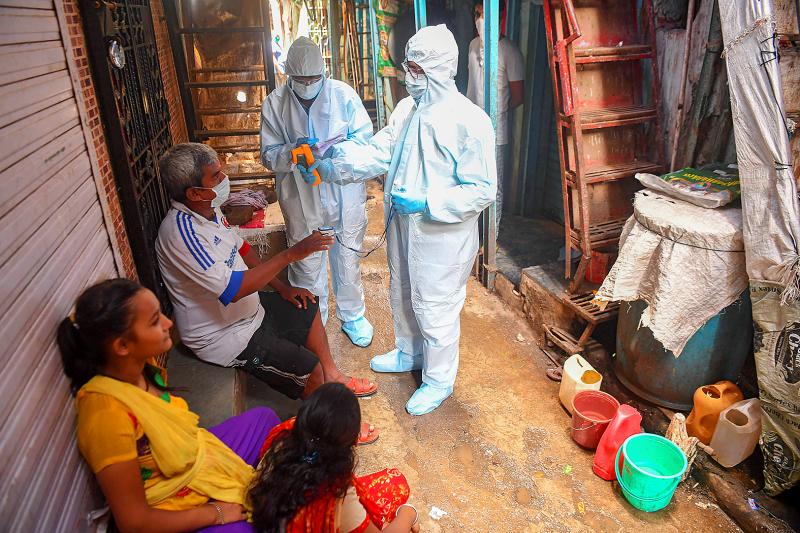
Photo: AFP
But, with infections rising fast and fewer than 50,000 people checked for symptoms, officials needed to move quickly and get creative.
What they came up with was coined “Mission Dharavi.”
Each day, medical workers set up a “fever camp” in a different part of the slum, so residents could be screened for symptoms and tested for coronavirus if needed. Schools, wedding halls and sports complexes were repurposed as quarantine facilities that offered free meals, vitamins and “laughter yoga” sessions.
Strict containment measures were deployed in virus hotspots that were home to 125,000 people, including the use of drones to monitor their movements and alert police, while a huge army of volunteers swung into action, distributing rations so they didn’t go hungry.
Bollywood stars and business tycoons paid for medical equipment as construction workers built a 200-bed field hospital at breakneck speed in a park inside Dharavi.
By late last month, more than half the slum’s population had been screened for symptoms and around 12,000 tested for coronavirus.
So far Dharavi has reported just 82 deaths — a fraction of Mumbai’s more than 4,500 fatalities.
‘BRINK OF VICTORY’
“We are on the brink of victory, I feel very proud,” said Abhay Taware, a doctor who saw around 100 patients daily in his tiny clinic at the height of the crisis.
The 44-year-old father-of-two also had to fight his own battle against coronavirus when he contracted the disease in April, but said he had “no doubts” about returning to work.
“I thought I could show my patients that a positive diagnosis does not mean the end,” he said.
Although doctors like Taware worked to reassure worried residents, the stigma persists.
After an isolating 25-day spell in hospital and a fortnight in quarantine, Sushil — not his real name — said he now feared discrimination if people found out about his diagnosis.
The 24-year-old also struck a note of caution, warning of a potential resurgence in infections.
“People need to take as many precautions as possible. The numbers might have come down but they can swiftly rise again”, he said.
‘NO ESCAPE NEXT TIME’
With Mumbai and Delhi struggling to accommodate coronavirus patients as India’s cases surge past half a million officials are also wary of celebrating too soon.
“It’s a war. Everything is dynamic,” said Dighavkar.
“Right now, we feel like we are on top of the situation,” he said. “The challenge will be when factories reopen,” he added, referring to the billion-dollar leather and recycling industries run out of Dharavi’s cramped tenements.
And some in the slum fear their community might not be as lucky next time.
On a blazing morning, as car salesman Vinod Kamble lined up to have his temperature taken, he recalled his terror when the virus landed in Mumbai.
“I felt like Dharavi would be destroyed, and nothing would be left,” he said, describing the near impossibility of avoiding infection in the slum.
“We need better infrastructure,” the 32-year-old said. “Otherwise the next time a disease like this emerges, I don’t think Dharavi will be able to escape.”

In late October of 1873 the government of Japan decided against sending a military expedition to Korea to force that nation to open trade relations. Across the government supporters of the expedition resigned immediately. The spectacle of revolt by disaffected samurai began to loom over Japanese politics. In January of 1874 disaffected samurai attacked a senior minister in Tokyo. A month later, a group of pro-Korea expedition and anti-foreign elements from Saga prefecture in Kyushu revolted, driven in part by high food prices stemming from poor harvests. Their leader, according to Edward Drea’s classic Japan’s Imperial Army, was a samurai

The following three paragraphs are just some of what the local Chinese-language press is reporting on breathlessly and following every twist and turn with the eagerness of a soap opera fan. For many English-language readers, it probably comes across as incomprehensibly opaque, so bear with me briefly dear reader: To the surprise of many, former pop singer and Democratic Progressive Party (DPP) ex-lawmaker Yu Tien (余天) of the Taiwan Normal Country Promotion Association (TNCPA) at the last minute dropped out of the running for committee chair of the DPP’s New Taipei City chapter, paving the way for DPP legislator Su

It’s hard to know where to begin with Mark Tovell’s Taiwan: Roads Above the Clouds. Having published a travelogue myself, as well as having contributed to several guidebooks, at first glance Tovell’s book appears to inhabit a middle ground — the kind of hard-to-sell nowheresville publishers detest. Leaf through the pages and you’ll find them suffuse with the purple prose best associated with travel literature: “When the sun is low on a warm, clear morning, and with the heat already rising, we stand at the riverside bike path leading south from Sanxia’s old cobble streets.” Hardly the stuff of your

Located down a sideroad in old Wanhua District (萬華區), Waley Art (水谷藝術) has an established reputation for curating some of the more provocative indie art exhibitions in Taipei. And this month is no exception. Beyond the innocuous facade of a shophouse, the full three stories of the gallery space (including the basement) have been taken over by photographs, installation videos and abstract images courtesy of two creatives who hail from the opposite ends of the earth, Taiwan’s Hsu Yi-ting (許懿婷) and Germany’s Benjamin Janzen. “In 2019, I had an art residency in Europe,” Hsu says. “I met Benjamin in the lobby


 RSS
RSS