


Every afternoon, Sandra Perez and Francisco Ramirez go over their list of fellow New Yorkers who need help because of the coronavirus pandemic. Some are sick. Others lost jobs, but have children to feed. Others are elderly or disabled. All are immigrants, like them.
Then, the friends, both originally from Mexico, stock up on rice, beans, vegetables, cereal, soups and fruit at an East Harlem supermarket, and make deliveries by car to as many as 15 families a day.
“I feel that if we are well, physically, emotionally, then we can help others,” said Ramirez, a 52-year-old day laborer who used to do construction jobs, but now finds work scarce because of the crisis.
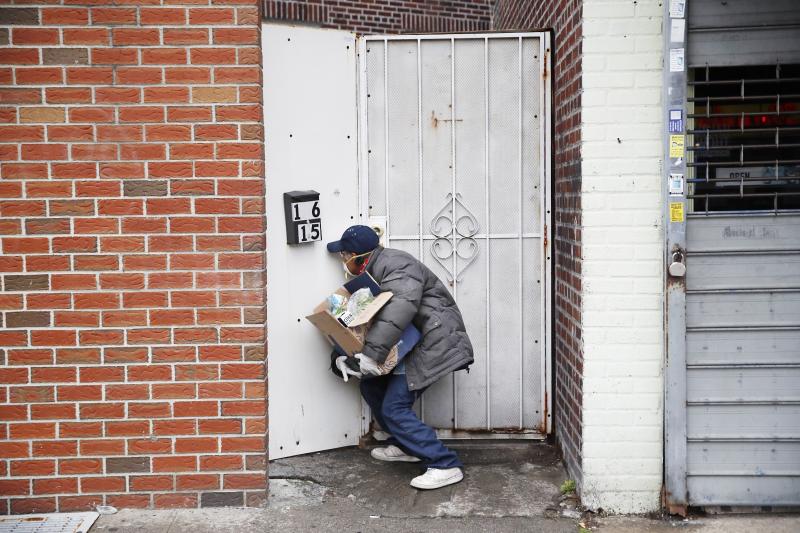
Photo: AP
IN THE SHADOWS
Perez and Ramirez are among a growing number of people who have taken it upon themselves to help an immigrant community that has been hard hit by the pandemic, but often lives in the shadows of government and not-for-profit aide systems because of barriers such as language and immigration status.
These aide networks can be informal and operate on word-of-mouth and social media fundraising campaigns.
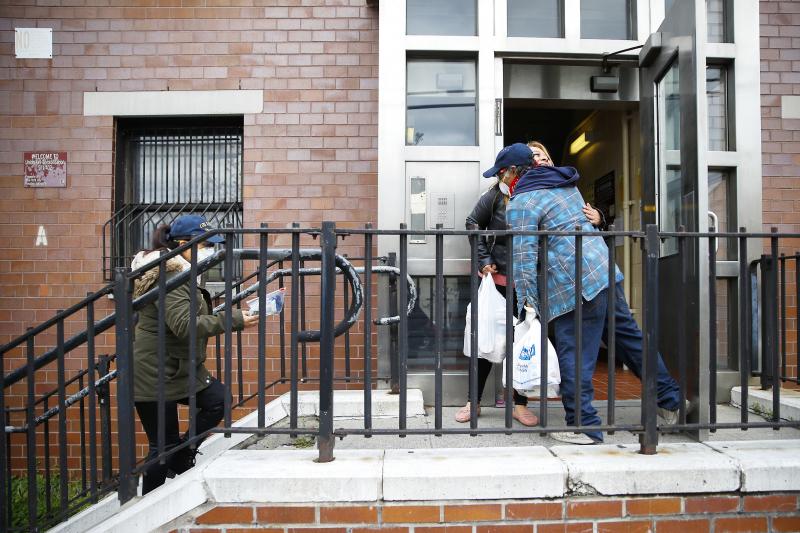
Photo: AP
In Stamford, Connecticut, Erika Zamora has been distributing food from the restaurant she co-owns even after it was forced to close.
“Many people here live check by check. If you miss a check you are in trouble,” said Zamora, herself a Mexican immigrant. She plans to start calling people for donations. In Delaware, Spanish-language radio station La ZMX manager Vladimir Rosales has been receiving calls from Guatemalan, Mexican, Salvadoran, Honduran and other immigrants asking for food. He responded by soliciting donations from stores in Wilmington and Seaford and having families pick up the bags of groceries from the station.
“It is very sad. People call me in tears,” he said.
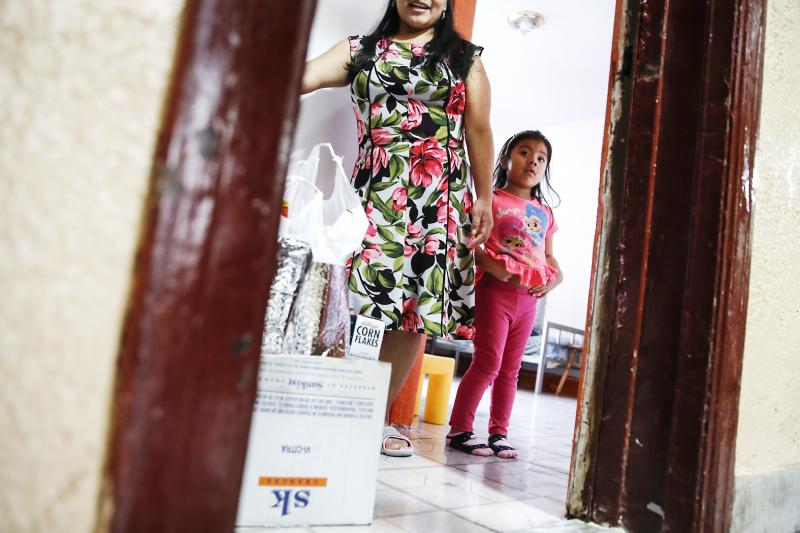
Photo: AP
The Migration Policy Institute found that 20 percent of the US workers in vulnerable industries facing layoffs are immigrants, even though they only make up 17 percent of the civilian workforce.
According to a Pew Research Center study conducted in March, 49 percent of Hispanics surveyed say they or someone in their household has taken a pay cut or lost a job — or both — because of the COVID-19 outbreak, compared with 29 percent of white and 36 percent of black people.
The death toll from the coronavirus has also been disproportionately high in black and Hispanic communities in New York City. Blacks have suffered roughly double the fatality rate of whites during the epidemic, according to city health data. The fatality rate for Hispanics has been only slightly better. Perez said she felt compelled to begin offering volunteer help after seeing messages needy members of the Mexican community were posting on Facebook. Ramirez started his own Facebook page where people could share information. Perez bought food with her own money at first, but she and Ramirez now pay for the groceries with donated money.
People they deliver to tell them about others going hungry. Phone numbers get passed along and chain develops: Perez says she gets about 10 to 15 phone calls or texts per day from people seeking help.
“We want to focus on the most vulnerable ones.” said Perez, a 40-year-old single mother who works part-time for the city.
Perez and Ramirez spend a daily average of between US$100 and US$150 at the supermarket. There are days that Peruvian and Mexican restaurants donate food and the friends just distribute those boxes. They raise the money through the Facebook page and a growing list of friends.
Sometimes the requests are more grim. People ask which funeral home they should call for relatives who have died or for the name of groups that can help cover the costs of a funeral or the repatriation of ashes to Mexico.
FILLING THE GAPS
Raquel Barrera, a Mexican single mother who is sick in the Bronx, got a food delivery from Perez and Ramirez last week.
Barrera, who is getting over a fever, body pain and strong coughing, lives with her mother, daughter, two nieces, a sister and a grandchild in a two-bedroom apartment.
“The food they brought was a blessing because we were able to feed the kids for several days,” said Barrera, who lost her job cleaning horse stables at a ranch in Chester, New York, about an hour from her home.
Most green-card holders can benefit from unemployment insurance or from the economic stimulus package recently approved by Congress. Some immigrants on a temporary work permit, like those applying for asylum, can also get unemployment insurance and the new relief checks.
Immigrants without social security numbers, however, are unable to access any of these options. New York City Mayor Bill de Blasio recently announced a partnership with Open Society Foundations to provide emergency relief to immigrant families, regardless of immigration status.
In California, Gov. Gavin Newsom announced that his state will give cash to immigrants living in the country illegally who are hurt by the coronavirus, offering US$500 apiece to 150,000 adults.
Filling in the gaps are volunteers like Myrna Lazcano, who lost her own job cleaning homes and offices thanks to the shutdown.
The 43-year-old Mexican immigrant, her husband and two daughters live off their savings, but still Lazcano delivers food to others in her East Harlem neighborhood bought with money that local churches, activists and acquaintances.
“By helping the community like this I feel that we are lifting the weight of this crisis,” she said. “People smile when they see the bags with food. I call them canisters of hope.”

If a leisurely afternoon of high-end dining and watching the scenery roll by from the comfort of a plush armchair sounds like a good time to you, consider a trip on the Sea Breeze (海風號). This culinary, cultural and scenic experience is the perfect setting for a date, a celebratory outing with a small group of friends or a relaxing solo ride. The price tag is steep, especially if you consider the short distance the train actually covers over the 3.5-hour journey. But what you’re paying for on the Sea Breeze isn’t transportation; it’s the comfort, the service, the exclusivity, the

June 15 to June 21 According to legend, a giant from Orchid Island (Lanyu, 蘭嶼) named Si Mangangavang once built a large tatala canoe capable of carrying 16 people. He set sail southward to the Batanes in the Philippines, where he traded with the local Ivatan people. One of the goods they coveted was cowhide, which the Tao people of Orchid Island used to make armor. Through continued trade, the Tao and Ivatan forged close ties, and Si Mangangavang became good friends with a Batanes giant named Si Vakag. This story, collected in a 1998 book by ethnologist Yu Guang-hong (余光弘)

Taiwan’s renewable shortfall is a problem of execution, not resources. Japan’s long-cycle, joined-up energy planning is the model worth studying — but what Taiwan can borrow is the institutional machinery, not the politics. When Nvidia CEO Jensen Huang (黃仁勳) used his visit to Taipei last month to warn that the country needs far more electricity, he was naming a constraint its own planners already know well: Taiwan Power Co (Taipower, 台電) expects demand from the semiconductor and artificial intelligence (AI) sector alone to exceed 5 gigawatts (GW) by 2030. The harder question is not whether to build more capacity but which

One of the wildest things about the reception of Chinese Nationalist Party (KMT) Chair Cheng Li-wun (鄭麗文) in the international media is the way her words are presented without being contextualized, let alone challenged. The Financial Times, for example, interviewing her during her visit to New York, said that she blamed the halt to exchanges between Taiwan and the People’s Republic of China (PRC) for raising tensions. “There has been no dialogue, so you can see that the situation is almost on the brink of war,” the Financial Times quoted her as saying, without any hint that the PRC, not


 RSS
RSS