


Before Taiwan became part of the Japanese Empire in 1895, privately-run tutorial academies (書院) were key providers of education. At these establishments, boys — never girls, it seems— studied the works of Confucius and other thinkers, and tried to memorize principles of law, taxation and military strategy. According to one list, at least 62 such schools were founded in Taiwan between 1683 and 1893.
Academies of this type are an element of Chinese culture which early Han settlers brought to Taiwan. They have a very long history in the Sinosphere. According to the online New World Encyclopedia, they first appeared in the eighth century, and “were not only centers for the compilation and study of classical literature, but were crucial for the development of Confucianism and Neo-Confucianism.” Among those who developed their ideas and taught at such institutes was Wang Yang-ming (王陽明, 1472-1529), after whom Yangmingshan (陽明山) near Taipei is named.
In Taiwan, as in China, many of those who studied at tutorial academies were preparing for the imperial examinations through which men qualified for civil-service appointments. Passing these exams was no guarantee of a government post, and anthropologist Francis Hsu (許良光, 1909-1999) compared the situation in China’s capital long ago to that in modern Hollywood. Just as aspiring actors flock to California, hoping to break into movies, “thousands of office seekers… clustered around the many inns and the provincial and district guilds waiting for that long desired interview with an important official.”
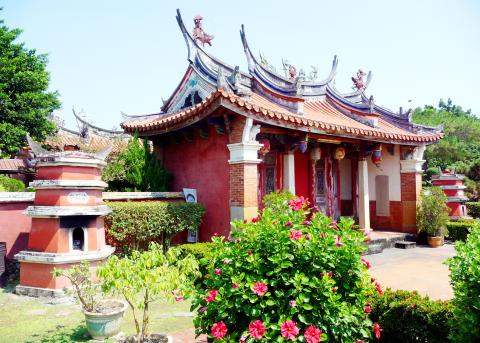
Photo: Steven Crook
Rather than waste years hoping for an appointment that might never come, some successful candidates immediately returned to their hometowns. There they could expect to bask in the tremendous prestige that attached to success in the exams. Throughout the period of Qing rule, a mere 29 Taiwanese passed the highest-level exams to attain jinshi (進士) status. Another 251 obtained the second-highest degree and were known as juren (舉人). Several of these individuals later worked as elite tutors and trained the next generation of test-takers.
Hsu had a couple more interesting things to say on this subject: “To the extent that the Chinese tutor schools of old allowed students to proceed at different speeds, one might say that they also were partially progressive. But this… was a matter of practical convenience and not a matter of principle. [Students] had to concentrate on memorizing great literature from the past and practicing the art of handwriting. There was never any thought of devising methods to make the learning process more palatable…”
RENOVATED ACADEMIES
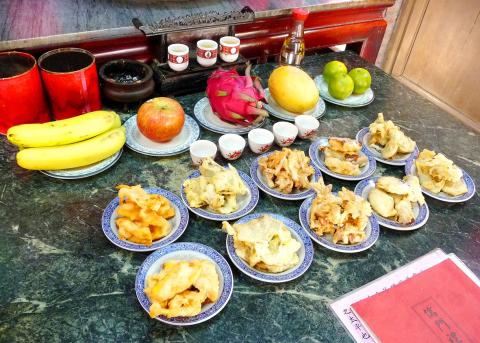
Photo: Steven Crook
Dozens of academies of classical learning in Taiwan disappeared during the 20th century, victims of social change and urban redevelopment. Since the 1990s, several of the survivors have been thoroughly renovated, among them Huangxi Academy (磺溪書院) in Taichung and Fongyi Tutorial Academy (鳳儀書院) in Kaohsiung.
One traditional preparatory school that still looks authentically timeworn is Zhenwen Academy (振文書院) in Yunlin County. It’s the only survivor of the four which operated in the county before 1900.
Zhenwen Academy is near the center of Siluo (西螺), a town famous for its century-old shophouses, yet it doesn’t seem to get many tourists. Like other academies, it has always been more than a place where teachers instructed pupils. Confucian rites have been conducted here since its founding in 1813, and it retains a religious function.

Photo: Steven Crook
When I visited recently, on a weekday morning, several men and women were putting on plain robes and preparing for a ritual. They then moved into the adjacent and affiliated Nantian Xuewen Jude Branch Institution (南天修文院懿德分院), which an Academia Sinica Web page describes as a place where Taoism is taught, Confucian theory is promoted and “simple and kind social customs” are encouraged.
The man I spoke with exemplified traditional courtesy. I just wish my Mandarin was better so I could understand more of what he told me. There seemed to be certain reasons why the offerings in both the academy and the institution were meat-free, and included deep-fried eggplant and sweet potato, but I failed to grasp what they were.
Nantian Xuewen Jude Branch Institution was founded in 1934. A few years later, the Japanese colonial authorities launched the Kominka Movement (皇民化運動), a campaign that aimed to culturally align Taiwan with Japan. The institution was demolished and its supporters forced to curtail their activities until the end of World War II. The current two-story building dates from the early 1970s.

Photo: Steven Crook
Not wanting to disturb the practitioners, I returned to the academy and tried to get a closer look at the memorial tablets which honor the local literati who founded this institution. The complex has a number of weathered, but still colorful, woodcarvings. Look up as you face the main altar and you’ll see a pair of squid. The lattice windows at the formal entrance feature face-to-face tigers. On the roof, statuettes of immortals look toward the road.
If I lived in Siluo, I could see myself coming here from time to time, settling down with a good book, and unplugging from the modern world for an hour or two. Confucius would surely approve.
Steven Crook has been writing about travel, culture, and business in Taiwan since 1996. He is the co-author of A Culinary History of Taipei: Beyond Pork and Ponlai, and author of Taiwan: The Bradt Travel Guide, the third edition of which has just been published.


Taiwan’s English education system is being pulled apart by three opposing forces. Bilingual Nation 2030 pulls students toward English and global communication. Artificial Intelligence (AI) readiness pulls them toward digital judgment, verification and AI-mediated work. But Taiwan’s old exam culture pulls them back toward memorization, grammar drills, timed reading and correct answers. If the education system keeps using old exams to define success, it risks producing graduates who are neither genuinely bilingual nor genuinely AI-ready, but trained for tasks machines can already perform. The first force is Bilingual Nation 2030. Launched in 2018, the policy aimed to “help Taiwan’s workforce connect

“Taiwan’s Opposition Leader Comes to US With a Message Straight Out of Beijing” read a May 31 headline in the Wall Street Journal. Top US administration officials and members of Congress almost certainly read the WSJ, and if there was a bullet point takeaway that people in Washington should absorb ahead of Chinese Nationalist Party (KMT) Chair Cheng Li-wun’s (鄭麗文) arrival in DC on June 9, that headline is it. The last few columns have discussed this very topic, and the timing is not coincidental. While those top officials likely do not read the Taipei Times, judging by the number

With weighty, anxiety-inducing geopolitical topics dominating the headlines, checking in on the wild and weird state of local politics can take some of the edge off. This November’s elections will determine who will be in charge of fixing potholes in your neighborhood, not the potholes in Taiwan’s complicated geopolitical space. Recently, after an online interview with a Taipei-based journalist, I commented that Taipei journalists never go further than the MRT can take them. He laughed and agreed. Naturally, the Taipei mayoral race is eating up much of the press attention. TAIPEI CITY Democratic Progressive Party (DPP) candidate Puma Shen (沈伯洋) has
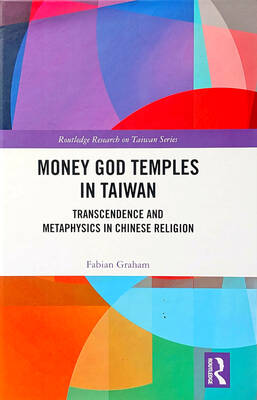
As someone who normally steers clear of books with “transcendence” or “metaphysics” in their subtitles, this reviewer — a casual observer of local belief systems since the 1990s — found Fabian Graham’s Money God Temples in Taiwan a challenging read. Those who’ve only dipped their toes into temple culture will likely need to parse several sections with special care if they’re to keep up with the author, a British ethnographic researcher whose previous books have investigated religious practices among ethnic Chinese in Southeast Asia. This scholarly volume examines a facet of Taiwan’s religious landscape that didn’t exist a century ago, and


 RSS
RSS