


For 53-year-old Perry Dino, a paintbrush and canvas are weapons for opposing the Hong Kong government as it faces mass protests against a now-suspended bill that would allow extraditions to mainland China.
Dino, who has painted many of Hong Kong’s social movements, including the pro-democracy “Umbrella movement” in 2014, considers it important to record what is happening in the Chinese-ruled city.
“I am already one of those standing on the front line to defend Hong Kong,” Dino said.
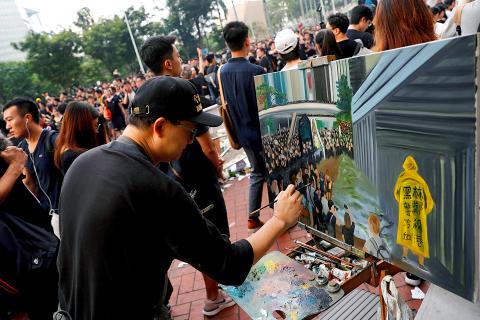
Photo: Reuters
Hong Kong’s government has indefinitely suspended the bill that would allow criminal suspects to be sent to mainland China for trial in courts controlled by the Communist Party.
However, activists — mostly students in face masks, hard-hats and goggles — are demanding the bill be fully withdrawn.
The bill has seen millions of people, fearing erosion of freedoms promised when Hong Kong returned to Chinese rule in 1997, throng the streets in protest, plunging the former British colony into political crisis.
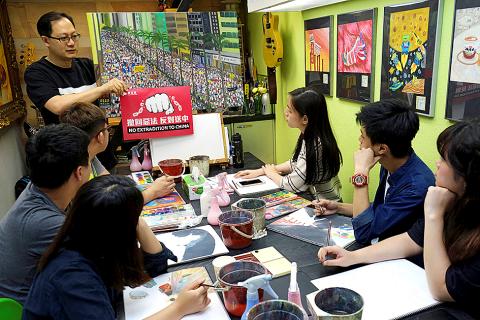
Photo: Reuters
Braving tear gas, rubber bullets and beanbag rounds in recent weeks when protests turned violent, Dino says he has drawn and painted as much as he can about the mass rallies.
“I hope the future generation can understand what Hong Kong has gone through,” he said.
Dino, a part-time teacher, says he hopes that when Hong Kong has true democracy, he can donate his artwork to a “democracy progression museum.”
None of his artwork is currently for sale.
“Making how much money doesn’t matter to me. Only the future matters,” he said.
Among his paintings, which feature colorful brushstrokes, are ones showing demonstrators’ tents occupying major thoroughfares and a flower-etched tribute to a protester who fell to his death.
One painting depicts police firing tear gas, with thick plumes of smoke billowing across a mass of demonstrators. An abstract canvas shows activists shielding their eyes as they flee while a police officer with a rifle grins.
Since he started doing protest artwork in 2012, Dino has joined the annual June 4 Tiananmen Square vigil and made 25 paintings during the “Umbrella movement,” when protesters paralyzed parts of the financial hub for 79 days.
Dino said that during protests, Hong Kong police have told him to paint somewhere else.
In the mainland, Chinese censors strive to erase or block news or depictions of the protests.
Dino is confident he can keep doing what he is doing.
“They can’t hack into my computer and delete it like a photo, nor can they destroy it with a baton as I can always fix my painting,” he said.
May 11 to May 17 Traversing the southern slopes of the Yushan Range in 1931, Japanese naturalist Tadao Kano knew he was approaching the last swath of Taiwan still beyond colonial control. The “vast, unknown territory,” protected by the “fierce” Bunun headman Dahu Ali, was “filled with an utterly endless jungle that choked the mountains and valleys,” Kano wrote. He noted how the group had “refused to submit to the measures of our authorities and entrenched themselves deep in these mountains … living a free existence spent chasing deer in the morning and seeking serow in the evening,” even describing them as

Yesterday, the Democratic Progressive Party (DPP) nominated legislator Puma Shen (沈伯洋) as their Taipei mayoral candidate, the Chinese Nationalist Party (KMT) put their stamp of approval on Wei Ping-cheng (魏平政) as their candidate for Changhua County commissioner and former legislator Tsai Pi-ru (蔡壁如) of the Taiwan People’s Party (TPP) has begun the process to also run in Changhua, though she has not yet been formally nominated. All three news items are bizarre. The DPP has struggled with settling on a Taipei nominee. The only candidate who declared interest was Enoch Wu (吳怡農), but the party seemed determined to nominate anyone
In a sudden move last week, opposition lawmakers of the Chinese Nationalist Party (KMT) and Taiwan People’s Party (TPP) passed a NT$780 billion special defense budget as a preemptive measure to stop either Chinese leader Xi Jinping (習近平) or US President Donald Trump from blocking US arms sales to Taiwan at their summit in Beijing, said KMT heavyweight Jaw Shaw-kong (趙少康), speaking to the Taipei Foreign Correspondents Club on Wednesday night in Taipei. The 76-year-old Jaw, a political talk show host who ran as the KMT’s vice presidential candidate in 2024, says that he personally brokered the deal to resolve
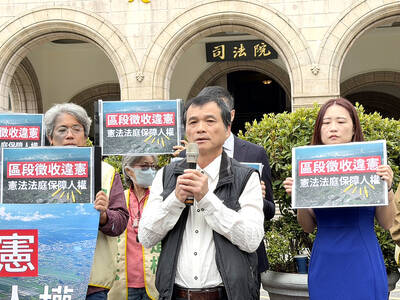
What government project has expropriated the most land in Taiwan? According to local media reports, it is the Taoyuan Aerotropolis, eating 2,500 hectares of land in its first phase, with more to come. Forty thousand people are expected to be displaced by the project. Naturally that enormous land grab is generating powerful pushback. Last week Chen Chien-ho (陳健和), a local resident of Jhuwei Borough (竹圍) in Taoyuan City’s Dayuan District (大園) filed a petition for constitutional review of the project after losing his case at the Taipei Administrative Court. The Administrative Court found in favor of nine other local landowners, but


 RSS
RSS