


Forward-looking altruism that goes beyond borders and could bring Taiwan many benefits or an effort to shift the world’s center of gravity from the West to China? It’s a question that’s been asked about the Tang Prize (唐獎) since it was first awarded in 2014.
For one thing, the prize — which a 2013 BBC report dubbed an “Asian Nobel” — takes its name from the Tang Dynasty, which ruled China from AD 618 to 907. Many regard this period as the pinnacle of Chinese civilization, an era of prosperity, peace, stability and international influence that continues to inspire people of Chinese nationality and descent.
Then there’s the funding. The Taipei-based foundation that awards the prize was endowed by Samuel Yin (尹衍樑), a Taiwanese businessman with extensive investments in China. Yin, the billionaire chairman of insurance/real estate/retail conglomerate Ruentex Group (潤泰集團), has a long history of giving. In 1994, he donated US$10 million to help set up Guanghua School of Management at Peking University.
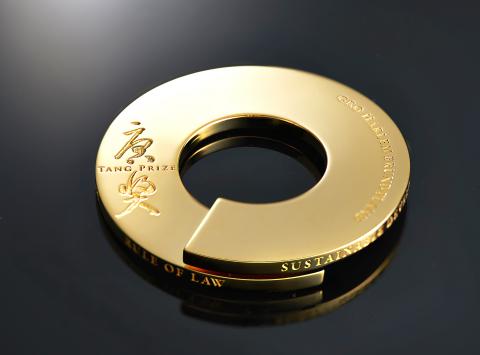
Photo courtesy of The Tang Prize Foundation
Yet according to Steve Tsang (曾銳生), director of the SOAS China Institute, School of Oriental and African Studies University of London: “The Tang Prize has done more to project Taiwan’s soft power than practically any other initiative I have seen from Taiwan.”
As for the name, Tsang adds, critics should refresh their understanding of Tang history.
“It was not a Han-centric, inward-looking time. The Tang royal family was part Han and part Turkic, and its court was home to many non-Han generals and ministers. It was not like the [People’s Republic of China]. It was one of the most, if not the most, open and outward-looking empires of the medieval world,” Tsang says.
.jpg)
Photo courtesy of The Tang Prize Foundation
He describes the quality of the selection process as “Nobel Prize level,” and points out that only one of the four prize categories, Sinology, is China-focused. The other three categories are Biopharmaceutical Science, Rule of Law and Sustainable Development. The 2013 BBC report quoted Yin as saying these fields were chosen because they don’t overlap with the Nobel prizes.
“As to the integrity of the Sinology prizes, critics should note that the first winner was Ying-shih Yu (余英時) of Princeton University, who has consistently refused to visit China unless and until it is democratic. If the Tang Prize founder had intended to appease Beijing — and the prize selection process was not of the highest standards — Yu would not have been so honored.”
INDEPENDENT PRIZE
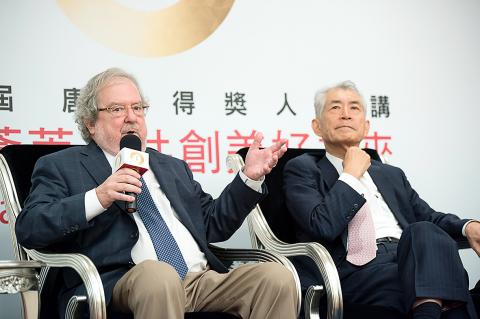
Photo courtesy of The Tang Prize Foundation
According to the Web site of the Tang Prize Foundation (TPF, www.tang-prize.org), the prize is rooted “in the long-standing cultural traditions of Chinese philosophical thought and in an outlook of convergence and mutual enrichment with other traditions... to provide fresh impetus to first-class research and development in the 21st century, to bring about positive change to the global community and to create a brighter future for all humanity.”
The TPF stresses the humanitarian nature of the prize.
“Dr Yin founded the prizes as a response to the challenges we face in the 21st century, for example climate change and emerging infectious diseases like Zika fever,” says Lin Wei-hsin (林緯欣), a TPF project manager.
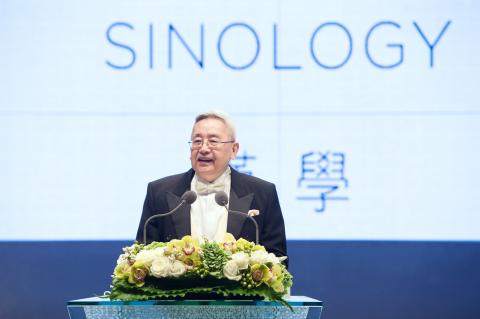
Photo courtesy of The Tang Prize Foundation
“Our position is one of absolute fairness, with no political interference,” says TPF chief executive Chern Jenn-chuan (陳振川), a professor of civil engineering at National Taiwan University. “The most important thing is to let people know about our laureates, and to spread their ideas and their influence. Like the Nobel prizes, it’s all for the betterment of the world.”
Chern, who served as a cabinet minister under president Ma Ying-jeou (馬英九), says that the Tang Prize has received some coverage in major media in China.
Tang Prize laureates are announced every second year, and the selection process for the 2020 prize has just begun. While waiting for the selection committees to make their choices, Chern and his team at the TPF are busy promoting the prize by organizing lectures by laureates at major academic conferences.
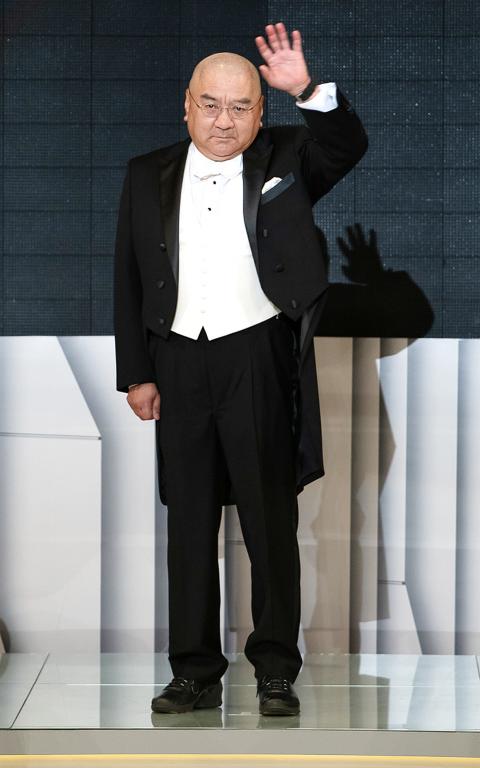
Photo courtesy of The Tang Prize Foundation
Asked if the prize might be awarded annually in the near future, Chern responds: “Our international advisory board, many of whom are Nobel laureates, say that once every two years is the best arrangement, as it provides enough time to review and select, and plan the prize-giving ceremonies.”
Yin has so far endowed TPF with cash and stocks to the value of about NT$4 billion (US$127 million). Neither Yin nor Chern ever offer suggestions or make hints as to who they think might be deserving of a Tang Prize.
“We respect our selection committees completely,” Chern says.
.jpg)
Photo courtesy of The Tang Prize Foundation
The TPF’s charter stipulates that the work of gathering and reviewing nominations and choosing winners should be handled by independent committees. For the 2014 and 2016 prizes, these committees were organized by Academia Sinica. Since 2017, the TPF has been in charge of assembling the selection committees, with Academia Sinica holding an advisory role.
The TPF identifies members of its international advisory board, the general convener of the selection process, and the chairs of the four selection committees. However, to reduce the risk of lobbying or interference, other committee members are asked to keep their role secret until after the announcement.
“Afterward, they can put it on their resume if they wish, but the content of each committee’s discussions must be kept secret,” says Chern, adding that so far there have not been any leaks.
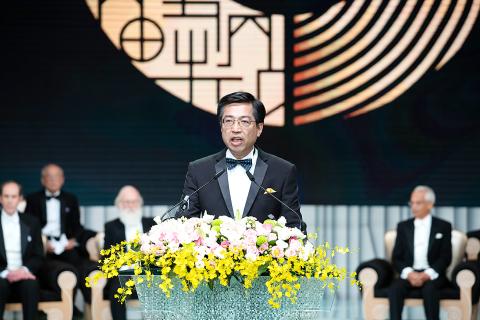
Photo courtesy of The Tang Prize Foundation
Each committee is an international grouping of around 20 members, chosen purely because of their professional achievements and reputation, Chern says.
Some committee members serve for more than one prize cycle.
Every Tang Prize winner is awarded a diploma and a medal weighing 241g and made of 99.9 percent pure gold. They receive — or share, if the prize is awarded to more than one person in their category — NT$40 million. Laureates are also encouraged to apply for a research grant of NT$10 million.
“This helps build an ongoing relationship with our laureates,” Chern says.
GAINING ACCEPTANCE
Given the controversy that has surrounded the Confucius Peace Prize (孔子和平獎) — an honor launched in 2010 by a Chinese organization, and awarded to Lien Chan (連戰), Robert Mugabe, Hun Sen and others — it’s no wonder that some early laureates were hesitant to associate themselves with the Tang Prize.
“Back in 2014 the Tang Prize had no history, so it was a little challenging to get winners to accept the award. Now it’s much easier,” Chern says.
Chern visited several of the 2014 winners prior to the award ceremonies to offer his personal congratulations. Among the laureates he met that year were former Norwegian prime minister Gro Harlem Brundtland, who was director-general of the WHO from 1998 to 2003.
Chern describes Brundtland, recipient of the first Tang Prize for Sustainable Development, as “now a very good friend of the foundation.”
Brundtland used NT$5 million of her Tang Prize award to create the Gro Brundtland Week of Women in Sustainable Development. Since 2016, the event, which is organized by National Cheng Kung University (NCKU), brought female researchers from developing countries to Taiwan to give talks.
A March 29, 2018 Central News Agency report quoted NCKU president Su Huey-jen (蘇慧貞) as expressing hopes that the researchers will gain a better understanding of Taiwan, and help build links between Taiwan and the international scientific community.
Other public figures who have received the prize include anti-apartheid veteran Albie Sachs (2014 Prize for Rule of Law) and climate scientist James Hansen (2018 Prize for Sustainable Development, shared with Veerabhadran Ramanathan of India). The 2014 Prize for Biopharmaceutical Science went to immunologists Tasuku Honjo of Japan and James Allison of the US. The duo’s discoveries, which have led to new cancer treatments, earned them a Nobel Prize in Medicine last year.
In 2014, Brundtland was the only woman among the five laureates. In 2016, three of the six were female. Of eight laureates last year, not one was a woman.
Asked if the selection committees are under pressure to reflect gender or ethnic diversity, Chern replies that no such expectations are imposed. Because each committee works independently and secretly, he adds, they cannot know if women or people of color will be underrepresented in that prize cycle.
In this era of #MeToo, “selection committee members are no doubt aware they have to be cautious,” Chern says. “The board has to take responsibility, as issues like misconduct could harm the reputation of the prize and the foundation.”
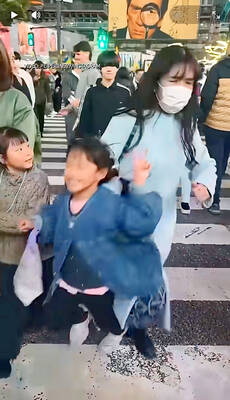
It starts out as a heartwarming clip. A young girl, clearly delighted to be in Tokyo, beams as she makes a peace sign to the camera. Seconds later, she is shoved to the ground from behind by a woman wearing a surgical mask. The assailant doesn’t skip a beat, striding out of shot of the clip filmed by the girl’s mother. This was no accidental clash of shoulders in a crowded place, but one of the most visible examples of a spate of butsukari otoko — “bumping man” — shoving incidents in Japan that experts attribute to a combination of gender

The race for New Taipei City mayor is being keenly watched, and now with the nomination of former deputy mayor of Taipei Hammer Lee (李四川) as the Chinese Nationalist Party’s (KMT) candidate, the battle lines are drawn. All polling data on the tight race mentioned in this column is from the March 12 Formosa poll. On Christmas Day 2010, Taipei County merged into one mega-metropolis of four million people, making it the nation’s largest city. The same day, the winner of the mayoral race, Eric Chu (朱立倫) of the Chinese Nationalist Party (KMT), took office and insisted on the current
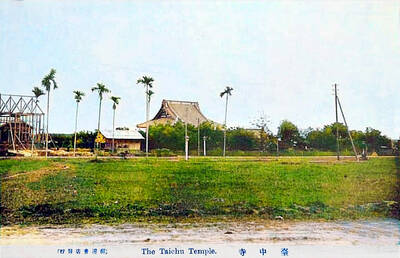
March 16 to March 22 Hidden for decades behind junk-filled metal shacks, trees and overgrowth, a small domed structure bearing a Buddhist swastika resurfaced last June in a Taichung alley. It was soon identified as a remnant of the 122-year-old Gokokuzan Taichuu-ji (Taichung Temple, 護國山台中寺), which was thought to have been demolished in the 1980s. In addition, a stone stele dedicated to monk Hoshu Ono, who served as abbot from 1914 to 1930, was discovered in the detritus. The temple was established in 1903 as the local center for the Soto school

Last week the government announced that by year’s end Taiwan will have the highest density of anti-ship missiles in the world. Its inventory could exceed 1,400, or enough for the opening two hours of an invasion from the People’s Republic of China (PRC). Snark aside, it sounds impressive. But an important piece is missing. Lost in all the “dialogues” and “debates” and “discussions” whose sole purpose is simply to dawdle and delay is what the Chinese Nationalist Party (KMT) alternative special defense budget proposal means for the defense of Taiwan. It is a betrayal of both Taiwan and the US. IT’S


 RSS
RSS